
Indonesia International Financial Centers Bill Passed by Parliament
On July 21, 2026, the Parliament passed the Bill on Indonesia International Financial Centers (the “Passed Bill”). The Passed Bill now awaits enactment by the President. Under the relevant law, the President has 30 days to enact the Passed Bill as law.
Note that for this Newsflash we reviewed the Passed Bill that is dated as of July 21, 2026, that is publicly available. Although unlikely, we note that there may be changes to the Passed Bill when it is enacted as law. We will update this Newsflash if there is indeed any change of the Passed Bill in the enacted law.
We summarize the pertinent provisions of the Passed Bill below.
♦ Basis of Bill and Indonesia International Financial Centers
The Passed Bill is based on Article 248A of Law No. 4 of 2023 on Development and Improvement of Financial Sector as amended by Law No. 4 of 2026 (“Law 4/2023”).
Article 248A of Law 4/2023 provides that the Government may establish one or more Indonesian International Financial Center (each, a “Center”) in Indonesia. A Center is a territory that (i) is financially and administratively independent and (ii) possesses certain legal specialties which may adopt, incorporate, apply, and/or comply with the international principles of standards.
Businesses in a Center includes businesses in the financial sector and the financial sector’s supporting services. Also, businesses in a Center may be granted certain tax and non-tax incentives.
Article 248A of Law 4/2023 contemplates that a law that manages the Centers be enacted not later than 3 months after the date Law No. 4 of 2026 is enacted, i.e., by September 17, 2026.
♦ Establishment of Centers
Consistent with Law 4/2023, under the Passed Bill one or more Center may be established in Indonesia under a Government Regulation based on a proposal from the Minister of Finance (the “Minister”). It is now unclear whether a Government Regulation will be issued for each Center or one Government Regulation will establish multiple Centers.
Each Center is a separate entity. Further provisions on the Centers (including their establishment) would be covered by a Government Regulation.
♦ Center Council
Under the Passed Bill, the Centers will be overseen and governed by a Council for the Indonesia International Financial Center (the “Center Council”). The Center Council will have special authorities (sui generis) within a Center. The special authorities are to, among other things, issue investment licenses, ease of doing business, and special incentives to support the financing for the preparation, construction, and development of a Center.
The Center Council is managed by a Chairperson (who is also designated as the Governor of the Center(s)), and the members. The members of the Center Council consist of (i) the Head of the Center Operating Agency (the “LP Center”), (ii) the Head of the Center Financial Sector Supervisory Agency (the “LPJK Center”), and (iii) up to four other members. The Center Council’s Chairperson and members are appointed by the President.
♦ Businesses Permitted in Centers
The permitted business activities in a Center are as follows:
Financial Services, including:
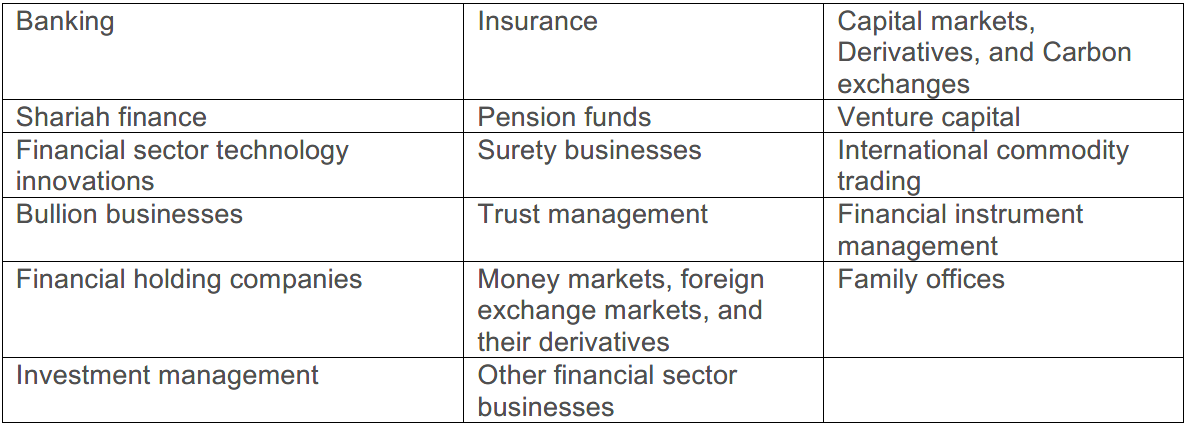
Financial Support Services, including:

Other Businesses, including:

Details of these businesses and the management of such businesses in a Center will be determined in a regulation of the Center Council.
♦ Forms of Businesses
In carrying out the businesses above, an entrepreneur may establish a business entity, a legal entity, a special purpose vehicle, a trust, and/or any other form determined by the Center Council.
♦ Incentives for Businesses in Centers
- Tax Incentives
The Passed bill grants certain tax incentives to businesses and entrepreneurs within a Center. The tax incentives are also given to foreign and Indonesian financial experts which meet certain requirements, ad hoc judges, foreign tax subjects investing in the Center, and the LP Center as well as the LPJK Center.The tax incentives granted under the Passed Bill apply to income taxes, value added taxes, and/or tax on the sale of luxury items, tariffs, and inheritance taxes.
- Income Taxes
Under the Passed Bill, the incentives for income taxes in the Center are applicable to income generated within the Center and the income of businesses operating in the Center, experts in the financial sector which meet certain requirements, and foreign tax subject investing in the Center.The income tax incentives are in the following forms:
- Exemption from income tax on foreign-sourced income;
- Reduction of corporate income taxes;
- Application of a 0% final income tax rate;
- Exemption from domestic tax residency status; and
- Exemption from income tax withholding and/or collection.
The terms of the incentives on Income Taxes vary based on the tax subjects. For main sectors within the Center, which covers the Financial Services and investment activities of foreign tax subjects, the Passed Bill allows income tax incentives for up to 50 years. On the other hand, Financial Support Services and Other Businesses will be granted income tax incentives for a shorter period of time.
- Income Taxes
-
- Value Added Taxes and Taxes on Sale of Luxury Item
Value Added Taxes and Taxes on Sale of Luxury Items are exempted within the Center under certain conditions, including for the development and construction of the infrastructures required by the LP Center and other Governmental agencies. Deliveries of certain services are also covered by incentives, such as services for the rent of buildings for housing, shopping centers, warehouses, and certain governmental agencies and the construction services on public utilities within the Center, and other strategic services deemed necessary for the construction and development of the Center.
- Value Added Taxes and Taxes on Sale of Luxury Item
-
- Tariffs
The incentives on Tariffs under the Passed Bill applies in the form of exemption of import tariffs to goods used for the construction and development of the Center. The details on the goods exempted from import tariffs have yet to be regulated and will be further specified under ministerial regulation.
- Tariffs
-
- Inheritance Taxes
The Passed Bill exempts certain inheritance taxes. This exemption is granted on a condition that, the inherited object is registered within a Family Office in the Center, and that the heir or heiress is a foreign national registered in the Family Office in the Center.
- Inheritance Taxes
- Non-Tax Incentives and Allowances
Aside from tax incentives, the Passed Bill provides other incentives to experts, and related parties within the Center. These incentives are in the form of facilities relating to immigration, employment, permits, residency, golden visas, and stay permits. The details on these incentives will be regulated further in a regulation of the Center Council.
♦ Special Conditions in Centers
- Language Used in Centers
The Passed Bill stipulates that the English would be the official language used within the Center. English shall be used in decrees, policies, contracts, and court judgments within the Center. - Laws Applied in Centers
Within the Center, laws and regulations are applied specifically. Under the Passed Bill, Indonesian law applies to the Center and all activities within the Center, with the exception of the Indonesian Civil Law and the Indonesian Business Law. Indonesia law also does not apply to the regulations, guidelines and certain decrees determined by the Center Council. Instead, the laws that apply within the Center is the Center’s law, which may adopt, incorporate, and apply general principles of law, jurisprudence, international commercial laws and practice. If a certain issue is not regulated by the Center’s Law, the Center’s Court may determine which law or principle of law that applies. - Currency Used in Centers
Business activities within a Center may be conducted in any foreign currency and need not use Indonesian Rupiah. However, certain transactions are exempted from this rule. Transactions to support operational transactions such as payment of salaries and wages, and daily activities transactions which cover transactions for used for daily consumptions, may be conducted using Rupiah. - No Restrictions for Repatriation of Funds
The Passed Bill expressly permits any transfer and repatriation of foreign currencies, capital, funding, profits, dividends, interests, and other forms of payment to outside Indonesia. The Passed Bill also expressly states that control of foreign exchange, control of capital, limitation of fund transfer, approval requirements, conversion requirements, or other limitations imposed based on regulations applicable outside the Center shall be exempted for businesses conducted within, from, or through the Center. Unless a regulation of the Center Council determines otherwise.
♦ Restrictions for Businesses in Centers
The Passed Bill prohibits business operating within the Center to open accounts in Indonesian Rupiah. The Passed Bill also prohibits the business in the Center from selling its products to Indonesian customers within Indonesia without the approval of the relevant government agency. Further, the business in the Center is also prohibited from giving loans outside the Center within Indonesia, except that the loans are given to a business entity using a foreign currency and that the loan meets certain criteria as well as the minimum amount requirement stipulated in a regulation of the Center Council.
Businesses in the Center that violate any of these restrictions may be subject to administrative sanctions. The Passed Bill stipulates that the administrative sanctions in this regard include:
- written warnings;
- restrictions on products, services, and partial or full restriction of a business activity;
- suspension on products, services, and partial or full suspension of a business activity;
- dismissal of management;
- administrative fines;
- revocation of products or services licenses;
- revocation of business licenses; and/or
- other administrative sanctions determined by the Center Council.
♦ LP Center
The Center Operating Agency (in the Indonesian Language Lembaga Pengelola Pusat Finansial Internasional Indonesia or the LP Center) is an independent institution that conduct the Center’s day-to-day operation. The LP Center is led by the Head of LP Center which is appointed by the President. In carrying out its duties, the Head of LP Center is assisted by a Deputy. The Head and the Deputy shall report to the Center Council. The authorities of the Head of LP Center shall be further regulated under the LP Center Regulation and the LP Center internal policy. The Passed Bill prohibits the LP Center Organ from having conflicting interest in conducting its duties.
During its operation, any profits gained or losses suffered by the LP Center shall be for the account of the LP Center. The Passed Bill also stipulates that LP Centers may not be declared bankrupt, unless it is declared insolvent by the Central Council.
♦ LPJK Center
The Center Financial Sector Supervisory Agency (in the Indonesian Language Lembaga Pengawas Jasa Keuangan or the LPJK Center) is an independent agency that regulates and oversees the business activities in the financial sector within a Center. In carrying out its function, the LPJK Center shall:
- conduct the issuance of regulations, oversight, inspection, request of information, consumer protection, and other actions towards businesses or other relevant parties in the financial sector or the sector supporting the financial sector;
- issue and revoke business licenses, individual licenses, business activity permits, or other relevant licenses and permits in the financial sector or the sector supporting the financial sector;
- impose administrative sanctions on businesses in the financial sector or the sector supporting the financial sector which committed violation;
- collect fees and charges of services provided in carrying out its function.
The Passed Bill provides that LPJK Center shall be led by the Head of LPJK Center. The Head of LPJK Center is appointed by the President and shall be assisted by a Deputy. In carrying out its duties, the Head of LPJK Center shall report to the Center Council.
♦ Arbitration Center
The Passed Bill stipulates that the Center’s Arbitration Center (the “Arbitration Center”) shall be established as an alternative dispute resolution agency in the Center. The Arbitration Center shall be established by the Center Council. The Arbitration Center conducts arbitration proceedings, mediation, conciliation, expert determination, and other forms of alternative dispute resolution mechanisms.
The Arbitration Center has jurisdiction over disputes where the parties have agreed to submit such disputes to the Arbitration Center for resolution. Such agreement between the disputing parties revokes the authority of the Center Court over the relevant dispute.
At present, the only method within the Passed Bill in regard to the enforcement of the Arbitration Center awards is through the Center Court. The Passed Bill is also silent regarding the organization structure and management of the Arbitration Center. The Passed Bill stipulates that further provisions on the Arbitration Center shall be set forth in a regulation of the Center Council.
♦ Center Court
The Passed Bill establishes the Center Court as a special court in Indonesia’s judicial system. The Center Court has jurisdiction to examine, hear, and determine disputes that:
- arise in relation to a business activity within the Center;
- arise from a contract in which the entire or partial performance is or will be conducted within the Center;
- arise from the granting of tax incentives in the Center;
- arise from any incident or transaction occurred entirely or partially within the Center;
- concern bankruptcy and restructuring of businesses established or registered in the Center;
- the disputing parties agree to resolve their dispute at the Center Court;
- arise in relation to any decision, action, or omission made by the Center Council, the LP Center, or the LPJK Center; and
- arise within the Center and of a civil nature.
Additionally, the Passed Bill grants the Center Court jurisdiction to adjudicate applications for the recognition and enforcement of awards rendered by the Arbitration Center or any other international arbitral tribunals, provided that such awards relate to disputes arising from the matters referred to in points 1, 2, and 4 above. Further, the Center Court may resolve legal issues in relation to the legal matters concerning the interpretation, implementation, scope, and legal effects of the Center Council Regulations, any LP Center regulations, and any LPJK Center regulations, as well as matters relating to the jurisdiction, competence, and authority of the Center Court.
The Passed Bill states that any criminal case that arise within the Center, remains to be within the jurisdiction of the relevant district court.
- Organization Structure of Center Court
The Center Court shall consist of a Chief Judge, a Vice Chief Judge, Judges, Secretary, Registrar, and the Bailiffs. The Judges of the Center Court shall comprise Supreme Court Judges and ad hoc Judges. Ad hoc Judges of the Center Court may be either Indonesian nationals or foreign nationals. Ad hoc Judges may be appointed either for a fixed term of office or for the purpose of adjudicating a specific dispute. Foreign nationals serving as ad hoc Judges shall be registered with the Center Council.
The Passed Bill requires that supreme court judges serving in the Center Court shall be experts in international commercial law, financial law, banking law, capital markets law, insolvency law, tax law, technology law, private international law, arbitration, and/or other fields relevant to the objectives of the Center. - Judicial Stages in Center Court
The Center Court shall comprise of two stages, a first-instance court and an appellate court. In the first-instance court, the examination of the dispute shall be conducted by 3 judges. The examination in the appellate court shall be conducted by three to five judges. At any stage within the Center Court, at least one supreme court judge shall preside in the proceedings. The Passed Bill adds a special provision which stipulates that the decision of the appellate court may not be subject to further appeal, cassation, judicial review, or any other form of legal remedy by any other judicial authority. - Rules of Proceedings in Center Court
The Center Court may establish its own procedural rules, including expedited and summary proceedings, interim relief measures, electronic filing and case management systems, evidentiary rules, mandatory procedural timelines, remote hearings, electronic evidence, and other procedures necessary for the efficient and fair resolution of disputes. - Enforcement of Center Court Judgments
Judgments and orders of the Center Court, as well as arbitral awards recognized by the Center Court, are enforceable throughout Indonesia in accordance with applicable laws and regulations. The Center Court may issue enforcement orders, seizure orders, asset-freezing orders, conservatory attachment orders, and other interim protective measures. The Center Court may also cooperate with domestic and foreign courts in relation to judicial assistance, recovery of evidence, insolvency proceedings, and the resolution of inter-state disputes.
Certainly, more details and provisions are anticipated and expected in the implementation of the Passed Bill and the establishment and operation of a Center in the future. We continue to monitor the developments in this regard and attempt to provide updates accordingly.
AKSET
Please contact Johannes C. Sahetapy-Engel (jsahetapyengel@aksetlaw.com), or Muhammad Dzaki Ramadhan Al Rizal (mrizal@aksetlaw.com) for further information.
Disclaimer:
The foregoing material is the property of AKSET and may not be used by any other party without our prior written consent. The information herein is of general nature and should not be treated as legal advice, nor shall it be relied upon by any party for any circumstance. Specific legal advice should be sought by interested parties to address their particular circumstances.
Any links contained in this document are for informational purposes and are available and relevant at time this publication is made. We provide no liability whatsoever in respect of any information or content in such links.
