
Constitutional Court Decision on Articles Relating to Defamation and False News
On March 21, 2024, the Constitutional Court (in Indonesian, Mahkamah Konstitusi or “MK”) rendered its Decision No. 78/PUU-XXI/2023 (the “Decision”) in relation to the judicial review on Articles 14 and 15 of Law No. 1 of 1946 dated February 26, 1946, on Criminal Law Code (“Law 1/1946”), Article 310(1) of the Indonesian Criminal Code (the “ICC”), and Articles 27(3) and 45(3) of Law No. 11 of 2008 dated April 21, 2008 on Electronic Information and Transactions as amended by Law No. 19 of 2016 dated November 25, 2016 (the “EIT Law”) (collectively, the “Reviewed Articles”).
The judicial review was petitioned by Haris Azhar, Fatiah Maulidiyanty, Yayasan Lembaga Bantuan Hukum Indonesia, and Aliansi Jurnalis Independen (collectively, the “Petitioners”). The Petitioners argued that the Reviewed Articles, which mainly deal with defamation and false news towards an individual, are contrary to the principles of a democratic state. The Petitioners argued that the Reviewed Articles had been utilized to silence, restrict, and criminalize an individual’s criticism, opinion, and beliefs in relation to government policies, the advancement of human rights, as well as the eradication of corruption, collusion, and nepotism. Also, the Reviewed Articles had been commonly categorized as catchall articles (in Indonesian, pasal karet) that did not have any clear measurement in its interpretation and may lead to legal uncertainty.
Further, the Petitioners argued that the Reviewed Articles were contrary to Articles 1(2), 27(3), 28, 28C(2), 28D(1), 28E(2), 28E(3), 28F, 28G(1), 28I(1), 28I(2), 28I(4), 28I(5), 28J(1), 28J(2), and Article I of the Transitional Provisions of the 1945 Constitution of the Republic of Indonesia (collectively, the “Constitution”).
The following table highlights the substance of the Reviewed Articles and the contents of the Decision:
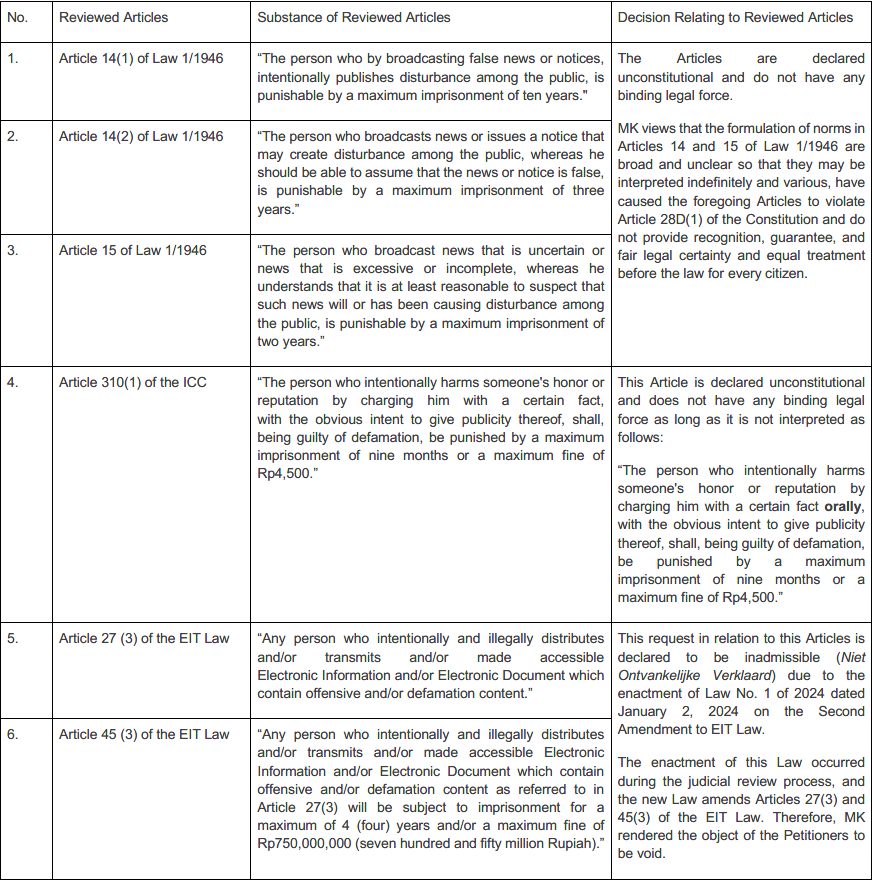
The issuance of the Decision to some extent may be a fresh air or advancement within the Indonesian democracy, where it provides further protection towards an individual’s rights that are ensured in the Constitution. The nullification of Articles 14 and 15 of Law 1/1946 and the interpretation made to Article 310(1) of the ICC may reduce any attempt to silence, restrict, and criminalize an individual’s criticism, opinion, and beliefs.
AKSET
Please contact Johannes C. Sahetapy-Engel (jsahetapyengel@aksetlaw.com), M. Fatih Satria Kasmaliputra (mkasmaliputra@aksetlaw.com), or Justin Amadeus (jamadeus@aksetlaw.com) for further information.
Disclaimer:
The foregoing material is the property of AKSET and may not be used by any other party without prior written consent. The information herein is of general nature and should not be treated as legal advice, nor shall it be relied upon by any party for any circumstance. Specific legal advice should be sought by interested parties to address their particular circumstances.
Any links contained in this document are for informational purposes and are available and relevant at time this publication is made. We provide no liability whatsoever in respect of any information or content in such links.

New Importing Provisions for Entry of Hand-Carry Goods
To strengthen the effectiveness of import controls, the Ministry of Trade saw the need to readjust the policies and procedures on import activities. As such, on December 11, 2023, the Minister of Trade (the “MOT”) issued Regulation No. 36 of 2023 on Import Policies and Regulations (“Regulation 36/2023”). However, to further optimize the implementation of imports of certain goods, the MOT issued Regulation No. 3 of 2024 on the Amendment to Regulation 36/2023 (the “Amendment”). Regulation 36/2023 (as amended by the Amendment) became effective since March 10, 2024.
The Amendment replaces the lists of goods that are subject to certain import requirements previously set out in the Attachments of Regulation 36/2023.
In this Newsflash, we will specifically discuss the import limitations for hand-carry goods of passengers returning to Indonesia.
♦ Limitations on Imports via Hand-Carry Goods
According to Regulation 36/2023, returning passengers entering Indonesia (the “Passengers”) may bring certain goods without any import license subject to certain limitations.
As of March 10, 2024, the limitation on imports of non-commercial goods that comprise hand-carry goods belonging to Passengers is regulated under Attachment IV to the Amendment. The following table highlights several of the hand-carry goods imported to Indonesia by the Passengers that are subject to limitations:

AKSET
Please contact Johannes C. Sahetapy-Engel (jsahetapyengel@aksetlaw.com), Adhitya Ramadhan (aramadhan@aksetlaw.com) or Ayu Nandini Prameswari (aprameswari@aksetlaw.com) for further information.
Disclaimer:
The foregoing material is the property of AKSET and may not be used by any other party without prior written consent. The information herein is of general nature and should not be treated as legal advice, nor shall it be relied upon by any party for any circumstance. Specific legal advice should be sought by interested parties to address their particular circumstances.
Any links contained in this document are for informational purposes and are available and relevant at time this publication is made. We provide no liability whatsoever in respect of any information or content in such links.

New Importing Provisions for Entry of Hand-Carry Goods
OJK Issues New Guidelines for Peer-to-Peer Lending Business
On November 8, 2023, the Financial Services Authority (Otoritas Jasa Keuangan or “OJK”) issued OJK Circular Letter No. 19/SEOJK.06/2023 on the Implementation of Information Technology Based Collective Financing Services (“Letter 19/2023”). Letter 19/2023 sets out a detailed guideline for the implementation of OJK Regulation No. 10/POJK.05/2022, dated June 29, 2022 on Information Technology Based Collective Financing Services (“OJK Reg. 10/2022”).
In Letter 19/2023, OJK lays out a more comprehensive list of requirements in performing the Peer-to-Peer Lending (the “P2P Lending”) business process to fill in the gaps where OJK Reg. 10/2022 is silent. The topics covered under this Newsflash relate to the operations of business activities, fund distribution, repayment mechanism, outsourced work, interest rates, and payment success rates. We set out the salient provisions of Letter 19/2023 below.
♦ Business Activities of P2P Lending Provider
OJK Reg. 10/2022 states the business activities of a P2P Lending Provider (a “Provider”) consist of (i) provision (penyediaan), (ii) management (pengelolaan), and (iii) operation (pengoperasian) of the P2P Lending. Further definitions of such elements of business activities that shall be performed by a P2P Lending Provider are not set out under OJK Reg. 10/2022.
Now, Letter 19/2023 specifically clarifies the details of each type of business activity, as follows:
- Provision Business Activity: providing an electronic system that brings together a borrower and a lender in a funding or lending transaction and providing other facilities such as customer services, virtual accounts, and escrow accounts;
- Management Business Activity: conducting activities including user identity verification, users’ private data processing, funding or lending disbursement from lender to borrower, fund repayment from borrower to lender, and debt collection; and
- Operation Business Activity: performing operational activities of the Electronic System it owns in full.
♦ Fund Disbursement and Repayment Mechanism
Letter 19/2023 provides a comprehensive procedure for a lender and a borrower in receiving and disbursing funds within a Provider’s platform. Prior to approving certain funds to be provided by a lender, a Provider shall conduct an analysis by way of (i) verification of a document’s authenticity submitted by a lender, (ii) confirmation and clarification to the lender on matters regarding anti-money laundering and counter-terrorist financing, and (iii) an analysis of the prospective lender.
From the borrower’s side, a Provider shall conduct a credit scoring on a prospective borrower before a borrower may borrow through the platform. Following a borrower’s request to borrow funds, a borrower’s credit scoring shall be conducted by way of (i) verification of the document’s authenticity submitted by the borrower, (ii) confirmation and clarification to the borrower on matters regarding anti-money laundering and counter-terrorist financing, (iii) process of data from other relevant third parties for the purpose of scoring (if necessary), and (iv) an analysis of the prospective lender. Based on such analysis, the Provider shall determine whether or not a borrower is eligible for the disbursement of funds in the Provider’s electronic system.
Letter 19/2023 explicitly states that the scoring conducted by a Provider shall take into account the character and repayment capacity of the prospective borrower. It is stipulated under Section IV.3.i of Letter 19/2023 that scoring on the repayment capacity for consumptive funding or lending shall be conducted by way of comparing the total amount of the principal payment amount and economic benefits that are paid by the borrower with the income of the borrower. The repayment capacity of the borrower is set to be at a maximum of:
- 50% (fifty percent) on the first year since the issuance of Letter 19/2023;
- 40% (forty percent) on the second year since the issuance of Letter 19/2023; and
- 30% (thirty percent) on the third year since the issuance of Letter 19/2023.
Once the analysis for both the prospective lender and the borrower is complete, the prospective lender may choose the prospective borrower on a Provider’s electronic system and proceed with the execution of the P2P Lending agreement using an electronic signature. Thereafter, the payment mechanism of the funding or lending shall be disbursed by the lender through a payment gateway or a virtual account to be placed in the Provider’s escrow account which will be further transferred to the borrower.
♦ Prohibition on the Utilization of an Outsourced Worker
OJK Reg. 10/2022 stipulates that a Provider is permitted to have an outsourcing agreement through (i) a job-chartering agreement; and/or (ii) an outsourcing agreement. However, Article 19(2) of OJK Reg. 10/2022 limits that the work function of assessment of funding or lending feasibility and/or information technology may not be outsourced to another third party.
Under Section V.5 of Letter 19/2023, such function is elaborated to cover that the prohibition on the outsourced work on the works that perform the function of assessment of funding or lending feasibility is only regarding the scoring of the funding or lending feasibility. In line with the foregoing, a Provider may still cooperate with a credit information processing agency to increase the data reference in conducting the funding or lending feasibility scoring.
Letter 19/2023 further stipulates that the prohibition of outsourcing in the information technology works which essentially relates to the development and operation of the information technology, which comprise of (i) user access management activities, (ii) database management activities, (iii) backup and restore activities, (iv) troubleshooting, and (v) disaster recovery.
♦ Interest Rates for P2P Lending
Previously, the interest rate for P2P Lending Activities was only regulated under the Indonesia Fintech Lending Association (Asosiasi Fintech Pendanaan Indonesia or “AFPI”) Code of Conduct which was amended periodically since its first issuance in 2018 and its latest amendment in 2021. Under such AFPI Code of Conduct, the applicable rate is a maximum of flat interest rate of 0.4% per day, calculated based on the principal lending amount.
While OJK Reg. 10/2022 does not stipulate any maximum interest rate, Articles 29(1) and (2) of OJK Reg. 10/2022 require Providers to fulfill provisions on the maximum limitation of funding or lending economic benefits (batas maksimum manfaat ekonomi), which will be determined by OJK.
OJK through its Letter 19/2023 now stipulates the maximum limit of funding or lending economic benefits. To clarify, economic benefits that are imposed by a Provider are the return rate which includes: (i) interest/margin/profit sharing, (ii) administration fees/commission fees/platform fees/ujrah (compensation fees in syariah) equivalent to the relevant fees, and (iii) other costs, other than late fines, stamp duty, and taxes.
The maximum limits of funding or lending economic benefits under Letter 19/2023 are as follows:
- For productive funding or lending:
- 0.1% (zero point one percent) per calendar day of the value of the funding or lending balance, which is valid for 2 (two) years from January 1, 2024; and
- 0.067% (zero point zero six seven percent) per calendar day of the value of the funding or lending balance, which is valid from January 1, 2026.
- For consumptive funding or lending:
- 0.3% (zero point three percent) per calendar day of the value of the funding or lending balance, which is valid for 1 (one) year from January 1, 2024;
- 0.2% (zero point two percent) per calendar day of the value of the funding or lending balance, which is valid for 1 (one) year from January 1, 2025; and 0.1% (zero point one percent) per calendar day of the value of the funding or lending balance, which is valid from January 1, 2026.
The above rates are also applicable for the maximum limit of late fines according to Sector VI.4 of Letter 19/2023.
Similar to the provision under AFPI Code of Conduct, Letter 19/2023 clarifies that all economic benefits and late fines that may be imposed on the borrowers may not exceed 100% (one hundred percent) of the funding or lending value that is stated in the funding or lending agreement.
♦ Introduction of a New Payment Succes Rate
Before the issuance of Letter 19/2023, there was only one criterion for a Payment Succes Rate (Tingkat Keberhasilan Bayar or “TKB”), as governed under OJK Reg.10/2022, namely TKB90. Letter 19/2023 introduces additional TKBs, which are TKB 0, TKB30, and TKB60. These TKBs are the rate for success payment by the Provider in facilitating the completion of funding or lending obligation within 0 calendar days for TKB0, 30 calendar days for TKB30, 60 calendar days for TKB60, and 90 calendar days for TKB90.
Similar to the previous requirement under OJK Reg.10/2022, the TKB shall be published in the electronic system of the Provider as part of the funding or lending performance of a Provider along with the value of distributed funding or lending, the number of lenders, and the number of borrowers.
AKSET
Please contact Johannes C. Sahetapy-Engel (jsahetaypyengel@aksetlaw.com), Clara Anastasia So (canastasia@aksetlaw.com), and Ammarsyarif G. Goenawan (agoenawan@aksetlaw.com) for further information.
Disclaimer:
The foregoing material is the property of AKSET and may not be used by any other party without prior written consent. The information herein is of general nature and should not be treated as legal advice, nor shall it be relied upon by any party for any circumstance. Specific legal advice should be sought by interested parties to address their particular circumstances.
Any links contained in this document are for informational purposes and are available and relevant at time this publication is made. We provide no liability whatsoever in respect of any information or content in such links.
OJK Issues New Guidelines for Peer-to-Peer Lending Business
Health Omnibus Law Series – Health Information System
This Newsflash is a part of our Health Omnibus Law Newsflash series, i.e., Law No. 17 of 2023 dated August 8, 2023, on Health (the “Health Law”). The Health Law governs a wide range of topics in the health sector, including health information systems (the “System”).
As previously noted, the Health Law was issued using the omnibus method. The Health Law revokes several laws and regulations in the health sector, including Law No. 36 of 2009 dated October 13, 2009 on Health.
♦ Key Definitions
Before we discuss the System, it is important to note the following definitions provided in the Health Law:
- System is defined as systems that integrate various stages of processing, reporting, and use of necessary information to increase the effectiveness and efficiency of health administration and directing actions or decisions that are useful in supporting health development;
- National System is defined as a System that is managed by the ministry which carries out government affairs in the health sector that integrates and standardizes all Systems in supporting health development.
♦ General Information on the System
Pursuant to Article 345(2) of the Health Law, the System shall be carried out by the (i) the Central Government, (ii) Regional Governments, (iii) health services facilities, and (iv) public community, whether an individual or an organization (collectively be referred to as the “Organizer”).
In this regard, Article 345(3) of the Health Law stipulates that the Organizer must integrate the System with the National System.
♦ Health Information Governance
Articles 346(3) and (4) of the Health Law provide that health information governance shall be carried out in accordance with the architecture of the System designed by the Minister of Health.
Based on Article 346(6) of the Health Law, the Organizer must conduct the data processing and health information in Indonesia. Article 347(1) of the Health Law stipulates that the Organizer is required to ensure the reliability of the System, which covers the (i) availability, (ii) security, (iii) maintenance, and (iv) integration.
Furthermore, Article 347(2) of the Health Law provides that the reliability of the System shall be conducted by way of (i) suitability of the system testing, (ii) maintaining the confidentiality of the data, (iii) determining data access rights policies, (iv) owning the system reliability certification, and (v) conducting regular audit.
In addition, Article 348(2) of the Health Law provides that the public shall be able to access public data and/or their own health data via the Organizer of a System that is integrated into the National System in accordance with the provisions of the prevailing laws and regulations.
Further, the Organizer must conduct the data processing and health information, which covers (i) planning, (ii) collection, (iii) storage, (iv) examination, (v) transfer, (vi) utilization, and (vii) demolishment.
According to Article 350(1) of the Health Law, the System shall contain data and information from (i) health services facilities, (ii) the Central Government and Regional Government Agencies, (iii) social security agencies, (iv) other agencies that engage in the health sector, (v) public community activities other than health service facilities, (vi) individual self-reporting, and (vii) other sources.
Article 351(1) of the Health Law provides that the Organizer of the System must ensure the data protection and health information of every individual.
Further, Article 351(2) of the Health Law stipulates that the data processing and health information that uses the health data of an individual must obtain an approval from the data owner and/or fulfill other provisions as the basis of the personal data processing in accordance with the prevailing laws and regulation in the personal data protection sector. This refers to Law No. 27 of 2022 on Personal Data Protection. Please click the following link for our newsflash on the Personal Data Protection Law: The Highly-Awaited Indonesian Personal Data Protection Law Is Passed.
An owner of the data is entitled to (i) obtain information with respect to the purpose of the collection of individual health data, (ii) access and rectify the data and information through the Organizer, (iii) request the Organizer to send his/her data to other Organizer, (iv) obtain the rights of other personal data subjects in accordance with the provisions of laws and regulations invitation in the field of personal data protection.
As mandated by Article 456 of the Health Law, all of the implementing regulations of the Health Law (including the ones relating to Systems) shall be issued at the latest 1 (one) year from the enactment of the Health Law.
September 14, 2023
AKSET
Please contact Johannes C. Sahetapy-Engel (jsahetapyengel@aksetlaw.com), Radiansyah S. Yamin (ryamin@aksetlaw.com), and M. Raehan A. Fadila (mfadila@aksetlaw.com) for further information.
Disclaimer:
The foregoing material is the property of AKSET and may not be used by any other party without prior written consent. The information herein is of general nature and should not be treated as legal advice, nor shall it be relied upon by any party for any circumstance. Specific legal advice should be sought by interested parties to address their particular circumstances.
Any links contained in this document are for informational purposes and are available and relevant at time this publication is made. We provide no liability whatsoever in respect of any information or content in such links.
Health Omnibus Law Series – Health Information System
Health Omnibus Law Series – General Overview
After long discussions within the House of Representatives and objections from the medical society, the Government finally issued Law No. 17 of 2023 dated August 8, 2023 on Health (the “Health Law”). The Health Law is over 200 pages and contains 20 chapters and 458 Articles. The Health Law took effect as of August 8, 2023.
The Health Law is an omnibus law. In other words, the Health Law revokes and combines a significant number of existing laws and regulations in the health sector, among others: (i) Law No. 29 of 2004 dated October 6, 2004, but entered into force on October 6, 2005 on Medical Practice, (ii) Law No. 36 of 2009 dated October 13, 2009 on Health, (iii) Law No. 44 of 2009 dated October 28, 2009 on Hospital, and (iv) Law No. 20 of 2013 dated August 6, 2013 on Medical Education. It is also worth noting that the Health Law expressly stipulates that the implementing regulations of the laws revoked by the Health Law remain valid for so long they do not contradict with the provisions of the Health Law.
We understand that the issuance of the Health Law is related to the Covid-19 pandemic event which brought awareness to the importance of strengthening Indonesia’s national health system and the need to carry out a thorough transformation to Indonesia’s national health system as an effort to improve Indonesia’s public health as well as increasing Indonesia’s competitiveness as a nation.
The Health Law contains provisions that support the implementation of the transformation of Indonesia’s health system, among others, (i) synchronization of health management carried out by the Central Government, Regional Governments, and/or the public, (ii) strengthening the implementation of health efforts in the form of promotive, preventive, curative, rehabilitative, and/or palliative, by prioritizing public rights and government responsibilities, (iii) equal distribution of the Health Service Facilities (in Indonesian, Fasilitas Pelayanan Kesehatan) for easy access for the public through the development of the Health Service Facilities, (iv) availability of Medical Personnel (in Indonesian, Tenaga Medis) and Health Personnel (in Indonesian, Tenaga Kesehatan) through increased implementation of specialist/sub-specialist education, transparency in the registration and licensing process, and improvements in the mechanism of accepting Indonesian overseas graduate Medical Personnel and Health Personnel through transparent competency test, and (v) strengthening of Health Information System (in Indonesian, Sistem Informasi Kesehatan) through the Government’s authority to manage and use health data through integration of multiple Health Information Systems to the National Health Information System.
Provisions on the majority of matters governed under the Health Law are to be further governed under its implementing regulations, i.e., Presidential Regulations, Government Regulations, and Minister of Health Regulations. We also anticipate that, considering the objections from the medical society with respect to certain provisions of the Health Law, it is possible the Health Law to be challenged by the medical society or other parties of interest to the Constitutional Court. We will monitor the development and will issue further updates as relevant.
We will also continue to review the changes and additions regulated under the Health Law and shall circulate follow-up newsflashes in due course.
August 24, 2023
AKSET
Please contact Johannes C. Sahetapy-Engel (jsahetapyengel@aksetlaw.com), Thomas P. Wijaya (twijaya@aksetlaw.com), or M. Fatih Satria Kasmaliputra (mkasmaliputra@aksetlaw.com) for further information.
Disclaimer:
The foregoing material is the property of AKSET and may not be used by any other party without prior written consent. The information herein is of general nature and should not be treated as legal advice, nor shall it be relied upon by any party for any circumstance. Specific legal advice should be sought by interested parties to address their particular circumstances.
Any links contained in this document are for informational purposes and are available and relevant at time this publication is made. We provide no liability whatsoever in respect of any information or content in such links.
Health Omnibus Law Series – General Overview
Update on Obligation to Retain Foreign Exchange Export Proceeds from Natural Resources Within Indonesia
On July 12, 2023, the Government of Indonesia (the “Government”) enacted Government Regulation No. 36 of 2023 on the Foreign Exchange Export Proceeds from the Business, Management, and/or Processing of Natural Resources (“GR 36/2023”). GR 36/2023 sets as an update to, and revokes, Government Regulation No. 1 of 2019 dated June 1, 2019, on the Foreign Exchange Export Proceeds from the Business, Management, and/or Processing of Natural Resources (“GR 1/2019”).
GR 36/2023 will enter into force from August 1, 2023.
Under its consideration, GR 36/2023 states GR 1/2019 must be updated to accommodate the latest developments in the Indonesian financial system. Further, GR 36/2023 states that the foreign exchange export proceeds in relation to natural resources (Devisa Hasil Ekspor Sumber Daya Alam or the “DHE SDA”) must be retained in Indonesia’s financial system to maintain the sustainability of development, improvement, and resilience of the national economy, as well as to increase the optimization of the utilization of natural resources for the maximum prosperity of the people.
While the main provisions of GR 36/2023 are similar to those of GR 1/2019, there are new provisions introduced by GR 36/2023. We set out the salient provisions of GR 36/2023 below.
♦ Retention and Placement of DHE SDA
Same as GR 1/2019, the DHE SDA under GR 36/2023 is derived from the proceeds of exported goods in the following sectors: (i) mining, (ii) plantation, (iii) forestry, and (iv) fishery. Under GR 36/2023 the DHE SDA from the foregoing sectors currently may be placed by the exporter in a Special Account for the DHE SDA (the “Special Account”) with the Indonesian Export Financing Agency (Lembaga Pembiayaan Ekspor Indonesia – “LPEI”) and/or a Foreign Exchange Bank (or Bank Devisa in Bahasa Indonesia, a “Bank”). Previously, GR 1/2019 did not stipulate the placement of the DHE SDA with the LPEI.
GR 36/2023 now regulates that the DHE SDA that is retained and placed by the exporter in the Special Account shall remain in the Indonesian financial system for at least 3 (three) months since the placement for a minimum of 30% (thirty percent). GR 36/2023 also stipulates that the placement of the DHE SDA may be conducted in the following:
- Special Account at the LPEI or the same Bank;
- banking instruments;
- financial instruments issued by the LPEI; and/or
- instruments issued by Bank Indonesia (“BI”).
GR 36/2023 also stipulates that the obligation of to place the DHE SDA above applies to an exporter which has a DHE SDA with an export value in the Export Customs Notification (Pemberitahuan Pabean Ekspor or a “PPE”) of at least USD250,000 or its equivalent. GR 36/2023 allows an exporter with an export value less than US$250,000 to voluntarily place the DHE SDA with the Special Account.
Through the retention and placement of the DHE SDA, the Government incentivizes exporters by way of granting certain tax incentives for any income derived from the placement of the DHE SDA and an exporter who places the DHE SDA with the Special Account may be determined as an exporter with good reputation.
♦ Utilization of DHE SDA
There is no difference between GR 36/2023 and GR 1/2019 regarding what the DHE SDA may be used for (e.g., for the payment of export duty and other levies in the Export sector, loans, and others). If such payment is conducted through an escrow account, the exporter shall open an escrow account with either the LPEI and/or a Bank. If the escrow account is opened prior to GR 36/2023’s entry into force, it shall be transferred to the foregoing two institutions no later than 90 (ninety) days after August 1, 2023.
While GR 36/2023 permits the DHE SDA to be used for payment, it shall be noted that the DHE SDA placed with either the LPEI and/or a Bank shall remain for at least 3 (three) months since the placement for a minimum of 30% (thirty percent).
♦ Supervision of DHE SDA and Sanctions for Violations
The supervision of the DHE SDA will be conducted by the Ministry of Finance (the “MOF”), BI, and the Financial Services Authority (Otoritas Jasa Keuangan – “OJK”) through an integrated information system that is provided and/or used jointly by the foregoing institutions. The supervision by the MOF, BI, and OJK will be the basis for the MOF to either impose an administrative sanction; and revoke an administrative sanction.
An administrative sanction in the form of suspension of export services will be imposed by the MOF on an exporter who:
- does not place the DHE SDA in the Special Account;
- does not conduct the DHE SDA placement amounting to at least 30% (thirty percent) for a period of at least 3 (three) months; and/or
- does not create or transfer an existing escrow account to LPEI or a Bank.
July 28, 2023
AKSET
Please contact Johannes C. Sahetapy-Engel (jsahetapyengel@aksetlaw.com), Radiansyah S. Yamin (ryamin@aksetlaw.com), or Ammarsyarif G. Goenawan (agoenawan@aksetlaw.com) for further information.
Disclaimer:
The foregoing material is the property of AKSET and may not be used by any other party without prior written consent. The information herein is of general nature and should not be treated as legal advice, nor shall it be relied upon by any party for any circumstance. Specific legal advice should be sought by interested parties to address their particular circumstances.
Any links contained in this document are for informational purposes and are available and relevant at time this publication is made. We provide no liability whatsoever in respect of any information or content in such links.
Regulation on National Cyber Security Strategy and Cyber Crisis Management
On July 20, 2023, the President issued a cyber security framework namely President Regulation No. 47 of 2023 on National Cyber Security and Cyber Crisis Management Strategies (“PR 47/2023”). This regulation was issued to safeguard the nation and its interests against the abuse of cyber resources and to address and recover from cyber crises considering the potential of technological advancements in the future.
PR 47/2023 governs the strategy of national cyber security which consists of focus areas and an action plan on cyber security national (the “National Cyber Security Action Plan”) made by the State Cyber and Signal Agency or Badan Siber dan Sandi Negara (“BSSN”). PR 47/2023 is effective as of its issuance.
We set out below the key provisions of PR 47/2023.
♦ National Cyber Security Strategy
The national cyber security strategy is aimed at obtaining cyber security and ensuring a secured national digital economy ecosystem. The focus areas of this strategy consist of:
- governance;
- risk management;
- preparedness and resilience;
- strengthening the protection of vital information infrastructure;
- national cryptography independence;
- capability, capacity, and quality enhancement;
- cyber security policy; and
- international cooperation.
PR 47/2023 stipulates that the National Cyber Security Action Plan shall be made by focusing on the abovementioned areas. The National Cyber Security Action Plan is prepared for 5 (five) years and may be reviewed at any time. The Plan shall cover at least the following elements: (i) activities; (ii) success indicators; (iii) implementation timelines; and (iv) responsible parties.
The National Cyber Security Action Plan must be carried out by a state administration agency or instansi penyelenggara negara.
♦ Cyber Crisis Management
Under Article 17(2) of PR 47/2023, the Cyber Crisis Management is coordinated by BSSN which will involve Electronic Service Providers or Penyelenggara Sistem Elektronik (each, an “ESP”).
In implementing the Cyber Crisis Management, BSSN conducts preparation in the form of preparation of a Cyber Crisis Contingency Plan and Contingency Plan Simulation. The latter is carried out through exercise and role playing.
We set out below the implementation actions to be done for each phase of the cyber crisis management, namely actions before the cyber crisis occurs, when the cyber crisis is occurring, and after the cyber crisis occurred.

Before the Cyber Crisis Occurs
The cyber incident response as a means of cyber crisis management before a cyber crisis occurs shall be carried out gradually by the Cyber Incident Response Team. In relation to the cyber crisis early warning, pursuant to Article 22 of PR 47/2023, not only that it shall be informed to ESPs, such ESPs are required to take action in response to such early warning. Subsequently, a cyber crisis status shall be determined by the President based on a suggestion from the Head of BSSN. Upon such determination, the President shall create a cyber crisis task force.
When the Cyber Crisis is Occurring
Cyber Crisis Countermeasures shall be carried out through several activities as set out under PR 47/2023, among others, the identification and analysis of the scope of electronic systems affected by the cyber crisis. Meanwhile, the Cyber Crisis Recovery shall be carried out through data and system restoration for data and system that has been affected or utilization of backup and/or alternative resources, followed by retesting critical and support functions to ensure that recovery objectives are met.
As for the Cyber Crisis Handling Report, it shall be done by the Cyber Crisis task force to the President, which shall consist of the analysis report and objectives of the cyber crisis handling as well as the recommendation on further cyber crisis handling. The determination of the termination of the cyber crisis status shall be done by the President.
After the Cyber Crisis Occurred
The implementation of the activities done in this stage shall be coordinated by the BSSN with the involvement of ESPs. The calculation of the estimated damages, losses, and recovery costs due to a cyber crisis shall derive from the economic value of the temporarily damaged assets arising out of the cyber crisis and costs borne to restore the electronic system to its state prior to the cyber crisis. An evaluation of cyber crisis handling will be a consideration in taking a cyber security policy.
July 26, 2023
AKSET
Please contact Johannes C. Sahetapy-Engel (jsahetapyengel@aksetlaw.com) or Clara Anastasia So (canastasia@aksetlaw.com) for further information.
The foregoing material is the property of AKSET and may not be used by any other party without prior written consent. The information herein is of general nature and should not be treated as legal advice, nor shall it be relied upon by any party for any circumstance. Specific legal advice should be sought by interested parties to address their particular circumstances.
Any links contained in this document are for informational purposes and are available and relevant at time this publication is made. We provide no liability whatsoever in respect of any information or content in such links.
Perppu Job Creation Series – Amendments to the Multi Storey Housings Law
This Newsflash is a continuation of our previous Perppu Job Creation Newsflashes with respect to the issuance of a Government Regulation in Lieu of Law (Peraturan Pemerintah Pengganti Undang-Undang or Perppu) No. 2 of 2022 dated December 30, 2022, regarding Job Creation (the “Perppu Job Creation”), specifically for Multi Storey Housings Law (as regulated under Law No. 20 of 2011 dated November 9, 2011, regarding Apartments or the “Multi Storey Housings Law”).
As Perppu Job Creation expressly revokes and replaces Law No. 11 of 2020 dated November 2, 2020, regarding Job Creation (the “Job Creation Law”) (and took effect immediately as of December 30, 2022), consequently, the amendments to the Multi Storey Housings Law under the Job Creation Law are no longer in effect.
Please note that the Multi Storey Housings Law was previously amended in the Job Creation Law as can be seen in our Newsflash on New Provisions Relating to the Agrarian Sector Introduced in the Omnibus Law. Similar provisions on the amendment of the Multi Storey Housings Law (as previously regulated in the Job Creation Law) are being reinstated into the the Perppu Job Creation.
The minor amendments to the Multi Storey Housings Law under the Perppu Job Creation are made in 2 (two) articles in the Multi Storey Housings Law, namely under Article 29(2) and Article 54(4). Under the Perppu Job Creation, Article 29(2) of the Multi Storey Housings Law stipulates that the function and utilization plan (required for constructing the Multi Storey Housings) must obtain a business permit from the Regent/Mayor in accordance with the norms, standards, procedures and criteria stipulated by the Central Government. Previously in the Job Creation Law, the reference was made to “Government”.
Meanwhile, Article 54(4) of the Multi Storey Housings Law under the Perppu Job Creation only rephrases the provision which stipulates that the criteria, procedures, and transfer for granting ease of ownership of Public Flats by Low Income Community (Masyarakat Berpenghasilan Rendah or MBR) will be further regulated under a Presidential Regulation. To date, such Presidential Regulation to implement Article 54(4) has yet to be issued by the President. Despite the rewording, the purpose and intention of this article remain the same.
It shall be noted that the Perppu Job Creation must be submitted to the Parliament (Dewan Perwakilan Rakyat or “DPR”) for the DPR’s approval after which the Perppu Job Creation would be enacted as a Law. If the DPR rejects the Perppu Job Creation, the regulation will be canceled and the Job Creation Law will be re-enacted. As of the issuance of this Newsflash, the legislative body of the DPR (Badan Legislasi DPR) has approved the Perppu Job Creation to be brought to the second hearing (plenary meeting/rapat paripurna), but is currently still waiting for the DPR’s approval.
March 1, 2023
AKSET
Please contact Inka Kirana (ikirana@aksetlaw.com), Clara Anastasia So (canastasia@aksetlaw.com), or M. Raehan A. Fadila (mfadila@aksetlaw.com) for further information.
Disclaimer:
The foregoing material is the property of AKSET and may not be used by any other party without prior written consent. The information herein is of general nature and should not be treated as legal advice, nor shall it be relied upon by any party for any circumstance. Specific legal advice should be sought by interested parties to address their particular circumstances.
Any links contained in this document are for informational purposes and are available and relevant at time this publication is made. We provide no liability whatsoever in respect of any information or content in such links.
Perppu Job Creation Series – Amendments to the Multi Storey Housings Law
Perppu Job Creation Series – Amendments to the Housing and Residential Areas Law
This Newsflash is a continuation of our previous Newsflash with respect to the issuance of a Government Regulation in Lieu of Law (Peraturan Pemerintah Pengganti Undang-Undang or Perppu) No. 2 of 2022 dated December 30, 2022, regarding Job Creation (the “Perppu Job Creation”). Perppu Job Creation expressly repeals and replaces Law No. 11 of 2020 dated November 2, 2020, regarding Job Creation (the “Job Creation Law”).
This Newsflash discusses the latest amendments to the Housing and Residential Areas Law (Law No. 1 of 2011 dated January 12, 2011, regarding Housing and Residential Areas) in accordance with the Perppu Job Creation. Accordingly, the amendments to the Housing and Residential Areas Law under the Job Creation Law are no longer in effect.
Please see below the relevant amendments to the Housing and Residential Areas Law under the Perppu Job Creation compared to the previous amendments under the Job Creation Law.
♦ Minor Amendments and Changes
In general, the amendments to the Housing and Residential Areas Law under the Perppu Job Creation are similar with the amendments under the Job Creation Law. The Perppu Job Creation makes minor amendments and changes to the provisions of the Housing and Residential Areas Law previously amended by the Job Creation Law.
Such changes may be seen under Article 36 of the Housing and Residential Areas Law which removes the previous paragraph 4 of Article 36 that explains the possibility of converting a Basic House (Rumah Sederhana) into a general flat if it cannot be built in the form of a single house or townhouse. We note that the removal of such a section is due to a similar provision that has been provided under Article 36(2) of the Housing and Residential Areas Law.
Furthermore, the Perppu Job Creation also amends Article 55(5) of the Housing and Residential Areas Law in which only the appointment and formation of the institution which handles the transfer of ownership of a Basic House with facilities provided by the Government will be regulated under the Presidential Regulations, while the facility and/or assistance in the construction and acquisition of Housing for Low-income Citizens (Masyarakat Berpenghasilan Rendah or MBR) will be regulated under the Government Regulation.
The Perppu Job Creation also amends (i) Article 109(4) of the Housing and Residential Areas Law by not requiring a confirmation and recommendation of the suitability of space utilization activities for Consolidated Land Location that has been determined, (ii) Article 134 of the Housing and Residential Areas Law by removing the conformity to a standard that has been agreed as part of the prohibition of building houses, and (iii) Article 150(1) of the Housing and Residential Areas Law by adding a violation of Article 36(4) as a violation that is subject to an administrative sanction.
Several cosmetic changes can also be seen in the Perppu Job Creation such as the capitalization of the word Houses, Housing, and others.
♦ Restatements of Amendments
Other than the above, the Perppu Job Creation only restates the amendments to the Housing and Residential Areas Law previously made under the Job Creation Law.
Further, it shall be noted that the Perppu Job Creation must be submitted to the Parliament (Dewan Perwakilan Rakyat or “DPR”) for the DPR’s approval after which the Perppu Job Creation would be enacted as a Law. If the DPR rejects the Perppu Job Creation, the regulation will be canceled and the Job Creation Law will be re-enacted. As of the issuance of this Newsflash, the legislative body of the DPR (Badan Legislasi DPR) has approved the Perppu Job Creation to be brought to the second hearing (plenary meeting/rapat paripurna), but still waiting for the DPR’s approval.
March 1, 2023
AKSET
Please contact Inka Kirana (ikirana@aksetlaw.com), Adhitya Ramadhan (aramadhan@aksetlaw.com), or Ammarsyarif Ghazyandra Goenawan (agoenawan@aksetlaw.com) for further information.
Disclaimer:
The foregoing material is the property of AKSET and may not be used by any other party without prior written consent. The information herein is of general nature and should not be treated as legal advice, nor shall it be relied upon by any party for any circumstance. Specific legal advice should be sought by interested parties to address their particular circumstances.
Any links contained in this document are for informational purposes and are available and relevant at time this publication is made. We provide no liability whatsoever in respect of any information or content in such links.
Perppu Job Creation Series – Amendments to Manpower Law
The President issued a Government Regulation in Lieu of Law (Peraturan Pemerintah Pengganti Undang-undang or “Perppu” in short) No. 2 of 2022 dated December 30, 2022 regarding Job Creation (“Perppu Job Creation”). This Newsflash discusses the amendments to the Manpower Law (Law No. 13 of 2003 dated March 25, 2003 regarding Manpower).
Perppu Job Creation is effective as of December 30, 2022. Perppu Job Creation expressly repeals and replaces Law No. 11 of 2020 dated November 2, 2020 regarding Job Creation (the “Job Creation Law”). Like the Job Creation Law, Perppu Job Creation amends certain provisions of the Manpower Law. So, the amendments to the Manpower Law under the Job Creation Law are no longer in effect. But, the implementing regulations issued under the Job Creation Law remain in effect unless they contradict Perppu Job Creation.
The pertinent amendments of the Manpower Law are set out below.
- Outsourcing. Article 64 of the Manpower Law prior to the Job Creation Law allowed outsourcing and subcontracting. The Job Creation Law removed Article 64 entirely. Now Perppu Job Creation amends Article 64 of the Manpower Law to expressly allow outsourcing only. Under Perppu Job Creation, Article 64 of the Manpower Law is silent about subcontracting.
The amended Article 64 of the Manpower Law under Perppu Job Creation is fine because it gives an underlying basis for Government Regulation No. 35 of 2021 dated February 2, 2021 regarding Fixed-Term Employment Agreements, Outsourcing, Working Hours and Rest Time, and Employment Termination (“GR 35/2021”). GR 35/2021 deals with, among others, outsourcing.
- City/Regency Minimum Wages Determined by Governors. Under Perppu Job Creation, Governors now may only determine the minimum wage of a regency/city within the province if the minimum wage of the regency/city is higher than the minimum wage of the province.
- Additional Basis for Wage Increases Calculation. Under Perppu Job Creation, in addition to the economic growth and the inflation rate, ‘a certain index’ is included as the bases for the calculation of wage increases. Perppu Job Creation does not elaborate what ‘a certain index’ means. We will need to wait for the relevant implementing regulation for the clarity of this matter.
- Government Determines Wage Increases. Under Perppu Job Creation, the Government may determine a different method for the calculation of the wage increases in certain circumstances. These circumstances include pandemics and extraordinary global economics conditions.
January 06, 2023
AKSET
Please contact Johannes C. Sahetapy-Engel (jsahetapyengel@aksetlaw.com) or Thomas P. Wijaya (twijaya@aksetlaw.com) for more information.
Disclaimer:
The foregoing material is the property of AKSET and may not be used by any other party without prior written consent. The information herein is of general nature and should not be treated as legal advice, nor shall it beperppuciptakerjaPer relied upon by any party for any circumstance. Specific legal advice should be sought by interested parties to address their particular circumstances.
Any links contained in this document are for informational purposes and are available and relevant at time this publication is made. We provide no liability whatsoever in respect of any information or content in such links.
Copyright © 2023 AKSET. All rights reserved.