
Constitutional Court Mandates Color Labels on Food and Beverages
On September 29, 2026, the Constitutional Court of the Republic of Indonesia (the “Court”) pronounced, in an open plenary session, its decision in Case No. 110/PUU-XXIV/2026 (the “Decision”), which was rendered on September 21, 2026. The case was submitted and examined for the judicial review of Law No. 8 of 1999 dated April 20, 1999 on Consumer Protection as amended by Law No. 1 of 2026 dated January 2, 2026 on Adjustments of Criminal Sanctions (the “Consumer Protection Law”) and Law No. 17 of 2023 dated August 8, 2023 on Health as amended by Law No. 1 of 2026 dated January 2, 2026 on Adjustments of Criminal Sanctions (the “Health Law”).
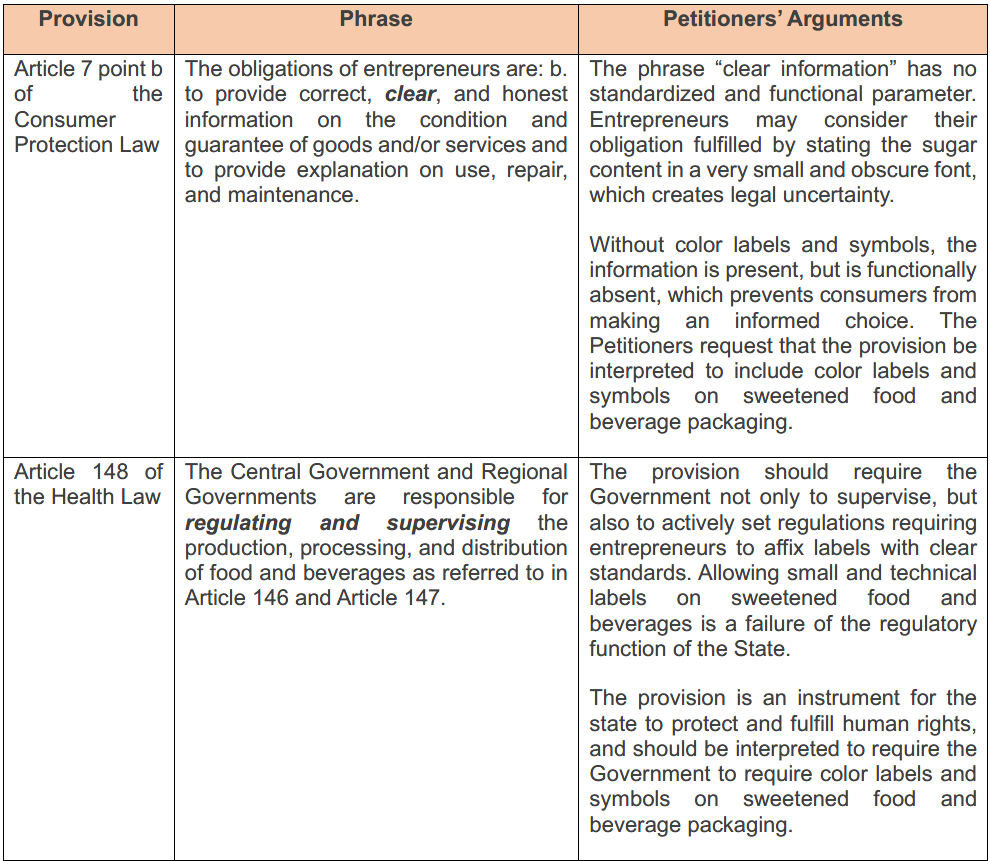
The petitioners Imamudin, S.H. and Andru Steven, S.Sn. (the “Petitioners”) sought judicial review of Article 7 point b of the Consumer Protection Law and Article 148 of the Health Law. The Petitioners contend that these provisions do not provide a clear standard for the “clear information” that entrepreneurs must provide on food and beverage packaging, nor oblige the Government to require color and symbol labels on sweetened food and beverages. As such, the Petitioners deem those Articles to be in conflict with Article 28D(1), Article 28H(1), and Article 28I(4) of the 1945 Constitution of the Republic of Indonesia.
We set out below the key arguments of the Petitioners and the Decision.
♦ Petitioners’ Arguments
The Petitioners submit the following provisions to the Court for judicial review, which contain phrases and obligations that the Petitioners deem unconstitutional as currently formulated.
♦ Decision
Referring to the findings of the National Consumer Protection Agency and the Indonesian Consumers Foundation that small-print labels are ineffective, and to the health risks of excessive sugar, salt, and fat consumption, the Court considers that an express affirmation in the Consumer Protection Law necessary, even though labeling is already addressed in other regulations, including under Minister of Health Decree No. HK.01.07/MENKES/301/2026 dated April 14, 2026 on Inclusion of Nutrition Labels and Health Messages on Ready-to-Serve Processed Food.
The Court then partially grants the petition by ruling that Article 7 point b of the Consumer Protection Law is conditionally unconstitutional and has no binding legal force unless interpreted as follows:
“to provide correct, clear, honest, and adequate information on the condition and guarantee of goods and/or services, including the inclusion of color labels and symbols on food and beverage packaging that contain sugar, salt, and fat, and to provide explanation on use, repair, and maintenance.”
Article 148 of the Health Law is also deemed to be conditionally unconstitutional unless interpreted as follows:
“The Central Government and Regional Governments are responsible for regulating and supervising the production, processing, and distribution of food and beverages as referred to in Article 146 and Article 147, including requiring entrepreneurs to include color labels and symbols on food and beverage packaging that contain sugar, salt, and fat.”
The petition is granted only in part, as the interpretation of the Court covers sugar, salt, and fat, and differs from that requested by the Petitioners, which is limited to sweetened food and beverages. Two Constitutional Justices, Enny Nurbaningsih and Arsul Sani, have dissenting views, considering that the issue concerns the implementation of existing regulations rather than the constitutionality of the norms, and that the Petitioners should pursue legislative review instead.
♦ Impact of Decision
The Decision clarifies that the obligation of entrepreneurs to provide “clear” information under Article 7 point b of the Consumer Protection Law expressly includes adding color labels and symbols on the packaging of food and beverages that contain sugar, salt, and fat, and that the Central Government and Regional Governments must regulate and supervise this under Article 148 of the Health Law by mandating the inclusion of such labels.
That said, the Decision does not prescribe the technical format of the labels or any transitional period. This should nevertheless give entrepreneurs in the food and beverage sector clear guidance to review their packaging and labeling practices.
AKSET
Please contact Johannes C. Sahetapy-Engel (jsahetapyengel@aksetlaw.com) or Giorgio Alexander William Robot (grobot@aksetlaw.com) for further information.
Disclaimer:
The foregoing material is the property of AKSET and may not be used by any other party without our prior written consent. The information herein is of general nature and should not be treated as legal advice, nor shall it be relied upon by any party for any circumstance. Specific legal advice should be sought by interested parties to address their particular circumstances.
Any links contained in this document are for informational purposes and are available and relevant at time this publication is made. We provide no liability whatsoever in respect of any information or content in such links.
