
Constitutional Court Decision on the Judicial Review of the Consumer Protection Law: Consumer Protection in Digital and Cross-Border Transactions
On September 29, 2026, the Constitutional Court of the Republic of Indonesia (the “Court”) pronounced, in an open plenary session, its decision on Case No. 86/PUU-XXIV/2026 (the “Decision”), concerning the judicial review of Law No. 8 of 1999 dated April 20, 1999 on Consumer Protection (the “Consumer Protection Law”).
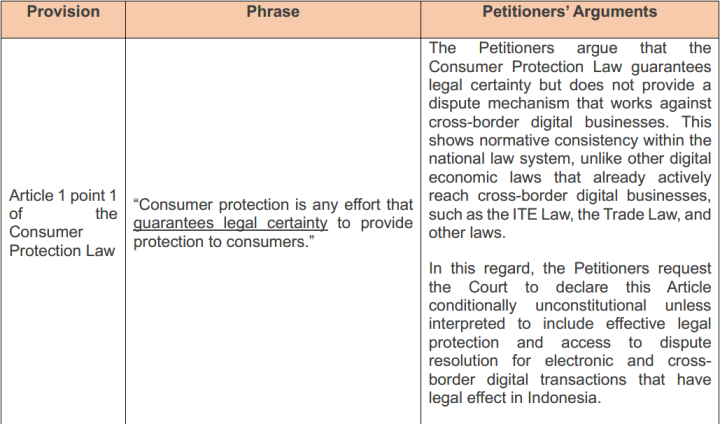
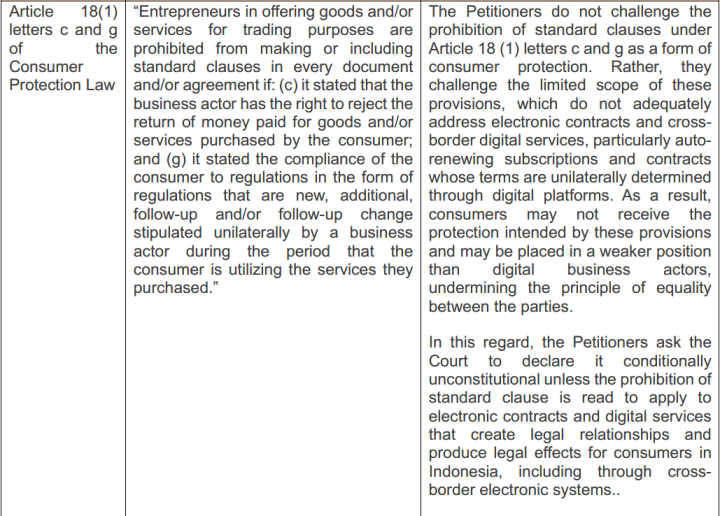
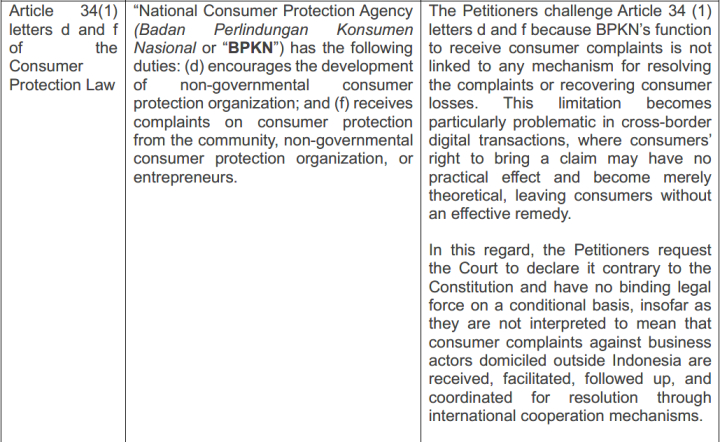
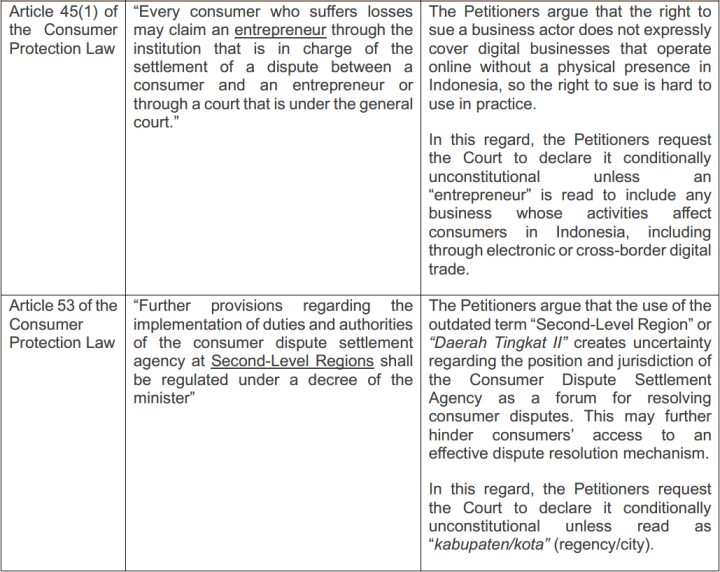
The case was submitted by Ms. Bernita Matondang, Ms. Gabby Mayang Sari, and Ms. Evelyn Amanda (the “Petitioners”), who sought judicial review of Article 1(1), Article 18(1) letters (c) and (g), Article 34(1) letters (d) and (f), Article 45(1), and Article 53 of the Consumer Protection Law.
The Petitioners contend these provisions to be in conflict with Article 28D(1) and Article 28H(4) of the 1945 Constitution of the Republic of Indonesia (the “Constitution”). Generally, the Petitioners argue that the existing provisions do not adequately address consumer protection in electronic and cross-border digital transactions.
We set out below the key arguments of the Petitioners and the Decision.
♦ Petitioners’ Arguments
The Petitioners submit the following provisions to the Court for judicial review:
♦ Decision
In relation to the Petitioners’ petition in relation to Article 1(1) and Article 45(1) of the Consumer Law, the Court partially granted the petition. the Court rejected the Petitioners’ argument that the phrase “guarantees legal decision” fails to provide effective protection for consumers in electronic and cross-border transaction because the existing consumer protection framework already provides adequate legal protection and dispute resolution mechanisms, including for electronic and cross-border transactions.
Further, the Court declares that the petition in relation to Article 18(1) letters (c) and (g) of the Consumer Protection Law is inadmissible. The Court views the challenges obscure, as the Petitioners improperly combine provisions that regulate different matters and made unclear the specific issues being challenged. The Court likewise declares the challenge to Article 34(1) letters (d) and (f) of the Consumer Protection Law obscure, as the provisions regulate different BPKN functions, while the Petitioners request interpretation concerning international cooperation is actually addressed under Article 34(2) of the Consumer Protection Law.
As for the petition in relation to Article 53 of the Consumer Protection Law, the Court grants the petition by declaring that the phrase “Second-Level Region” or “Daerah Tingkat II” is contrary to the 1945 Constitution and has no binding legal force to the extent that it is not interpreted as “regency/city” or “kabupaten/kota.” The Court considers that the term “Second-Level Region” or “Daerah Tingkat II” is outdated and no longer consistent with the current constitutional terminology of “regency/city” or “kabupaten/kota.”
♦ Impact of Decision
The Decision does not introduce a new substantive compliance obligation under the Consumer Protection Law. Instead, the Constitutional Court confirms that consumer protection in the digital and cross-border context should be read together with the broader regulatory framework governing electronic transactions, including the rules on jurisdiction, applicable laws, electronic contracts and dispute resolutions.
The Decision does, however, provide a clarification to Article 53 of the Consumer Protection Law by replacing the outdated reference to “Second-Level Region” or “Daerah Tingkat II” with “regency/city” or “kabupaten/kota.” This clarification is intended to provide greater certainty regarding the territorial context a consumer dispute resolution forum.
AKSET
Please contact Johannes C. Sahetapy-Engel (jsahetapyengel@aksetlaw.com) or Shafa Femalea S. Nuswantari (snuswantari@aksetlaw.com) for further information.
Disclaimer:
The foregoing material is the property of AKSET and may not be used by any other party without our prior written consent. The information herein is of general nature and should not be treated as legal advice, nor shall it be relied upon by any party for any circumstance. Specific legal advice should be sought by interested parties to address their particular circumstances.
Any links contained in this document are for informational purposes and are available and relevant at time this publication is made. We provide no liability whatsoever in respect of any information or content in such links.
