
Key Changes under Indonesia’s Labor Protection Bill
Indonesia’s House of Representatives (“DPR”) issued a draft bill on Employment Protection (Rancangan Undang-Undang tentang Pelindungan Ketenagakerjaan, the “Labor Protection Bill”) in August 2026. The Bill seeks to consolidate Indonesia’s employment framework into a single statute, replacing both Law No. 13 of 2003 dated March 25, 2003 on Manpower (“Law 13/2003”) and the employment-related provisions introduced under the Job Creation Law regime (collectively, the “Manpower Law”).
The Labor Protection Bill traces its origin to the Constitutional Court’s Decision No. 168/PUU-XXI/2023, in which the Court raised constitutional concerns over regulating employment matters through an omnibus law and directed the legislature to place manpower regulation in a standalone statute. The bill also seeks to address inconsistencies between Law 13/2003 and the Job Creation Law framework, which currently operate side by side and must be read together with the Constitutional Court’s interpretive rulings.
On October 6, 2026, the DPR and the Government approved the Labor Protection Bill in a plenary session. The law will take effect upon promulgation.
The summary below is based on the version of the Labor Protection Bill circulated in August 2026. As of the date of this Newsflash, the final officially promulgated version of the law has not yet become available to us. Accordingly, the final text may differ from the draft discussed below. We will provide a further update once the final version is available.
♦ New Categories of Workers
The Labor Protection Bill introduces two new categories of workers that have historically fallen outside the scope of the Manpower Law and brings them within a statutory protection framework.
- Informal Sector Workers
For the first time, the Labor Protection Bill expressly regulates Informal Sector Workers (Tenaga Kerja Sektor Informal). This category may include, for example, domestic workers, street vendors, casual workers, independent craftsmen, and other workers engaged outside formal employment arrangements.Employers engaging informal sector workers would be required to provide fair compensation, taking into account working hours, occupational risks, and the operational costs borne by the worker. Disputes involving informal sector workers would be resolved through deliberation and consensus in the first instance. If no resolution can be reached, the dispute may be brought before the District Court rather than the Industrial Relations Court.The bill also grants informal sector workers access to social security and requires the Central and/or Regional Government to subsidize social security contributions, including work accident and death benefits, for workers classified as vulnerable. - Digital Platform Workers
The Labor Protection Bill also introduces a new category of Digital Platform Workers (Tenaga Kerja Platform Digital), recognizing workers who perform services through digital platforms under flexible working arrangements. This category may include, for example, ride-hailing drivers, food-delivery and logistics couriers, and other individuals who obtain and perform assignments through digital platforms. This category is characterized by flexible working time and location, with compensation commonly linked to completed tasks, platform algorithms, and performance-based incentives.In addition to social security coverage, Digital Platform Workers would be entitled to: (i) fair compensation for completed work; (ii) occupational health and safety appropriate to the nature of the work; (iii) transparency regarding platform algorithms and changes affecting task allocation, performance assessment, and compensation; and (iv) protection against unilateral termination of a partnership or account deactivation without clear grounds and an opportunity to object.The Labor Protection Bill also contemplates a dedicated law governing digital platform workers, which must be enacted within two years after the law comes into force.
♦ Employment Agreements: Fixed-Term Contracts and Probation
- Maximum Duration of PKWT
The Labor Protection Bill shortens the maximum duration of a fixed-term employment agreement (Perjanjian Kerja Waktu Tertentu or PKWT). A PKWT may be entered into for a maximum initial term of 2 years and extended twice, with each extension limited to 1 year. This reduces the maximum aggregate duration of a PKWT from 5 years under the current Manpower Law to 4 years. - Mandatory PKWT Recordation
The Labor Protection Bill requires every PKWT to be recorded through the relevant online labor system within 3 working days of its execution. The recorded agreement must be accessible to both the employee and labor inspectors. While this requirement is not new and is currently regulated under Government Regulation No. 35 of 2021, the Labor Protection Bill incorporates it directly into the statute.Similar under the current regime, a PKWT that does not satisfy the statutory requirements, including those relating to the type of work or permitted duration, will be deemed by operation of law to be an indefinite-term employment agreement (Perjanjian Kerja Waktu Tidak Tertentu or PKWTT). - Probationary Period
The Labor Protection Bill introduces additional protections for employees during probation. Employers must pay probationary employees at least 75% of the wage applicable to the relevant position, subject in all cases to the minimum wage requirement. Employers must also enroll probationary employees in the applicable social security programs.This represents a departure from the current Manpower Law, which only requires wages during probation not to fall below the minimum wage. The Labor Protection Bill also introduces criminal sanctions for underpayment of probationary wages or failure to provide social security during the probationary period, with penalties of up to 4 years’ imprisonment and/or a Category V criminal fine.
♦ Outsourcing
The Labor Protection Bill significantly narrows the scope of permissible outsourcing arrangements, effectively restoring an approach closer to the outsourcing regime that existed prior to the Job Creation Law.
- Closed List of Permitted Activities
Under the Labor Protection Bill, outsourcing would be limited to five supporting activities that are not directly related to the principal’s production process: (i) cleaning services; (ii) catering services for workers; (iii) security services; (iv) supporting services in the mining and oil and gas sectors; and (v) worker transportation services. This represents a significant departure from the current framework, under which the scope of permissible outsourced activities is determined by the Minister and is not limited to a closed statutory list.The Labor Protection Bill also introduces a reclassification risk for principals. Where an outsourced worker is in fact engaged in activities directly related to the principal’s production process, the employment relationship would automatically transfer by operation of law from the outsourcing company to the principal.
♦ Termination of Employment and Severance Pay
- Termination-Reason Multipliers
The Labor Protection Bill revises the severance pay and long-service pay multipliers applicable to various termination scenarios. While the underlying formulas for severance pay (“SP”) and long-service pay (“LSP”) remain unchanged, the multipliers applicable to specific termination grounds would be adjusted from those currently prescribed under Government Regulation No. 35 of 2021.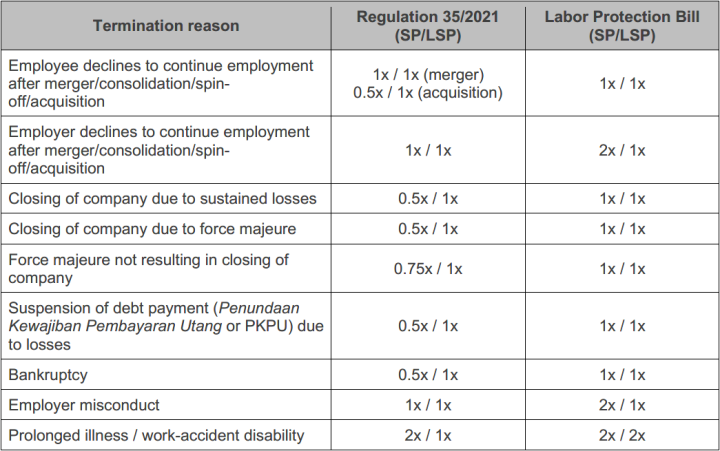
- Restoration of the Housing and Medical-Cost Replacement Component
The Labor Protection Bill reinstates the housing, medical, and care-cost replacement component as part of an employee’s compensation in lieu of rights. The amount is fixed at 15% of the employee’s SP and/or LSP entitlement, where the employee is eligible for such benefits. This component originally existed under Law 13/2003 but was removed following the enactment of the Job Creation Law.As a result, compensation in lieu of rights under the Labor Protection Bill would comprise of: (i) unused annual leave, (ii) repatriation costs, (iii) housing, medical, and care-cost replacement, equal to 15% of the applicable SP and/or LSP, and (iv) other matters stipulated in the employment agreement or company regulation. - Efficiency Measures as Grounds for Termination
The Labor Protection Bill does not retain efficiency as a specific ground for termination. While Article 154A(1)(b) of the Manpower Law permits termination based on company efficiency measures, Article 198 of the Labor Protection Bill contains no equivalent ground. Accordingly, an employer seeking to terminate employees for efficiency reasons would need to rely on another applicable statutory ground or reach an agreement with the affected employees. - Additional Measures to Prevent Employment Termination
Under Article 151(1) of the Manpower Law, employers and employees are required to make efforts to avoid termination. Its elucidation provides non-exhaustive examples of such efforts, including working-time arrangements, cost-saving measures, improvements to work methods, and employee coaching.Article 195(2) of the Labor Protection Bill goes further by expressly requiring the following measures to be taken in stages: (i) reducing overtime on holidays; (ii) reducing daily overtime; (iii) reducing the number of shifts; (iv) reducing working hours or working days; (v) not extending the PKWT of employees whose contracts have expired; (vi) not replacing employees who reach retirement age; (vii) adjusting the wages and/or facilities of managerial-level employees; (viii) temporarily or rotationally sending PKWTT employees home; and (ix) offering voluntary early retirement.
♦ Foreign Manpower
- New Exemptions from the RPTKA
The Labor Protection Bill expands the categories of foreign workers exempt from the requirement to obtain a foreign worker utilization plan (Rencana Penggunaan Tenaga Kerja Asing or RPTKA). In addition to the existing exemptions, the Bill introduces two new categories: (i) foreign workers validly married to Indonesian citizens; and (ii) foreign workers born from a valid marriage between a foreign national and an Indonesian citizen. - Mandatory Bahasa Indonesia Competency Certification
The Labor Protection Bill introduces a new requirement for foreign workers employed for technology or skills transfer purposes to hold a Bahasa Indonesia competency certificate issued by an accredited language education or training institution.In addition, employers would be required to facilitate Bahasa Indonesia language training for such foreign workers. This requirement does not exist under the current Manpower Law and would create an additional compliance obligation for employers engaging foreign workers in technology-transfer or knowledge-transfer roles.
♦ Mandatory City/Regency Level Minimum Wage
- Mandatory City/Regency Minimum Wage
The Labor Protection Bill would require every governor to set a city/regency minimum wage (upah minimum kabupaten/kota or UMK) in addition to the provincial minimum wage (upah minimum provinsi or UMP). The UMK must be set at a level higher than the applicable UMP.This represents a significant change from the current Manpower Law, under which governors are required to set the UMP, while the determination of a UMK is discretionary and subject to the applicable requirements.As a result, employers would need to take into account the applicable UMK, rather than relying solely on the UMP, when determining minimum wages for employees.
♦ Consolidation of Existing Manpower-Related Provisions
The Labor Protection Bill also incorporates several existing employment-related requirements that are currently regulated under other laws and regulations. Some notable examples are summarized below.
-
- Disability Employment Quota
The Labor Protection Bill incorporates the existing employment quotas for persons with disabilities under Law No. 8 of 2016 on Persons with Disabilities. Government agencies, regional governments, and state- and regional-owned enterprises must ensure that persons with disabilities comprise at least 2% of their workforce, while private companies are subject to a minimum 1% requirement. These requirements are not new and essentially restate those already provided under Law No. 8 of 2016. - Maternity and Companion Leave
The Labor Protection Bill retains 3 months of maternity leave, but removes the current fixed allocation of 1.5 months before and 1.5 months after childbirth. Instead, the timing of the leave would be determined based on the assessment of a specialist doctor or midwife. The leave may also be extended by up to an additional 3 months where the mother or child experiences certain health complications following childbirth.The Labor Protection Bill also provides male employees with 2 days of paid companion leave when their wife gives birth, which may be extended by up to an additional 3 days based on agreement with the employer. A male employee would also be entitled to 2 days of paid leave if his wife suffers a miscarriage.These provisions generally reflect the maternity and companion-leave framework already introduced under Law No. 4 of 2024 on Maternal and Child Welfare in the First 1,000 Days of Life, and would now be incorporated into the principal employment legislation.
- Disability Employment Quota
- New Prohibition on Withholding Diplomas and Personal Documents
The Labor Protection Bill prohibits employers from requiring employees to surrender, or from withholding, an employee’s diploma and/or personal documents as security in an employment relationship.While this prohibition is not entirely new, it is currently regulated under the Minister of Manpower Circular Letter No. M/5/HK.04.00/V/2025 on the Prohibition of Withholding Diplomas and/or Personal Documents. The Labor Protection Bill would incorporate the prohibition directly into the statutory employment framework.
AKSET
Please contact Johannes C. Sahetapy-Engel (jsahetapyengel@aksetlaw.com), Thomas Peter Wijaya (twijaya@aksetlaw.com) or Giorgio Alexander William Robot (grobot@aksetlaw.com) for further information.
Disclaimer:
The foregoing material is the property of AKSET and may not be used by any other party without our prior written consent. The information herein is of general nature and should not be treated as legal advice, nor shall it be relied upon by any party for any circumstance. Specific legal advice should be sought by interested parties to address their particular circumstances.
Any links contained in this document are for informational purposes and are available and relevant at time this publication is made. We provide no liability whatsoever in respect of any information or content in such links.

AKSET Newsflash - Key Changes under Indonesia’s Labor Protection Bill