
New Labor Protection Law: Key Changes for Employers
On October 28, 2026, the President signed and promulgated Law No. 27 of 2026 on Labor Protection (the “Labor Protection Law”). The Labor Protection Law took effect on the same date. The Labor Protection Law revokes Law No. 13 of 2003 on Manpower (“Law 13/2003”) and the employment-related provisions of the Job Creation Law (i.e., Law No. 6 of 2023).
Under the Labor Protection Law, existing implementing regulations remain in force to the extent that they do not conflict with the Labor Protection Law. This includes, among others, Government Regulation No. 35 of 2021 on Fixed-Term Employment Agreements, Outsourcing, Working Time and Rest Time, and Termination of Employment (“Regulation 35/2021”). New implementing regulations are required to be issued within one year from October 28, 2026.
This Newsflash follows our October 13, 2026 Newsflash which discusses the draft bill dated August 26, 2026 (the “Draft Bill”). We first highlight the principal differences between the final Labor Protection Law and the Draft Bill, before discussing the key changes in the Labor Protection Law that employers should be aware of.
♦ Summary of Notable Changes from Draft Bill
-
- Digital Platform Workers
The dedicated chapter on digital platform workers in the Draft Bill does not appear in the Labor Protection Law. Instead, Article 102 of the Labor Protection Law treats partnership and digital platform work as a “certain work relationship,” under which workers are entitled to decent income, occupational health and safety protection, social security, and other rights agreed between the parties. Under Article 103 of the Labor Protection Law, partnership arrangements will be governed by a separate law. - Permissible Outsourced Work – Supporting Services
Supporting services in the mining and oil and gas sectors under Article 96 of the Labor Protection Law must be performed through a subsidiary of the engaging company. - Additional Component of Severance Entitlements
The Draft Bill had proposed restoring the additional 15% (fifteen percent) component for housing, medical, and care costs as part of compensation of rights. This component does not appear in the Labor Protection Law. Under Article 232(4) of the Labor Protection Law, compensation of rights continues to consist of unused annual leave, the cost of returning the employee and his or her family to the place of hire, and other matters provided for in the employment agreement, company regulation, or collective labor agreement.
- Digital Platform Workers
♦ Key Changes under Labor Protection Law
-
- Fixed-Term Employment Agreements
The Labor Protection Law maintains the changes to fixed-term employment agreements (Perjanjian Kerja Waktu Tertentu or PKWT) introduced in the Draft Bill. Under Article 82(2), a PKWT may be entered into for an initial term of up to 2 (two) years and may be extended up to two times, for a maximum of 1 (one) year for each extension. Accordingly, the maximum total duration of a PKWT is up to 4 (four) years.Employers should review their existing PKWT arrangements and ensure that any PKWT entered into, extended, or continued following the enactment of the Labor Protection Law complies with the new requirements. There is no transition period for existing PKWT arrangements to comply with the Labor Protection Law. - Outsourcing Matters
Under Article 95, outsourcing is now limited to supporting services that are not directly related to the production process, namely: (i) cleaning services; (ii) catering for workers; (iii) security services; and (iv) worker transportation services. By contrast, under the Job Creation Law framework, the law itself did not limit outsourcing to specified types of work. Under Article 98, if an outsourced employee is in fact performing work directly related to the production process, the employment relationship transfers by operation of law to the company that commissions the work.Under Article 96, supporting services in the mining and oil and gas sectors must be performed through a limited liability company that is a subsidiary of the company using the services. Under Article 97, state-owned enterprises (Badan Usaha Milik Negara or BUMN) must likewise use subsidiaries for work that is not directly related to their main activities.The Labor Protection Law provides a 1 (one) year transition period for these requirements. Under Article 306, companies have 1 (one) year to bring their outsourcing arrangements into compliance, while outsourcing agreements entered into before the Labor Protection Law took effect remain valid until they expire. Under Articles 308 and 309, mining, oil and gas companies and BUMNs that do not yet have a subsidiary may continue using their existing outsourcing company until they establish or acquire a subsidiary, which must be done within the same 1 (one) year period.
- No Statutes of Limitations for Claims by Employees
The Labor Protection Law now expressly provides under Article 152 that there is no statute of limitations for an employee to claim an employer for any unpaid amount (i.e., salary and other payment). This highlights the importance to have a clear and express closure of any termination of employment. - Efficiency/Redundancy Removed as Grounds for Employment Termination
Previously, efficiency could be used as a ground for employment termination. The Labor Protection Law no longer includes efficiency among the permitted grounds for employment termination. So, employers may no longer rely on efficiency as a legal basis for employment termination. The Labor Protection Law is silent about the enforceability existing company regulations or collective labor agreements that allow termination of employment due to efficiency. - Urgent Reasons No Longer a Permissible Ground for Employment Termination
Previously, Law 13/2003 (as amended) permitted additional grounds for employment termination to be set out in employment agreements, company regulations, and collective labor agreements. This included the “urgent reason” mechanism under Regulation 35/2021, which allowed employment termination for specified serious violations without prior warning letters.The Labor Protection Law no longer allows these instruments to establish additional grounds for employment termination. In our view, an urgent reason is no longer a ground for employment termination and the corresponding provisions of Regulation 35/2021 no longer apply.Employers should review their employment agreements, company regulations, and collective labor agreements and revise provisions that allow immediate employment termination due to urgent reasons. Employee misconduct may instead support employment termination through the warning-letter mechanism under Article 231, which requires 3 (three) consecutive warning letters (each for a period of up to 6 (six) months).
- Changes to Employment Termination Entitlements
Under Articles 232(2) and 232(3), the basic calculations for severance pay (uang pesangon or “SP”) and long-service pay (uang penghargaan masa kerja or “LSP”) remain unchanged. However, the applicable multipliers for each ground of employment termination are now set out in the Labor Protection Law. The table below compares the previous and new regimes.
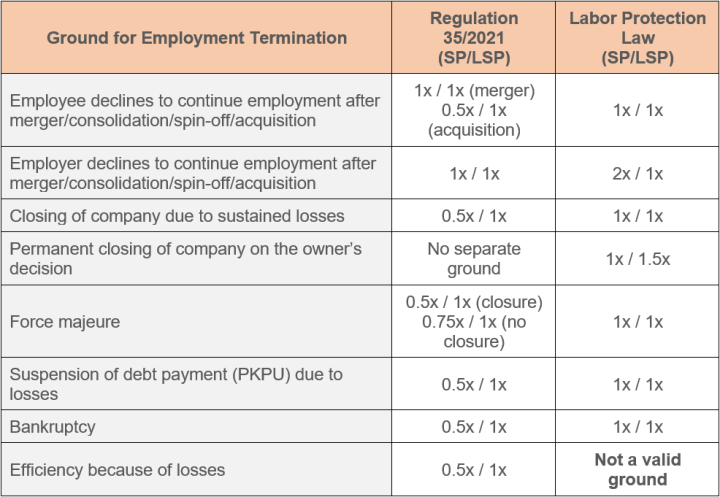
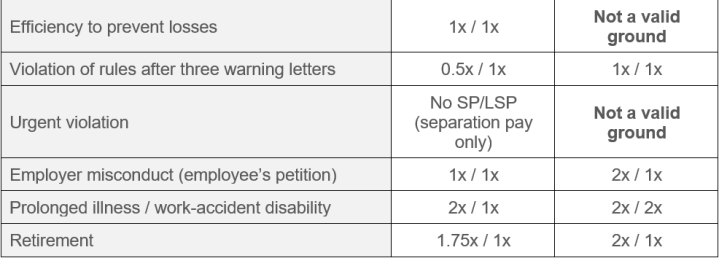
Under Articles 236 to 247, several grounds for employment termination now carry higher severance entitlements. Company closures, insolvency, and force majeure generally carry at least 1x SP, while higher multipliers apply in certain cases involving corporate actions, employer misconduct, and retirement. Together with the removal of efficiency as a ground for employment termination, these changes may significantly increase the cost of workforce reductions.
The Labor Protection Law also introduces criminal penalties for intentional non-payment of employment termination entitlements. Under Article 295, an intentional failure to pay SP, LSP, or compensation of rights may result in imprisonment of up to 4 (four) years and/or a Category IV fine of up to Rp200,000,000 (two hundred million Rupiah).
The Labor Protection Law also introduces a minimum separation pay (uang pisah). Previously, separation pay was payable for certain grounds, including resignation and unexplained absence, but the amount was determined by the employment agreement, company regulation, or collective labor agreement, without a statutory minimum.
Under Article 233, the amount of separation pay continues to be determined in those instruments, subject to a statutory minimum that appears to be 1 (one) month’s wage. Employers should therefore review their employment agreements, company regulations, and collective labor agreements and, where appropriate, expressly provide for the applicable amount of separation pay.
- Employees’ Lien on Assets of Employers
Article 299(1) and (2) gives employees a lien on all the assets of an employer against payment of any amount due to the employees under a mutual agreement or a final and binding court decision. Any person (including the government) that holds assets of such an employer must prioritize the payment to the employees under a mutual agreement or a final and binding court decision. - Termination Prevention Measures and Procedures
Under Article 228(2), before proceeding with employment termination, employers must take the following preventive measures in stages:
- reducing overtime on holidays;
- reducing daily overtime;
- reducing the number of shifts;
- reducing working hours or working days;
- not extending PKWT that have expired;
- not replacing employees who reach retirement age;
- adjusting the wages and/or facilities of managerial-level employees;
- temporarily or rotationally furloughing permanent employees;
- offering a voluntary early retirement program; and
- offering a retirement program to employees who meet the requirements.
- Fixed-Term Employment Agreements
This is a significant change from the previous regime which required employers only to attempt avoiding employment termination. However, the Labor Protection Law does not explain how these measures must be implemented or whether they must be exhausted for every ground of employment termination, including any misconduct following 3 (three) consecutive warning letters.
If employment termination may not be avoided, Article 228 requires bipartite negotiations within 30 working days. If no agreement is reached, employment termination may take place only after a final and binding decision of the industrial relations dispute settlement institution. Otherwise, the employment termination is void by law and the employee must be reinstated. Failure to reinstate the employee is punishable by imprisonment of up to 2 (two) years. Pending the conclusion of a termination dispute, both employers and employees must continue their respective obligations.
- Priorities of Salary and Other Payment In Bankruptcy of Liquidation
If an employer is bankrupt or liquidated, Article 151 prioritizes the payment of salary to employees ahead of all other creditors (secured, preferred, and unsecured). Payment other than salary is prioritized ahead of unsecured and preferred creditors but not secured creditors. - Mandatory Severance Reserve Fund
Under Article 253, employers (other than micro and small businesses) must establish a severance reserve fund managed by a government institution to fund employment termination entitlements for eligible employees who are not enrolled in a pension program. Non-compliance may result in administrative sanctions, including revocation of the business license.Although this requirement is now contained in the Labor Protection Law, employers will need to await the implementing Government Regulation for further details, including the managing institution, contribution amounts, and timing of the payments.
- Joint Leave and Mandatory Long Leave
Under Article 118, employees are entitled to at least 12 (twelve) working days of annual leave after 12 (twelve) consecutive months of service. If an employer observes the joint leave days (cuti bersama) set by the Government, those days may no longer be deducted from the employee’s annual leave entitlement. The Labor Protection Law does not clarify how this provision applies to employers that do not observe the Government-designated joint leave days.The Labor Protection Law also makes long leave (istirahat panjang) mandatory. Under Article 118, employees are now entitled to 30 (thirty) calendar days of long leave for every 5 (five) years of continuous service. An employee who takes long leave is not entitled to annual leave in the same year.
Employers should review their company regulations and leave policies to reflect these changes and account for the additional paid leave entitlement.
♦ Conclusion
The Labor Protection Law marks a significant change to Indonesia’s employment framework. While many elements of the previous regime remain, the new law introduces important changes affecting PKWTs, outsourcing, statutes of limitations, priorities of employees’ right against other creditors of employers, employment termination, severance entitlements, and employee leave. These changes require employers to review their existing employment arrangements and practices, given the sanctions and penalties provided in the Labor Protection Law.
Further implementing regulations are expected to provide additional, and clarifying, details on certain provisions of the Labor Protection Law. These implementing regulations must be issued by October 28, 2027. We will continue to monitor these developments.
AKSET
Please contact Johannes C. Sahetapy-Engel (jsahetapyengel@aksetlaw.com), Thomas Peter Wijaya (twijaya@aksetlaw.com) or Giorgio Alexander William Robot (grobot@aksetlaw.com) for further information.
Disclaimer:
The foregoing material is the property of AKSET and may not be used by any other party without our prior written consent. The information herein is of general nature and should not be treated as legal advice, nor shall it be relied upon by any party for any circumstance. Specific legal advice should be sought by interested parties to address their particular circumstances.
Any links contained in this document are for informational purposes and are available and relevant at time this publication is made. We provide no liability whatsoever in respect of any information or content in such links.

AKSET Newflash - New Labor Protection Law: Key Changes for Employers