
New Regulation Introduces Nutri-Level Labeling for Ready-to-Eat Processed Food
As a follow-up to the enactment of Minister of Health (the “MOH”) Regulation No. 3 of 2026 on Disease Control (the “MOH Regulation”), the MOH has issued Decree No. HK.01.07/MENKES/301/2026 on Inclusion of Nutrition Label and Health Message on Ready-to-Eat Processed Food (the “Decree”), which came into effect on April 14, 2026.
The Decree applies to “ready-to-eat processed food”, which includes food and beverage products that have undergone certain processing methods, with or without additional ingredients, as defined under Law No. 18 of 2012 on Food, as amended by Law No. 6 of 2023. The Decree further implements the obligations under MOH Regulation, particularly in relation to nutrition labeling and health messaging requirements.
We set out below the key provisions of the Decree.
♦ Nutritional Labeling for Ready-to-Drink Products
While the Decree applies broadly to ready-to-eat processed food (including both food and beverages), its current implementation appears to primarily target ready-to-drink products, particularly those produced, imported, and/or distributed by large-scale business actors. In this context, such business actors are expected to commence the inclusion of nutritional labeling and health messages on ready-to-drink products.
This obligation aligns with the MOH Regulation, which requires any person producing, importing, and/or distributing ready-to-eat processed food to (i) comply with maximum limits on sugar, salt, and fat content, and (ii) include nutritional labeling, including information on sugar, salt, and fat content, in their information media (e.g., packaging, menus, promotional materials, and digital platform).
♦ Nutri-Level Classification System
The Decree introduces a Nutri-level classification system, as follows:
-
- Level A, represented by the letter A in dark green;
- Level B, represented by the letter B in light green;
- Level C, represented by the letter C in yellow; and
- Level D, represented by the letter D in red.
The applicable Nutri-Level is determined based on the business actor’s self-declaration of the product’s sugar, salt, and fat content, which must be supported by laboratory testing results issued by government laboratories or other accredited laboratories.
The classification is further detailed in the table below:
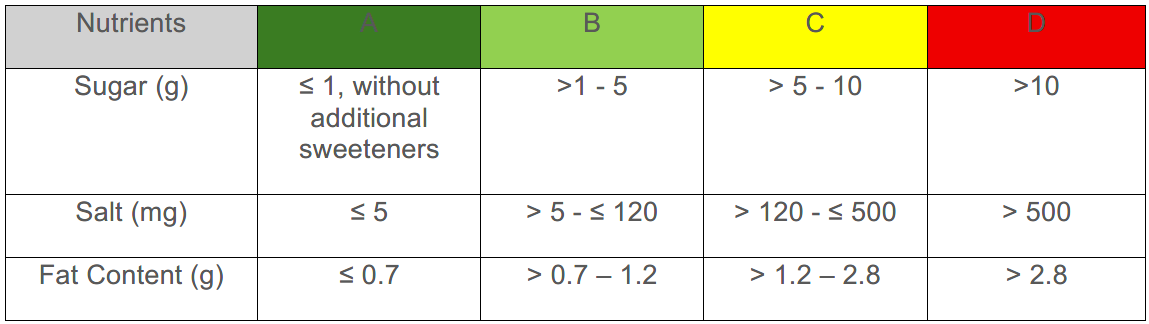
In general, Level A represents the lowest levels of sugar, salt, and fat, while Level D represents the highest, with Levels B and C falling in between. The Decree also regulates the use of sweeteners in each classification:
-
- Level A: not permitted to use any additional sweeteners, whether natural or artificial, including through direct addition or carry-over.
- Level B: permitted to use natural sweetening food additives only.
- Levels C and D: permitted to use both natural and artificial sweetening food additives.
♦ Effective Date of Labeling Requirement
The requirement to include nutritional labeling and health messages will become mandatory two years after the Government establishes the maximum limits for sugar, salt, and fat content under the applicable regulations. As of the date of this Newsflash, these implementing regulations have not yet been issued.
Accordingly, while the Decree is already in effect, the labeling requirement remains subject to a transitional period. This signals a move toward stricter nutrition regulation with compliance potentially extending beyond packaging to menus, promotional materials, and digital platforms. Businesses are encouraged to review their products and labeling practices in preparation for future implementation.
AKSET
Please contact Thomas P. Wijaya (twijaya@aksetlaw.com) or Shafa Femalea S. Nuswantari (snuswantari@aksetlaw.com) for further information.
Disclaimer:
The foregoing material is the property of AKSET and may not be used by any other party without our prior written consent. The information herein is of general nature and should not be treated as legal advice, nor shall it be relied upon by any party for any circumstance. Specific legal advice should be sought by interested parties to address their particular circumstances.
Any links contained in this document are for informational purposes and are available and relevant at time this publication is made. We provide no liability whatsoever in respect of any information or content in such links.
