
Perppu Job Creation Series – Amendments to the Housing and Residential Areas Law
This Newsflash is a continuation of our previous Newsflash with respect to the issuance of a Government Regulation in Lieu of Law (Peraturan Pemerintah Pengganti Undang-Undang or Perppu) No. 2 of 2022 dated December 30, 2022, regarding Job Creation (the “Perppu Job Creation”). Perppu Job Creation expressly repeals and replaces Law No. 11 of 2020 dated November 2, 2020, regarding Job Creation (the “Job Creation Law”).
This Newsflash discusses the latest amendments to the Housing and Residential Areas Law (Law No. 1 of 2011 dated January 12, 2011, regarding Housing and Residential Areas) in accordance with the Perppu Job Creation. Accordingly, the amendments to the Housing and Residential Areas Law under the Job Creation Law are no longer in effect.
Please see below the relevant amendments to the Housing and Residential Areas Law under the Perppu Job Creation compared to the previous amendments under the Job Creation Law.
♦ Minor Amendments and Changes
In general, the amendments to the Housing and Residential Areas Law under the Perppu Job Creation are similar with the amendments under the Job Creation Law. The Perppu Job Creation makes minor amendments and changes to the provisions of the Housing and Residential Areas Law previously amended by the Job Creation Law.
Such changes may be seen under Article 36 of the Housing and Residential Areas Law which removes the previous paragraph 4 of Article 36 that explains the possibility of converting a Basic House (Rumah Sederhana) into a general flat if it cannot be built in the form of a single house or townhouse. We note that the removal of such a section is due to a similar provision that has been provided under Article 36(2) of the Housing and Residential Areas Law.
Furthermore, the Perppu Job Creation also amends Article 55(5) of the Housing and Residential Areas Law in which only the appointment and formation of the institution which handles the transfer of ownership of a Basic House with facilities provided by the Government will be regulated under the Presidential Regulations, while the facility and/or assistance in the construction and acquisition of Housing for Low-income Citizens (Masyarakat Berpenghasilan Rendah or MBR) will be regulated under the Government Regulation.
The Perppu Job Creation also amends (i) Article 109(4) of the Housing and Residential Areas Law by not requiring a confirmation and recommendation of the suitability of space utilization activities for Consolidated Land Location that has been determined, (ii) Article 134 of the Housing and Residential Areas Law by removing the conformity to a standard that has been agreed as part of the prohibition of building houses, and (iii) Article 150(1) of the Housing and Residential Areas Law by adding a violation of Article 36(4) as a violation that is subject to an administrative sanction.
Several cosmetic changes can also be seen in the Perppu Job Creation such as the capitalization of the word Houses, Housing, and others.
♦ Restatements of Amendments
Other than the above, the Perppu Job Creation only restates the amendments to the Housing and Residential Areas Law previously made under the Job Creation Law.
Further, it shall be noted that the Perppu Job Creation must be submitted to the Parliament (Dewan Perwakilan Rakyat or “DPR”) for the DPR’s approval after which the Perppu Job Creation would be enacted as a Law. If the DPR rejects the Perppu Job Creation, the regulation will be canceled and the Job Creation Law will be re-enacted. As of the issuance of this Newsflash, the legislative body of the DPR (Badan Legislasi DPR) has approved the Perppu Job Creation to be brought to the second hearing (plenary meeting/rapat paripurna), but still waiting for the DPR’s approval.
March 1, 2023
AKSET
Please contact Inka Kirana (ikirana@aksetlaw.com), Adhitya Ramadhan (aramadhan@aksetlaw.com), or Ammarsyarif Ghazyandra Goenawan (agoenawan@aksetlaw.com) for further information.
Disclaimer:
The foregoing material is the property of AKSET and may not be used by any other party without prior written consent. The information herein is of general nature and should not be treated as legal advice, nor shall it be relied upon by any party for any circumstance. Specific legal advice should be sought by interested parties to address their particular circumstances.
Any links contained in this document are for informational purposes and are available and relevant at time this publication is made. We provide no liability whatsoever in respect of any information or content in such links.

Perppu Job Creation Series – Amendments to the Investment Law and Restatement of the Company Law
This Newsflash is a continuation of our previous Newsflash with respect to the issuance of a Government Regulation in Lieu of Law (Peraturan Pemerintah Pengganti Undang-Undang or Perppu) No. 2 of 2022 dated December 30, 2022, regarding Job Creation (the “Perppu Job Creation”). Perppu Job Creation expressly repeals and replaces Law No. 11 of 2020 dated November 2, 2020, regarding Job Creation (the “Job Creation Law”).
This Newsflash discusses the latest amendment to the Investment Law (Law No. 25 of 2007 dated April 26, 2007, on Investment Law) and restatement of the Company Law (Law No. 40 of 2007 dated August 16, 2007, on Company Law) in accordance with the Perppu Job Creation. In light of the foregoing, the amendments to the Company Law and the Investment Law under the Job Creation Law are no longer in effect.
♦ Investment Law
As for the Investment Law, the Perppu Job Creation only makes a minor amendment under the Investment Law.
Article 13 of the Investment Law under the Perppu Job Creation deletes 1 (one) paragraph regarding the protection and empowerment of (i) cooperatives; and (ii) micro, small, and medium enterprises by the central government and/or regional government according to their authority based on norm, standard, procedure, and criteria set by the central government.
Other than the above, the Perppu Job Creation only restates the amended Investment Law provisions under the Job Creation Law.
Please see our Newsflash on Amendments to Investment Law under the Job Creation Law in this link: https://aksetlaw.com/news-event/newsflash/changes-to-investment-law-under-omnibus-law/.
♦ Company Law
Unlike the amendment to the Investment Law, the Perppu Job Creation does not introduce any amendment with respect to the provisions under the Company Law other than those amended by the Job Creation Law. In this respect, the Perppu Job Creation only restates the amended Company Law provisions under the Job Creation Law. Therefore, the amended Company Law provisions under the Perppu Job Creation remain the same as the amended Company Law provisions under the Job Creation Law.
Please see our Newsflash on Amendments to Company Law under the Job Creation Law in this link: https://aksetlaw.com/news-event/newsflash/omnibus-law-amends-provisions-under-company-law-to-empower-micro-small-and-medium-business/.
February 10, 2023
AKSET
Please contact Johannes C. Sahetapy-Engel (jsahetapyengel@aksetlaw.com), Adhitya Ramadhan (aramadhan@aksetlaw.com), Thomas P. Wijaya (twijaya@aksetlaw.com), or M. Raehan A. Fadila (mfadila@aksetlaw.com) for further information.
Disclaimer:
The foregoing material is the property of AKSET and may not be used by any other party without prior written consent. The information herein is of general nature and should not be treated as legal advice, nor shall it be relied upon by any party for any circumstance. Specific legal advice should be sought by interested parties to address their particular circumstances.
Any links contained in this document are for informational purposes and are available and relevant at time this publication is made. We provide no liability whatsoever in respect of any information or content in such links.
Perppu Job Creation Series – Amendments to Manpower Law
The President issued a Government Regulation in Lieu of Law (Peraturan Pemerintah Pengganti Undang-undang or “Perppu” in short) No. 2 of 2022 dated December 30, 2022 regarding Job Creation (“Perppu Job Creation”). This Newsflash discusses the amendments to the Manpower Law (Law No. 13 of 2003 dated March 25, 2003 regarding Manpower).
Perppu Job Creation is effective as of December 30, 2022. Perppu Job Creation expressly repeals and replaces Law No. 11 of 2020 dated November 2, 2020 regarding Job Creation (the “Job Creation Law”). Like the Job Creation Law, Perppu Job Creation amends certain provisions of the Manpower Law. So, the amendments to the Manpower Law under the Job Creation Law are no longer in effect. But, the implementing regulations issued under the Job Creation Law remain in effect unless they contradict Perppu Job Creation.
The pertinent amendments of the Manpower Law are set out below.
- Outsourcing. Article 64 of the Manpower Law prior to the Job Creation Law allowed outsourcing and subcontracting. The Job Creation Law removed Article 64 entirely. Now Perppu Job Creation amends Article 64 of the Manpower Law to expressly allow outsourcing only. Under Perppu Job Creation, Article 64 of the Manpower Law is silent about subcontracting.
The amended Article 64 of the Manpower Law under Perppu Job Creation is fine because it gives an underlying basis for Government Regulation No. 35 of 2021 dated February 2, 2021 regarding Fixed-Term Employment Agreements, Outsourcing, Working Hours and Rest Time, and Employment Termination (“GR 35/2021”). GR 35/2021 deals with, among others, outsourcing.
- City/Regency Minimum Wages Determined by Governors. Under Perppu Job Creation, Governors now may only determine the minimum wage of a regency/city within the province if the minimum wage of the regency/city is higher than the minimum wage of the province.
- Additional Basis for Wage Increases Calculation. Under Perppu Job Creation, in addition to the economic growth and the inflation rate, ‘a certain index’ is included as the bases for the calculation of wage increases. Perppu Job Creation does not elaborate what ‘a certain index’ means. We will need to wait for the relevant implementing regulation for the clarity of this matter.
- Government Determines Wage Increases. Under Perppu Job Creation, the Government may determine a different method for the calculation of the wage increases in certain circumstances. These circumstances include pandemics and extraordinary global economics conditions.
January 06, 2023
AKSET
Please contact Johannes C. Sahetapy-Engel (jsahetapyengel@aksetlaw.com) or Thomas P. Wijaya (twijaya@aksetlaw.com) for more information.
Disclaimer:
The foregoing material is the property of AKSET and may not be used by any other party without prior written consent. The information herein is of general nature and should not be treated as legal advice, nor shall it beperppuciptakerjaPer relied upon by any party for any circumstance. Specific legal advice should be sought by interested parties to address their particular circumstances.
Any links contained in this document are for informational purposes and are available and relevant at time this publication is made. We provide no liability whatsoever in respect of any information or content in such links.
Copyright © 2023 AKSET. All rights reserved.

Perppu Job Creation Series – Amendments to Manpower Law
Job Creation Law Replaced by Perppu Job Creation
The President issued a Government Regulation in Lieu of Law (Peraturan Pemerintah Pengganti Undang-undang or “Perppu” in short) No. 2 of 2022 dated December 30, 2022 regarding Job Creation (“Perppu Job Creation”). Perppu Job Creation is effective as of December 30, 2022. After this, Perppu Job Creation must be submitted to the Parliament at its next hearing for the Parliament’s approval. If the Parliament rejects Perppu Job Creation, then Perppu Job Creation is cancelled.
Perppu Job Creation contains over 1,000 pages. We set out below a preliminary brief information about Perppu Job Creation.
- Perppu Job Creation Replaces Job Creation Law
Perppu Job Creation expressly repeals and replaces Law No. 11 of 2020 dated November 2, 2020 regarding Job Creation (the “Job Creation Law”). From our quick read of Perppu Job Creation, it contains similar contents like those of the Job Creation Law. Over the course of the next few weeks, we will circulate updates regarding Perppu Job Creation.
- All Licenses, Permits, and Certificates Issued under Job Creation Law Continue to be Valid
Perppu Job Creation expressly states that all licenses, permits and certificates issued under the Job Creation Law continue to be valid until their respective expiry dates, if any. The official elucidation of Perppu Job Creation provides examples of certificates, including halal certificates and feasibility certificates.
- All Implementing Regulations Issued under Job Creation Law Continue to be Valid
Perppu Job Creation expressly states that all implementing regulations issued under the Job Creation Law continue to be valid unless they contradict Perppu Job Creation. We are now reviewing and determining which implementing regulations under the Job Creation Law that may be affected by this provision.
- All Business Entities Established under Job Creation Law Continue to be Valid
Perppu Job Creation expressly states that all business entities established under the Job Creation Law continue to be valid until their respective expiry dates, if any.
- Pending Licenses and Permits Subject to Perppu Job Creation
Perppu Job Creation expressly states that all pending licenses and permits will be processed under Perppu Job Creation.
- Actions by Authorities under Job Creation Law Ratified
Perppu Job Creation expressly states that any and all actions of the Central Government, the Regional Governments, and/or any other governmental bodies taken under the Job Creation Law remain valid and effective provided such actions are consistent with good government governance. In our view, this is consistent primarily with the issuance of all licenses and permits by the relevant authorities.
As noted, we continue to review Perppu Job Creation and how it may affect businesses in general. We will send the follow-up updates in due course.
January 02, 2023
AKSET
Please contact Johannes C. Sahetapy-Engel Johannes C. Sahetapy-Engel (jsahetapyengel@aksetlaw.com), Inka Kirana (ikirana@aksetlaw.com), Thomas P. Wijaya (twijaya@aksetlaw.com), or Adhitya Ramadhan (aramadhan@aksetlaw.com) for further information.
Disclaimer:
The foregoing material is the property of AKSET and may not be used by any other party without prior written consent. The information herein is of general nature and should not be treated as legal advice, nor shall it be relied upon by any party for any circumstance. Specific legal advice should be sought by interested parties to address their particular circumstances.
Any links contained in this document are for informational purposes and are available and relevant at time this publication is made. We provide no liability whatsoever in respect of any information or content in such links.
Copyright © 2023 AKSET. All rights reserved.
Job Creation Law Replaced by Perppu Job Creation
Government Sets Minimum Wages to Increase at a Maximum of 10% for 2023
The Minister of Manpower (the “MoM”) enacted Regulation No. 18 of 2022 dated November 17, 2022 on Minimum Wages Stipulation for 2023 (“Regulation 18“) to allow the minimum wages in 2023 to rise up to 10% (ten percent). Provincial governments must decide on next year’s minimum wage’s increase rates by no later than November 28, 2022, while the deadline to decide the minimum wages at the regency/city levels will be on December 7, 2022. The increase in the Provincial Minimum Wages (in Indonesian in short known as the “UMP”) and Regency/City Minimum Wages (in Indonesian in short known as “UMK”) will take effect on January 1, 2023.
Prior to the enactment of Regulation 18, minimum wages are regulated only under Government Regulation No. 36 of 2021 on Wages (“GR 36/2021”). The adjustments to the 2023 minimum wages under Regulation 18 are stipulated by a new formula that combines inflation, economic growth and certain indices.
The key provisions of Regulation 18 are as follows:
♦ New Formula for Calculating Minimum Wages
The stipulation of the minimum wages for regions that already have a minimum wage is implemented by adjusting the amount of the minimum wage (“UM”). Adjustments to the value of the minimum wage for 2023 are calculated using the formula that considers the variables of economic growth, inflation and certain indices, as follows:

The following formula calculates the adjustment of the UM amount referred to in the above formula:
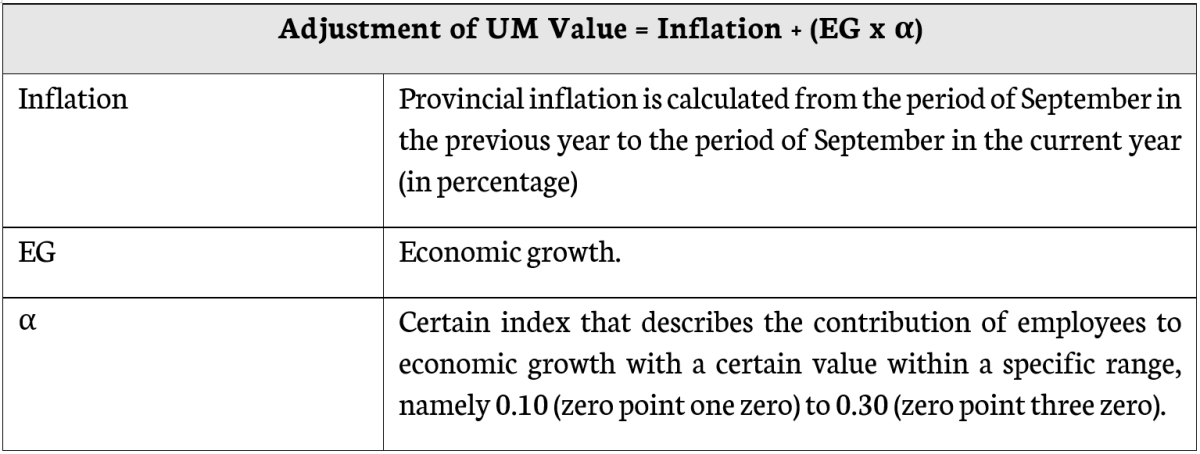
Economic growth at the province level is calculated from changes in provincial economic growth in the first quarter, second quarter, third quarter of the current year, and fourth quarter of the previous year against the provincial economic growth in the first quarter, second quarter, third quarter of the previous year, and fourth quarter in the 2 (two) years before.
As for the regency/city levels, the economic growth is calculated from changes in the regency/city’s economic growth in the first quarter, second quarter, third quarter and fourth quarter of the previous year against the economic growth of the regency/city’s economic growth in the first quarter, second quarter, third quarter and fourth quarter in the 2 (two) years before.
The value of α must consider the productivity and expansion of employment opportunities. Furthermore, the data used for calculating the minimum wages must be sourced from a competent authority in the field of statistics and the stipulation of adjustment to the amount of the minimum wage increase must not exceed 10% (ten percent).
♦ Minimum Wages for Regencies/Cities That Do Not Have Minimum Wages
The stipulation of minimum wages for regencies/cities that do not have minimum wages required to comply with specific requirements is as follows:
- The average economic growth of the relevant regency/city for the last 3 (three) years from available data for the same period is higher than the average provincial economic growth; or
- The value of economic growth minus the inflation of the relevant regency/city for the last 3 (three) years from the available data for the same period is always positive and is higher than the provincial economic growth.
In the event that either of the above requirements is not fulfilled, a Governor may not set a minimum wage for the concerned regency/city.
The calculation of the minimum wages for regencies/cities that do not have minimum wages is conducted in the following stages:
- Calculating the relative amount of the regency/city minimum wage against the provincial minimum wage based on the ratio of purchasing power parity.
- Calculating the relative amount of the regency/city minimum wage against the provincial minimum wage based on the ratio of employment rate.
- Calculating the relative amount of the regency/city minimum wage against the provincial minimum wage based on the median wage ratio.
- Calculating the average relative value of regency/city minimum wage as referred to in stage 1, stage 2 and stage 3 above.
It is also important to note that the variable of the purchasing power parity, employment rate and median wage are each calculated based on the average value of the last 3 (three) years of available data for the same period.
♦ Minimum Wages for Regions Resulting from Expansion
The provincial minimum wage for provinces resulting from expansions for the first time follows the minimum wage that applies in the parent/main province. Meanwhile, the minimum wage for regencies/cities resulting from expansions for the first time follows the minimum wage that applies in the parent/main regency/city. In the case that the parent/main regency/city does not have a certain minimum wage, it follows the minimum wage that applies in the relevant province.
The calculation of the minimum wage adjustment is conducted by the Wage Council in the respective province and regency/city. Subsequently, while the calculation result of the UMP adjustment is recommended to the Governor via the Provincial Employment Agency, the calculation result of the UMK adjustment is submitted to the relevant Regent/Mayor to be recommended to the Governor via the Provincial Employment Agency.
November 28, 2022
AKSET
Please contact Johannes C. Sahetapy-Engel (jsahetapyengel@aksetlaw.com), Thomas P. Wijaya (twijaya@aksetlaw.com), or Imam Fuad An Naufal (inaufal@aksetlaw.com) for further information.
Disclaimer:
The foregoing material is the property of AKSET and may not be used by any other party without prior written consent. The information herein is of general nature and should not be treated as legal advice, nor shall it be relied upon by any party for any circumstance. Specific legal advice should be sought by interested parties to address their particular circumstances.
Any links contained in this document are for informational purposes and are available and relevant at time this publication is made. We provide no liability whatsoever in respect of any information or content in such links.
Copyright © 2022 AKSET. All rights reserved.
Government Sets Minimum Wages to Increase at a Maximum of 10% for 2023
Facilitation for Foreign Nationals in Acquiring Property
One of the provision stated in Law No. 11 of 2020 dated November 2, 2020 dated November 2, 2020 on Job Creation (“Job Creation Law”) is the facilitation of property acquisition for foreign nationals in Indonesia. In essence, Article 144 of the Job Creation Law allows foreign nationals to have ownership rights (hak milik) over condominium units (satuan rumah susun), upon the fulfillment of certain conditions.
To implement the above provisions, the government has issued series of derivative regulations, namely Minister of Agrarian Affairs and Spatial Planning/Head of the National Land Agency (“ATR/BPN”) Regulation No. 18 of 2021 dated October 27, 2021 on Guidelines for the Determination of Right to Manage and Land Rights, which is recently further implemented by ATR/BPN Decree No. 1241/SK-HK.02/IX/2022 dated September 12, 2022 on Procurement and Price of Residential Houses for Foreign Nationals (“ATR/BPN Decree No. 1241”) and also ATR/BPN Circular Letter No. HR.01/1963/XI/2022 dated November 1, 2022 on Implementing Guidelines for ATR BPN Decree 1241 (“ATR/BPN CL No. HR.01”).
Please see the following for an overview of the relevant provisions of the above regulations.
♦ Types of Property Foreign Nationals Are Able to Own
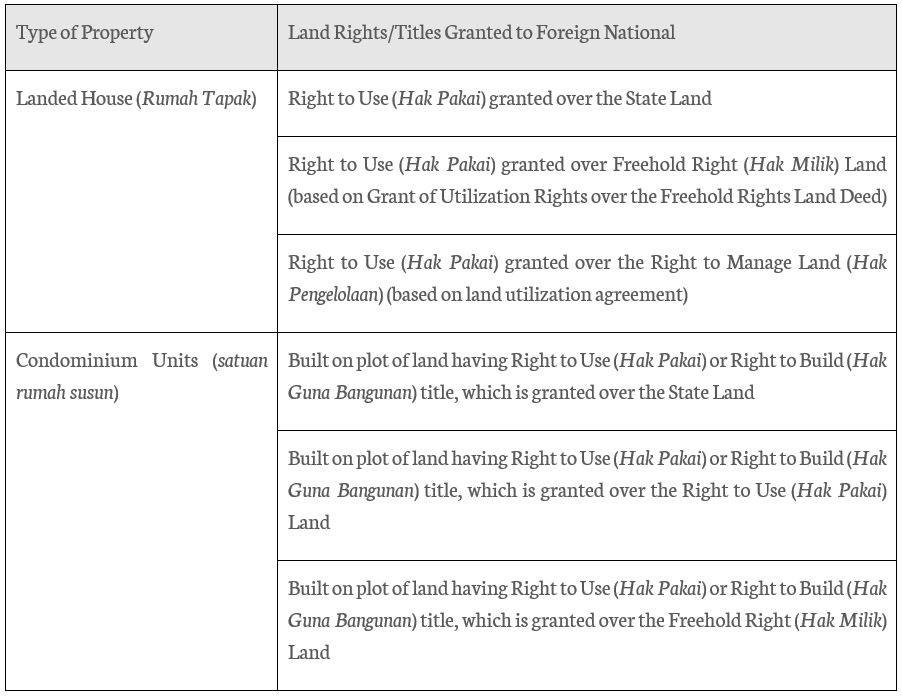
Point 1 of ATR/BPN Decree No. 1241 stipulates that foreign nationals may own residential houses based on either new or old houses/units. The type of property that foreign nationals may own, the type of land the property is on and the right/title they may hold over the property can be seen in the following table.
♦ Rights and Requirements
Previously foreign nationals must have either a permanent or temporary stay permit in order to acquire property. However, now they may now do so based on a visa, passport or stay permit. The properties owned by foreign nationals may also be inherited to a valid heir, collateralized as a loan security and be transferred to other parties.
Furthermore, there is also a minimum price requirement for the landed houses/condominium units that may be owned by foreign nationals. These minimum prices vary by province, with DKI Jakarta, Banten, Bali and several other provinces having a minimum price Rp5,000,000,000 (five billion Rupiah) for landed houses and Rp 3,000,000,000 (three billion Rupiah) for condominium units.
♦ Ownership Limitations
Despite the above, ATR/BPN CL No. HR.01 does impose certain restrictions over the ownership of property by foreign nationals.
For landed houses, foreign nationals are subjected to the following restrictions:
- houses that may be owned are only those categorized as luxury houses in accordance with existing regulations;
- each person/family is only allowed for 1 (one) plot of land; and/or
- the maximum area of the land is 2,000m2 (two thousand meters square).
If there are positive economic impacts to be had from the ownership of landed houses by foreign nationals, such person may be given more than 1 (one) plot of land or exceed the 2,000m2 (two thousand meters square) area, subject to the Minister approval. Currently, there are no further guidelines on the parameters of this exemption.
For condominium units, foreign nationals may only own commercial condominium units.
16 November 2022
AKSET
Please contact Inka Kirana (ikirana@aksetlaw.com) or Caleb K. N. Sitorus (csitorus@aksetlaw.com) for further information.
Disclaimer:
The foregoing material is the property of AKSET and may not be used by any other party without prior written consent. The information herein is of general nature and should not be treated as legal advice, nor shall it be relied upon by any party for any circumstance. Specific legal advice should be sought by interested parties to address their particular circumstances.
Any links contained in this document are for informational purposes and are available and relevant at time this publication is made. We provide no liability whatsoever in respect of any information or content in such links.
Facilitation for Foreign Nationals in Acquiring Property
New Visa for Digital Nomad: The Second Home Visa
On October 25, 2022, the Directorate General of Immigration issued Circular Letter No. IMI-0740.GR.01.01 of 2022 on Granting of Second Home Visas and Limited Stay Permits (the “Letter”). The Letter is issued based on the previously enacted Government Regulation No. 48 of 2021 dated February 2, 2021 on the Third Amendment of Government Regulation No. 31 of 2013 on the Implementing Regulation of Law No. 6 of 2011 on Immigration, in which the granting of visa and limited stay permit for the purpose of the second home was first introduced.
As a background, the Letter was issued before the commencement of the G20 Summit this November in Bali, Indonesia. The Letter aims at attracting foreigners to come to Bali and various other destinations in Indonesia by using the Second Home Visa. The Letter will become effective as of December 25, 2022.
Below, we set out the key provisions of the Letter.
♦ Granting of Second Home Visa
Based on the Letter, the Second Home Visa is a visa not for working purposes that is granted for foreigners and/or their family that is staying in Indonesia for 5 (five) or 10 (ten) years after fulfilling certain conditions.
In applying for the Second Home Visa, the applicant shall attach (i) a valid passport for a minimum of 36 (thirty six) months, (ii) the Proof of Fund of the foreigner or the Guarantor with a minimum nominal value of Rp2,000,000,000 (two billion Rupiah), (iii) Latest 4cm x 6cm colored ID Photo with white background; and, (iv) the Curriculum vitae of the applicant.
For dependents of a Second Home Visa holder, (i.e., family members), they may also apply for the Second Home Visa by submitting items (i) and (iii) above. The application shall attach a valid Second Home Visa of his/her spouse, child, or parent, and the proof of the family relationship with the Second Home Visa holder (e.g., a marriage certificate or a birth certificate).
♦ Application for Second Home Limited Stay Permit
After obtaining the Second Home Visa, the holder of such visa is required to apply for a Second Home Limited Stay Permit (Izin Tinggal Terbatas or “Itas”) at the latest 30 (thirty) days after the granting of the visa. The applicant shall submit the application for the Second Home Itas together with the following documents:
- Valid passport included with visa;
- A commitment letter which states that the applicant with a 5 (five) year stay permit is able to have a Proof of Fund in the form of:
- A Bank Account in an Indonesian State-Owned Bank with a minimum value of Rp2,000,000,000 (two billion Rupiah); or
- The proof of property ownership in Indonesia with luxury category under the name of the foreigners.
- Report such Proof of Fund to the stay permit issuing Immigration Office at the latest 30 (thirty) days after the issuance of the Second Home Itas; and
- Do not transfer, assign, and/or guarantee the Proof of Fund as long as he/she still holds the Second Home Itas.
The Second Home Itas may be granted for 5 (five) or 10 (ten) years and may be extended at the latest 5 (five) years since the issuance of the Itas, provided that the total period of the extension of Second Home Itas and the first Second Home Itas must not exceed 10 (ten) years.
♦ Conversion of Stay Permit for Foreign Senior Tourist
A holder of a foreign senior tourist Limited Stay Itas or a Permanent Stay Itas with a 180 (one hundred eighty) days validity period from the entry into force of the Letter must convert their Itas to a Second Home Itas. However, such obligation does not apply to a holder of foreign senior tourist Limited Stay Itas or Permanent Stay Itas with an unlimited period. Instead, they are required to submit a Proof of Fund to the relevant Immigration Office, at the latest 90 (ninety) days since the entry into force of the Letter.
10 November 2022
AKSET
Please contact Johannes C. Sahetapy-Engel (jsahetapyengel@aksetlaw.com), Thomas Peter Wijaya (twijaya@aksetlaw.com), or Ammarsyarif Ghazyandra Goenawan (agoenawan@aksetlaw.com) for further information.
Disclaimer:
The foregoing material is the property of AKSET and may not be used by any other party without prior written consent. The information herein is of general nature and should not be treated as legal advice, nor shall it be relied upon by any party for any circumstance. Specific legal advice should be sought by interested parties to address their particular circumstances.
Any links contained in this document are for informational purposes and are available and relevant at time this publication is made. We provide no liability whatsoever in respect of any information or content in such links.
New Visa for Digital Nomad: The Second Home Visa
Recommendation for RPTKA Ratification is No Longer Required
Due to the decreasing covid cases in Indonesia and to accelerate the national economic recovery, the Minister of Manpower issued Circular Letter No. M/4/HK.04/IX/2022 on Ratification of Plans for Employment of Foreign Workers (Rencana Penggunaan Tenaga Kerja Asing or “RPTKA”) for Acceleration of National Economic Recovery (“CL 4/2022”) on September 30, 2022. CL 4/2022 revokes the Minister of Manpower Circular Letter No. M/11/HK.04/IX/2021 dated September 24, 2021 on Ratification Service of RPTKA During the Period of Handling the Spread of Corona Virus Disease 2019 (“CL 11/2021”).
With the revocation of CL 11/2021 by CL 4/2022, recommendations from relevant ministries/institutions for an RPTKA ratification are no longer required. Further, the restriction for RPTKA ratification for employees from a certain country with high spread of covid-19 cases is also no longer applicable.
CL 4/2022 also stipulates that the process of RPTKA ratification will continue using the procedure as regulated under Government Regulation No. 34 of 2021 dated April 1, 2021 on the Use of Foreign Workers and its implementing regulation, the Minister of Manpower Regulation No. 8 of 2021 dated April 1, 2021 on the Implementing Regulation of Government Regulation No. 34 of 2021.
October 9, 2022
AKSET
Please contact Johannes C. Sahetapy-Engel (jsahetapyengel@aksetlaw.com) or Ammarsyarif Ghazyandra Goenawan (agoenawan@aksetlaw.com) for further information.
Disclaimer:
The foregoing material is the property of AKSET and may not be used by any other party without prior written consent. The information herein is of general nature and should not be treated as legal advice, nor shall it be relied upon by any party for any circumstance. Specific legal advice should be sought by interested parties to address their particular circumstances.
Any links contained in this document are for informational purposes and are available and relevant at time this publication is made. We provide no liability whatsoever in respect of any information or content in such links.
Recommendation for RPTKA Ratification is No Longer Required
Bappebti Now Regulates Use of Robo Advisors in Futures Commodity Trading
With the growth of illegal investment platforms recently, the Indonesian Commodity Futures Trading Regulatory Agency (Badan Pengawas Perdagangan Berjangka Komoditi or “Bappebti”) has blocked numerous unlicensed trading platforms which label themselves as ‘robot trading.’ Although regular advisory on futures trading has been regulated under Bappebti Regulation No. 6 of 2020 dated July 30, 2020 on Futures Advisors and Futures Advisor Representatives (“Regulation 6/2020”), such advisory does not include the provision of automated advisory or robot trading.
In light of the above, Bappebti issued Regulation No. 12 of 2022 dated September 2, 2022 on Provision of Information Technology-based Advice in the Form of Expert Advisors in the Commodity Futures Trading Sector (“Regulation 12/2022”). With Regulation 12/2022, Bappebti now regulates the use of IT-based advisory or robo trading services in the commodity futures trading industry for the orderly, fair, efficient, effective, and transparent futures trading activities.
We set out below the key provisions of Regulation 12/2022.
♦ Introduction of an IT-Based Advisors (Expert Advisors)
Advice provided by a Futures Advisor, in the form of information and/or recommendation, may be given by an IT-based advisor or Expert Advisor. An Expert Advisor is defined as a form of advice that may automatically conduct: market monitoring, calculation on the probability to enter or exit the market, placement of reasonable transactions, and risk management by considering the needs of a client. Regulation 12/2022 highlights that an Expert Advisor shall only be treated as a tool for a transaction, whereas the decision making shall be made by clients.
♦ Requirements for Futures Advisors to Offer Expert Advisors
Any Futures Advisor who wishes to conduct the activity of an Expert Advisor shall first obtain an approval from Bappebti. To obtain such approval, a Futures Advisors must:
- have a business license as a futures advisor from Bappebti;
- have an application, system, or program (the “System”) which must incorporate certain features and have been recommended by one of the Futures Exchanges;
- have a proof of cooperation with a developer or company that develops the System which shall be used as an Expert Advisor in the event the System is not developed by the Futures Advisor itself;
- have a special customer relation division that shall be the Futures Advisor Representative to make any updates on the algorithm program and after - sales service as well as education;
- have a minimum Rp1,000,000,000 (one billion Rupiah) of additional paid-up capital; and
- have a track record as a Futures Advisor which has a good assessment success rate based on the average total historical data of its clients' transactions.
♦ General Obligations in Provision of Expert Advisor
In providing IT-based advice through the Expert Advisor, Regulation 12/2022 stipulates certain obligations for a Futures Advisor. Such obligations apply in terms of (i) matters that must be taken into consideration with regard to the clients and the products offered (e.g., a client’s need, and financial capacity and knowledge on the use of the Expert Advisor); (ii) items that must be possessed by the Expert Advisor (e.g., the manual book, transaction records, and transparency of the algorithm); (iii) matters that must be offered in providing the Expert Advisor to clients (e.g., education, update on the algorithm, and after-sales services); and (iv) matters that must be considered in accepting clients who may use the Expert Advisor (e.g., a client’s margin capability of at least Rp50,000,000 (fifty million Rupiah) and a client’s understanding of the risk and procedures of the Expert Advisor in futures trading).
♦ Reporting Obligations to Bappebti
A Futures Advisor which provides the Expert Advisor shall submit regular reports and/or incidental reports if requested by Bappebti. The reports shall include information on (i) clients who use the Expert Advisor as well as the advice given to the clients, and (ii) changes of features in the Expert Advisor. Certain events such as changes in the System shall also be disclosed to and approved from the client before being periodically reported to Bappebti.
♦ Certain Prohibitions in Provision of Expert Advisor
Regulation 12/2022 sets out certain prohibitions for a Futures Advisor or a Futures Advisor Representative in offering Expert Advisor to clients or prospective clients. A Futures Advisor and a Futures Advisor Representative are prohibited from offering Expert Advisor before understanding a client’s need, financial capability, and other related issues. Further, a Futures Advisor that offers Expert Advisor is prohibited from conducting certain actions, including (i) guaranteeing fixed profits for the use of Expert Advisor, (ii) conducting transactions on behalf of a client, (iii) offering profit sharing from the use of Expert Advisor; and (iv) conducting direct selling or multi-level marketing scheme.
A Futures Advisor or Futures Advisor Representative is also subject to Regulation 6/2020.
♦ Disclosure Statement and Acknowledgement on Risks of Using Expert Advisor
Under Regulation 12/2022, a client is required to complete a disclosure statement and an acknowledgement form on the use of the Expert Advisor which is given by a Futures Advisor. The disclosure statement shall be based on the format set out in Regulation 12/2022 and shall be read and recorded in the form of video by the client to be uploaded and/or sent to the Futures Broker.
Additionally, a Futures Advisor which offers the Expert Advisor shall provide an acknowledgement form to be signed by a client which form states that the Futures Advisor is not liable for any risks and losses occurred based on the futures trading transaction. However, any liability shall be borne by a Futures Advisor in the event that the Futures Advisor fails to comply with Regulation 12/2022.
October 3, 2022
AKSET
Please contact Johannes C. Sahetapy-Engel (jsahetapyengel@aksetlaw.com), Clara Anastasia So (canastasia@aksetlaw.com), or Ammarsyarif Ghazyandra Goenawan (agoenawan@aksetlaw.com) for further information.
Disclaimer:
The foregoing material is the property of AKSET and may not be used by any other party without prior written consent. The information herein is of general nature and should not be treated as legal advice, nor shall it be relied upon by any party for any circumstance. Specific legal advice should be sought by interested parties to address their particular circumstances.
Any links contained in this document are for informational purposes and are available and relevant at time this publication is made. We provide no liability whatsoever in respect of any information or content in such links.
Bappebti Now Regulates Use of Robo Advisors in Futures Commodity Trading
Mandatory Tuberculosis Management in Workplaces
In an effort to eradicate Tuberculosis (“TB”) in Indonesia, employers now have additional obligations in connection with TB management. Recently, the Minister of Manpower (“MOM”) issued MOM Regulation No. 13 of 2022 dated September 22, 2022 on Tuberculosis Management in Workplaces (the “Regulation”). The issuance of the Regulation is intended to support the national tuberculosis control which targets in eliminating TB by 2030 and Indonesia will be free from TB in 2050.
The Regulation provides a technical guideline in TB management in workplaces and to push the effectiveness on TB management consistent with Law No. 1 of 1970 dated January 12, 1970 on Work Safety and Presidential Regulation No. 67 of 2021 dated August 2, 2021, on Management of Tuberculosis.
Below, we set out the key provisions of the Regulation.
♦ Formulation of TB Management Policies and TB Socialization
An employer must formulate a TB Management Policy for its workplace. Such policy shall be made to include at least the following: (i) a commitment to conducting TB management, (ii) a work plan for TB Management, and (iii) elimination of discrimination against any employee suffering from TB.
An employer shall also socialize, disseminate information, and educate its employees regarding TB in the workplace. Such action shall be conducted in the form of, among others, (i) TB Management policies; (ii) cultivating a clean and healthy lifestyle; (iv) education on the impact of comorbidities on the worsening of tuberculosis; and (v) maintenance and improvement of the quality of the workplace.
♦ TB Case Handling
In handling the TB case, an employer shall identify cases by conducting (i) an initial and regular medical check-up for its employees, (ii) a special medical check-up for employees in certain risk groups, and (iii) investigating and examining close contact cases at workplace. The Regulation suggests that the finding of TB cases may also be obtained from the diagnosis of health care facilities. It is now mandatory for an employee who suffers or knows the possibility of TB case in the workplace to report it to the employer.
Based on the case finding from the medical check-up or the reporting from an employee, an employer shall ensure that the employee obtains medical treatment in accordance with the National TB Management guidelines and shall monitor the medication progress of its employees.
After a TB case is found, an employer shall monitor the workplace and take appropriate control measures in accordance with the applicable laws and regulations.
♦ TB Recovery
An employer shall provide the rehabilitation support that is required by its employees after the TB handling. An wmployee who suffers from TB shall also return to work after obtaining an assessment and confirmation of the fitness to work by an employer’s doctor or the employee’s treating doctor.
October 3, 2022
AKSET
Please contact Johannes C. Sahetapy-Engel (jsahetapyengel@aksetlaw.com), Thomas Peter Wijaya (twijaya@aksetlaw.com), or Ammarsyarif Ghazyandra Goenawan (agoenawan@aksetlaw.com) for further information.
Disclaimer:
The foregoing material is the property of AKSET and may not be used by any other party without prior written consent. The information herein is of general nature and should not be treated as legal advice, nor shall it be relied upon by any party for any circumstance. Specific legal advice should be sought by interested parties to address their particular circumstances.
Any links contained in this document are for informational purposes and are available and relevant at time this publication is made. We provide no liability whatsoever in respect of any information or content in such links.