
Updates on Foreign Exchange Market Transaction Requirements
On May 26, 2026, the Members of the Board of Governors of Central Bank of Indonesia (“Bank Indonesia”) enacted Regulation (Peraturan Anggota Dewan Gubernur or PADG) No. 11 of 2026 on Second Amendment to Board of Governors Member Regulation No. 11 of 2024 on Foreign Exchange Market Transactions (“PADG 11/2026”). PADG 11/2026 came into effect as of June 2, 2026.
PADG 11/2026 was introduced as a monetary policy of Bank Indonesia to support the stability of Rupiah, in response to continued pressure on the Rupiah exchange rate arising from global financial market uncertainty and increasing domestic demand for foreign exchange. Under PADG 11/2026, Bank Indonesia adjusts the threshold applicable to cash foreign exchange purchases against Rupiah that are subject to underlying transaction document requirements.
PADG 11/2026 reduces the threshold for cash foreign exchange purchases against Rupiah that may be conducted without any underlying transaction. Previously, a person could purchase foreign currency in cash of up to USD50,000 (or its equivalent) per month per person without any underlying transaction. Under PADG 11/2026, the limit is reduced to USD25,000 (or its equivalent) per month per person.
PADG 11/2026 does not alter the existing limits applicable to derivative products. The thresholds for forward and domestic non-deliverable forward transactions remain at USD100,000 (or its equivalent) per month per person for buy transactions and USD10,000,000 (or its equivalent) per transaction for sell transactions. Furthermore, the limit applicable for swap transactions also remains unchanged at USD10,000,000 (or its equivalent) per transaction. Other derivative products continue to be subject to limits of USD100,000 (or its equivalent) per month per party for buy transactions and USD1,000,000 (or its equivalent) per transaction for sell transactions.
In light of the new threshold introduced under PADG 11/2026, Bank Indonesia provides temporary relaxation for cash foreign currency purchases exceeding USD25,000 and up to USD50,000 (or its equivalent) per month per person carried out between June 2, 2026, and June 30, 2026. For these transactions, the underlying transaction documents and/or supporting documents may be submitted no later than July 31, 2026.
AKSET
Please contact Johannes C. Sahetapy-Engel (jsahetapyengel@aksetlaw.com) or Shafa Femalea Sekar Nuswantari (snuswantari@aksetlaw.com) for further information.
Disclaimer:
The foregoing material is the property of AKSET and may not be used by any other party without our prior written consent. The information herein is of general nature and should not be treated as legal advice, nor shall it be relied upon by any party for any circumstance. Specific legal advice should be sought by interested parties to address their particular circumstances.
Any links contained in this document are for informational purposes and are available and relevant at time this publication is made. We provide no liability whatsoever in respect of any information or content in such links.

New Regulation on Drugs Promotion and Advertising
The Indonesian Food and Drug Supervisory Agency (Badan Pengawas Obat dan Makanan or “BPOM”) enacted BPOM Regulation No. 7 of 2026 dated April 29, 2026, on Drug Promotion and Advertising (“BPOM Reg 7/2026” or the “New Regulation”). The New Regulation replaces BPOM Regulation No. 2 of 2021 dated February 3, 2021, on Guidelines for Supervision of Drug Advertising (“BPOM Reg 2/2021”).
The New Regulation is enacted pursuant Law No. 17 of 2023 dated August 8, 2023, on Health (the “Health Law”) and its implementing regulation, Government Regulation No. 28 of 2024 dated July 26, 2024, on the Implementation of Health Law (“GR 28/2024”), together with Law No. 8 of 1999 dated April 20, 1999, on Consumer Protection.
The New Regulation introduces broader and more detailed rules on pharmaceutical promotion and advertising, particularly in relation to digital advertising, prescription drug promotion, supervision, and compliance obligations. Below are the key changes introduced under the New Regulation.
♦ Expanded Scope in New Regulation
The New Regulation expands several aspects previously regulated under BPOM Reg 2/2021, including the following:
- Expanded Scope of Regulated Parties
Under BPOM Reg 2/2021, promotional and/or advertising activities for drugs that have obtained marketing authorization may only be conducted by the pharmaceutical industries holding the relevant marketing authorization (izin edar or the “Permit”).Under the New Regulation, the scope of regulated parties has been expanded to include the following entities:
-
-
- pharmaceutical industry;
- pharmaceutical wholesalers/distributors (Pedagang Besar Farmasi or a “PBF”);
- pharmaceutical service facilities, which include hospital pharmacy installations, clinic pharmacy installations, and pharmacies;
- pharmaceutical electronic system providers; and/or
- other entities.
All the above, collectively, the “Regulated Parties.”
Note that the Regulated Parties may only conduct the promotion and/or advertisement of drugs that have the Permit.
-
- Risk Management in Promotional Activity
The New Regulation introduces risk management obligations, whereby the Regulated Parties are now required to assess and manage risks arising from promotional activities to prevent misuse and/or illegal drugs distribution. Such risk management includes stock management, including estimated demand and disease prevalence, shelf life, supply chain integrity, and return policies. - Sponsorship as Promotion
The New Regulation expressly recognizes sponsorship as a form of promotion, allowing pharmaceutical industries and a PBF to provide sponsorships to healthcare professionals in accordance with applicable laws and regulations.
♦ New Rules on Prescription Drug Promotion
The New Regulation provides more comprehensive provisions and restrictions on the promotion of prescription drugs. The New Regulation provides more detailed stipulation on the permitted promotional media by allowing promotional activities directed to healthcare professionals through restricted-access scientific forums and digital platforms, including e-detailing platforms, professional presentations, and scientific brochures, provided that:
- the access must be restricted exclusively to medical professionals and/or healthcare workers; and
- the promotional materials must be scientifically accountable and non-misleading.
Article 37 (1) of New Regulation stipulates that the promotion of prescription drugs is prohibited from being carried out by pharmaceutical service facilities, electronic pharmaceutical system providers, and other facilities.
Further, the New Regulation imposes stricter limitations regarding the display of prescription drugs on official websites of pharmaceutical industry marketing authorization holders as part of company profiles, limiting such display to product packaging, trade name, composition, and/or drug strength only.
♦ New Requirement on Digital Advertising of Drugs
Article 16(3) of BPOM Reg 7/2026 also introduces several provisions specifically addressing digital advertising practices, one of which relates to social media content requirements. Under this New Regulation, online advertisements, including social media advertisements, must include captions, descriptions, hashtags, or similar supporting text as an integral part of each publication.
In regard to the advertisement through audiovisual media, previously BPOM Reg 2/2021 required the storyboard submissions to consist of a maximum of 6 frames per page. In the New Regulation that technical restriction is removed, provided that the storyboard is submitted in a clear and readable resolution and includes descriptions, narratives, background texts, and/or background audio for each frame.
♦ Broader Exemption of Advertisement Approvals
The New Regulation significantly expands the criteria of advertisements exempted from a prior BPOM advertisement approval (persetujuan iklan) before publication. The Regulated Parties are also not required to submit an application for a BPOM approval if the advertisements meet the following criteria.
- Advertisements that only involve a change of advertisement talents from the previously approved advertisement;
- Advertisements that only involve changes to the design, orientation, or layout of a previously approved advertisement, provided that such changes do not alter the meaning of the advertisement;
- Advertisements intended solely for internal pharmaceutical industry purposes; and/or
- Advertisements intended for medical professionals and/or healthcare professionals, which must include statements such as the following:
- “For Medical Professional Use Only” or “Hanya untuk Tenaga Medis;” and/or;
- “For Healthcare Professional Use Only” or “Hanya untuk Tenaga Kesehatan.”;
♦ Changes to Advertisement Evaluation and Supervision
Under BPOM Reg 2/2021, advertisements categorized as notification-category advertisements could be processed through a self-assessment mechanism (i.e., independent evaluation by the applicant without BPOM review, processed automatically via the SIAPIK system). The New Regulation changes this approach by requiring an evaluation by BPOM officials even for notification-category advertisements.
Under Article 25(2) of the New Regulation, the evaluation timelines by BPOM officials are as follows:
- 1 working day for notification advertisements;
- 10 working days for minor advertisements; and
- 25 working days for major advertisements.
♦ Administrative Sanctions
Compared to BPOM Reg 2/2021, the New Regulation removes the administrative sanction in the form of suspension of a Permit and introduces the revocation of Good Drug Distribution Practice (Cara Distribusi Obat yang Baik or “CDOB”) certification.
Accordingly, administrative sanctions under the New Regulation may include the following:
- warnings;
- severe warnings (peringatan keras);
- temporary suspension of activities;
- revocation of marketing authorization; and/or
- revocation of CDOB certification.
AKSET
Please contact Johannes C. Sahetapy-Engel (jsahetapyengel@aksetlaw.com), Azzahra Saffanisa Sudiardiputri (asudiardiputri@aksetlaw.com) or Shafa Femalea Sekar Nuswantari (snuswantari@aksetlaw.com) for further information.
Disclaimer:
The foregoing material is the property of AKSET and may not be used by any other party without our prior written consent. The information herein is of general nature and should not be treated as legal advice, nor shall it be relied upon by any party for any circumstance. Specific legal advice should be sought by interested parties to address their particular circumstances.
Any links contained in this document are for informational purposes and are available and relevant at time this publication is made. We provide no liability whatsoever in respect of any information or content in such links.

AKSET Newsflash: New Regulation on Drugs Promotion and Advertising
Key Changes Under the New Outsourcing Regulation
On 30 April 2026, the Minister of Manpower enacted Regulation No. 7 of 2026 on Outsourcing (the “Regulation”). The Regulation introduces stricter limitations on the types of work that may be outsourced and imposes additional compliance requirements for outsourcing arrangements. The new framework is expected to significantly affect companies engaging outsourced workers in Indonesia.
We set out below key highlights of the Regulation.
♦ Background
Prior to the Job Creation Law regime, outsourcing arrangements were regulated under Law No. 13 of 2003 on Manpower (the “Manpower Law”). Article 65 of the Manpower Law limited outsourcing to supporting activities that were separate from the company’s main business activities, carried out under the user company’s instruction, constituted supporting activities only, and did not directly interfere with the production process.
Under the Job Creation Law, Article 65 was removed and Article 66 was amended. As a result, the previous statutory restrictions limiting outsourcing to supporting activities and prohibiting outsourcing of core production-related work were no longer expressly regulated under the Manpower Law. These changes were subsequently challenged before the Constitutional Court by labor unions and labor groups, which argued that the revised framework could expand outsourcing practices and weaken worker protection.
In Constitutional Court Decision No. 168/PUU-XXI/2023, the Court did not reinstate the previous restrictions under Article 65. However, the Court held that Article 64 of the Manpower Law, as amended by the Job Creation Law, was conditionally unconstitutional unless interpreted to require the Minister of Manpower to determine the categories of work that may be outsourced. This Decision formed the basis for the issuance of the Regulation.
♦ Permitted Outsourced Activities
The Regulation stipulates that the permitted outsourced activities are limited to the following:
-
- cleaning services;
- food and beverage services (i.e., catering);
- security services;
- driver and transportation services for workers;
- operational support services; and
- supporting services in the mining, oil and gas, and electricity sectors.
However, the term “operational support services” is not clearly defined under the Regulation. This lack of clarity may create uncertainty regarding the scope of activities that may still be outsourced under this category and could potentially lead to differing interpretations in practice.
♦ Reporting and Registration Requirement
The Regulation also introduces a mandatory registration requirement for outsourcing agreements. Such agreements must be recorded with the relevant Manpower Office by the outsourcing company. The Manpower Office will review the agreement before issuing proof of registration. If the agreement does not comply with the Regulation, including the permitted scope of outsourced work, the registration process may be delayed or rejected.
♦ Sanctions and Transition Period
The Regulation introduces administrative sanctions for non-compliance. User companies that outsource work outside the permitted categories may be subject to written warnings and restrictions on business activities, including limitations on production capacity and the postponement of business licensing processes.
Outsourcing companies that fail to comply with their obligations under the Regulation may also be subject to administrative sanctions under Indonesia’s risk-based business licensing regime, which may include suspension of business activities, fines, and licenses revocation.
The Regulation provides a two-year transition period, allowing companies until 30 April 2028 to align their existing outsourcing arrangements with the new requirements. Companies should therefore review the scope of outsourced work and assess whether their current outsourcing structures and agreements remain compliant under the Regulation.
AKSET
Please contact Thomas P. Wijaya (twijaya@aksetlaw.com) or Muhammad Dzaki Ramadhan Al Rizal (mrizal@aksetlaw.com) for further information or if you wish discuss the above.
Disclaimer:
The foregoing material is the property of AKSET and may not be used by any other party without our prior written consent. The information herein is of general nature and should not be treated as legal advice, nor shall it be relied upon by any party for any circumstance. Specific legal advice should be sought by interested parties to address their particular circumstances.
Any links contained in this document are for informational purposes and are available and relevant at time this publication is made. We provide no liability whatsoever in respect of any information or content in such links.
AKSET Newsflash: Key Changes Under the New Outsourcing Regulation
New Regulation Introduces Nutri-Level Labeling for Ready-to-Eat Processed Food
As a follow-up to the enactment of Minister of Health (the “MOH”) Regulation No. 3 of 2026 on Disease Control (the “MOH Regulation”), the MOH has issued Decree No. HK.01.07/MENKES/301/2026 on Inclusion of Nutrition Label and Health Message on Ready-to-Eat Processed Food (the “Decree”), which came into effect on April 14, 2026.
The Decree applies to “ready-to-eat processed food”, which includes food and beverage products that have undergone certain processing methods, with or without additional ingredients, as defined under Law No. 18 of 2012 on Food, as amended by Law No. 6 of 2023. The Decree further implements the obligations under MOH Regulation, particularly in relation to nutrition labeling and health messaging requirements.
We set out below the key provisions of the Decree.
♦ Nutritional Labeling for Ready-to-Drink Products
While the Decree applies broadly to ready-to-eat processed food (including both food and beverages), its current implementation appears to primarily target ready-to-drink products, particularly those produced, imported, and/or distributed by large-scale business actors. In this context, such business actors are expected to commence the inclusion of nutritional labeling and health messages on ready-to-drink products.
This obligation aligns with the MOH Regulation, which requires any person producing, importing, and/or distributing ready-to-eat processed food to (i) comply with maximum limits on sugar, salt, and fat content, and (ii) include nutritional labeling, including information on sugar, salt, and fat content, in their information media (e.g., packaging, menus, promotional materials, and digital platform).
♦ Nutri-Level Classification System
The Decree introduces a Nutri-level classification system, as follows:
-
- Level A, represented by the letter A in dark green;
- Level B, represented by the letter B in light green;
- Level C, represented by the letter C in yellow; and
- Level D, represented by the letter D in red.
The applicable Nutri-Level is determined based on the business actor’s self-declaration of the product’s sugar, salt, and fat content, which must be supported by laboratory testing results issued by government laboratories or other accredited laboratories.
The classification is further detailed in the table below:
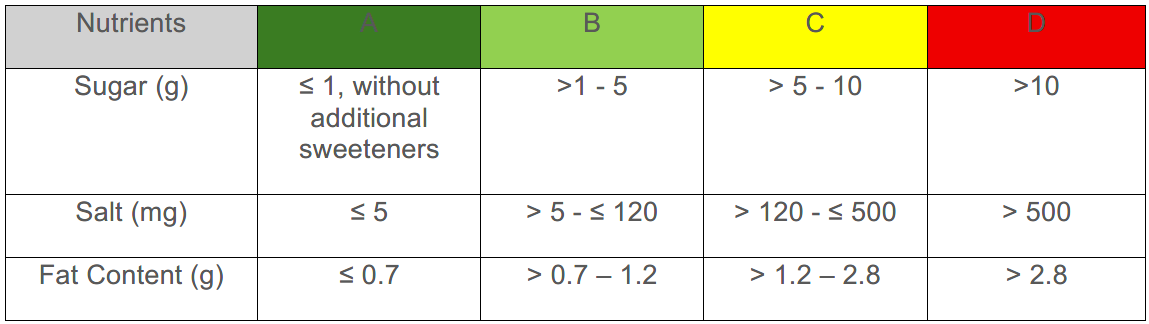
In general, Level A represents the lowest levels of sugar, salt, and fat, while Level D represents the highest, with Levels B and C falling in between. The Decree also regulates the use of sweeteners in each classification:
-
- Level A: not permitted to use any additional sweeteners, whether natural or artificial, including through direct addition or carry-over.
- Level B: permitted to use natural sweetening food additives only.
- Levels C and D: permitted to use both natural and artificial sweetening food additives.
♦ Effective Date of Labeling Requirement
The requirement to include nutritional labeling and health messages will become mandatory two years after the Government establishes the maximum limits for sugar, salt, and fat content under the applicable regulations. As of the date of this Newsflash, these implementing regulations have not yet been issued.
Accordingly, while the Decree is already in effect, the labeling requirement remains subject to a transitional period. This signals a move toward stricter nutrition regulation with compliance potentially extending beyond packaging to menus, promotional materials, and digital platforms. Businesses are encouraged to review their products and labeling practices in preparation for future implementation.
AKSET
Please contact Thomas P. Wijaya (twijaya@aksetlaw.com) or Shafa Femalea S. Nuswantari (snuswantari@aksetlaw.com) for further information.
Disclaimer:
The foregoing material is the property of AKSET and may not be used by any other party without our prior written consent. The information herein is of general nature and should not be treated as legal advice, nor shall it be relied upon by any party for any circumstance. Specific legal advice should be sought by interested parties to address their particular circumstances.
Any links contained in this document are for informational purposes and are available and relevant at time this publication is made. We provide no liability whatsoever in respect of any information or content in such links.
Update on Indonesia’s Taxation Policy for Electric Vehicles: Withdrawal of Support to Electric Vehicles?
On March 6, 2026, the Minister of Home Affairs (the “MOHA”) issued Regulation Number 11 of 2026 on Bases for Imposing Motor Vehicle Taxes, Motor Vehicle Ownership Transfer Fees, and Heavy Equipment Taxes (the “Regulation”). The Regulation came into effect on April 1, 2026, and revoked the MOHA Regulation Number 7 of 2025 on Bases for Imposing Motor Vehicle Taxes, Motor Vehicle Ownership Transfer Fees, and Heavy Equipment Taxes of 2025 (the “Previous Regulation”).
Under the Regulation it is no longer express that on the motor vehicle taxes (Pajak Kendaraan Bermotor or the “PKB”) and Motor Vehicle Title Transfer Fees (Bea Balik Nama Kendaraan Bermotor or the “BBNKB”) are exempted for electric vehicles as expressly set out in the Previous Regulation. Please see below for more details.
♦ Removal of Express Tax Exemptions for Electric Vehicles
Under the Previous Regulation, specifically in Articles 3 and 6, it was clearly stipulated that electric vehicles were exempted from the PKB and the BBNKB. This policy appears to boost the public interest in purchasing electric vehicles as opposed to conventional combustion engine vehicles.
The Regulation alters the policy by not including electric vehicles, including those converted from fossil fuel-based vehicles, from the list of objects exempted from the PKB and the BBNKB. Instead, Articles 19(1) and (3) of the Regulation state that incentives shall be applied for the PKB and the BBNKB on electric vehicles based on applicable laws and regulations. The incentives are in the form of an exemption or a reduction of the PKB and the BBNKB without going into details regarding the exemption or reduction.
♦ Implementation of Regulation
Following the issuance of the Regulation and in an attempt to clarify the reduction or exemption of the PKB and the BBNKB, the MOHA issued Circular Letter No. 900.1.13.1/3764/SJ of 2026 to all Governors in Indonesia (the “Circular Letter”). As you may know, a Governor is the Head of a Province in Indonesia.
The Circular Letter states that the granting of the exemption of the PKB and the BBNKB incentives shall be determined by Governors by May 31, 2026. This means that there may not be a uniform or consistent reduction or exemption of the PKB and/or the BBNKB. In other words, Governors may issue different exemptions and/or reductions of the PKB and/or the BBNKB in different provinces.
AKSET
Please contact Johannes C. Sahetapy-Engel (jsahetapyengel@aksetlaw.com) or Muhammad Dzaki Ramadhan Al Rizal (mrizal@aksetlaw.com) for further information or if you wish discuss the above.
Disclaimer:
The foregoing material is the property of AKSET and may not be used by any other party without our prior written consent. The information herein is of general nature and should not be treated as legal advice, nor shall it be relied upon by any party for any circumstance. Specific legal advice should be sought by interested parties to address their particular circumstances.
Any links contained in this document are for informational purposes and are available and relevant at time this publication is made. We provide no liability whatsoever in respect of any information or content in such links.
New Guidelines on the Employment of Foreign Workers in the Banking Sector
On February 6, 2026, the Financial Services Authority (Otoritas Jasa Keuangan or “OJK”) issued Regulation No. 9 of 2026 on the Utilization of Foreign Workers and Knowledge Transfer Program by Commercial Bank (the “Regulation”). The Regulation came into effect on February 23, 2026 and revoked OJK Regulation No. 37 of 2017 (the “Previous Regulation”).
The Regulation sets out updated requirements and obligations relating to the employment of foreign workers in the banking sector. It covers, among others, the principles governing the utilization of foreign workers, hiring procedures, knowledge transfer obligations, stay permit requirements, and termination of employment.
Below, we highlight the key points and updated rules that banks should note under the Regulation.
♦ Permitted Positions and Scope of Responsibilities
The Regulation permits certain positions to be filled by foreign workers, subject to the bank’s ownership structure.
1. For banks with 25% or more of their shares owned by foreign individuals or entities, the foreign workers may be appointed to the Board of Directors (“BOD”), Board of Commissioners (“BOC”), as Executive Officers, to certain positions requiring specific competencies; and/or as expert personnel and consultants.;
2. For banks with less than 25% of their shares owned by foreign individuals or entities, foreign workers may only be appointed as expert personnel and consultants. However, where the foreign shareholder qualifies as a controlling shareholder or there are elements of control by foreign individuals or entities, the bank may appoint foreign workers to positions on the BOD, BOC, as well as to roles as expert personnel and consultants.
Article 8 of the Regulation further specifies the areas of responsibility that may be assigned to foreign individuals, including treasury, risk management, information technology, credit or financing, marketing, finance, and internal audit. Foreign individuals are restricted from holding responsibilities in human resources and compliance, except for bank offices located overseas.
Assignments outside the permitted scope may be allowed in specific circumstances, subject to prior approval from OJK. In granting such approval, OJK will consider factors such as the bank’s needs, availability of Indonesian workers, compliance with regulatory requirements, efforts to develop local talent, and the principle of reciprocity.
♦ Employment Procedures
Banks intending to employ foreign workers must include such plan in their business plan submitted to OJK. The plan should outline, among others, the rationale for hiring, roles and responsibilities, number of foreign workers, designated supporting personnel, and a knowledge transfer program.
The appointment of foreign workers as members of the BOD, BOC, or as heads of foreign bank offices requires prior OJK approval through a fit and proper test. Such approval must be obtained before the bank submits the Foreign Worker Utilization Plan (RPTKA) to the Ministry of Manpower. For executive officers, a similar process applies, but without a fit and proper test, and is instead subject to the submission of supporting documents.
♦ Knowledge Transfer Program
Banks employing foreign workers are required to implement a knowledge transfer program for Indonesian employees, particularly where foreign workers serve as executive officers, experts, or consultants. The Regulation introduces a new requirement for banks to include a knowledge transfer plan as part of their proposal to employ foreign workers. In addition, the banks must provide opportunities for selected Indonesian employees to participate in competency development programs abroad.
♦ Employment Term and Termination
In contrast to the Previous Regulation, which limited the employment term of foreign workers to 3 years with a possible extension of up to 1 year, the Regulation extends the maximum term to 5 years. Article 29 further provides that where a bank seeks to extend the employment of a foreign worker within this period, it must submit a request for extension to OJK. In any event, the total duration of employment must not exceed 5 years.
The Regulation also introduces a new authority for OJK. It stipulates that OJK has the authority to require a bank to terminate the employment of a foreign worker prior to the expiration of the employment contract. OJK may exercise this authority on the following grounds: (i) the provision of false or misleading information to OJK, (ii) the foreign worker being found guilty of a criminal offense pursuant to a final and binding court judgment, (iii) failure to comply with the requirements set out under the Regulation, and/or (iv) a violation by the foreign worker of the principles of prudence and good governance. Any early employment termination by the bank must be reported to the Minister of Manpower.
♦ Sanctions
Non-compliance with the Regulation may subject banks to administrative sanctions imposed by OJK, including written warnings, a downgrade in the bank’s corporate governance factor under the bank soundness level assessment, restrictions or prohibitions on certain business activities, and/or monetary fines.
AKSET
Please contact Thomas P. Wijaya (twijaya@aksetlaw.com) or Muhammad Dzaki Ramadhan Al Rizal (mrizal@aksetlaw.com) for further information.
Disclaimer:
The foregoing material is the property of AKSET and may not be used by any other party without our prior written consent. The information herein is of general nature and should not be treated as legal advice, nor shall it be relied upon by any party for any circumstance. Specific legal advice should be sought by interested parties to address their particular circumstances.
Any links contained in this document are for informational purposes and are available and relevant at time this publication is made. We provide no liability whatsoever in respect of any information or content in such links.
An update on Land Valuation Rule: Highlights on Minister of Agrarian Affairs and Spatial Planning Regulation No. 3 of 2026
On February 25, 2026, the Minister of Agrarian Affairs and Head of the National Spatial Planning Agency (the “Minister”) issued Regulation No. 3 of 2026 on Land Valuation (“Regulation 3/2026”), which will come into effect on May 25, 2026.
The legal framework for land valuation in Indonesia was previously not comprehensive. Prior regulations merely mentioned or implicitly recognized the government’s authority to determine the value of plots of land. Regulation 3/2026 introduces clearer provisions regarding the object, implementation, utilization and objectives of land valuation.
We set out below several key adjustments and changes introduced under Regulation 3/2026.
♦ Products of Land Valuation
According to Article 1(1) of Regulation 3/2026, land valuation is a process undertaken to estimate the value of a plot of land or a designated zone. Land valuation may be used to determine the Land Value Zone (Zona Nilai Tanah or “ZNT”) and the Value of a Plot of Land (Nilai Bidang Tanah or “NBT”). ZNT represents a defined area comprising multiple NBTs that have relatively similar values. NBT, on the other hand, represents the value assigned to an individual plot of land. The results of ZNT and NBT are reflected in the ZNT Map and NBT Map, respectively. Both maps are made available electronically through the Minister’s land mapping application, BHUMI, or may be requested directly to land offices.
♦ Subject and Object of Land Valuation
Although the authority to conduct land valuation rests with the Minister, the actual valuation is carried out by a land appraiser, who may be either a civil servant or a non-civil servant. As mentioned earlier, land valuation may be conducted on a plot of land or for a group of plots of land (zone). Article 3 of Regulation 3/2026 states that the land subject to valuation may include both agricultural and non-agricultural land, but excludes areas designated as forest areas. It should be noted that land valuation does not take into account any building or vegetation growing on the land.
♦ Land Valuation Process
Pursuant to Article 7 of Regulation 3/2026, in conducting the land valuation, the appraiser will require two sets of data: first, the transaction data, which consists of information relating to sale and purchase activity within a certain period. Second, offering data, which consists of information on the prices at which properties are offered to potential buyers during a specific period. Furthermore, surveys may be conducted with respondents as well, including landowners who have conducted transactions or who are planning to sell their land, property agents, property developers, government officials, village heads, residents in the surrounding area.
♦ Land Valuation Update
Under Regulation 3/2026, updates to land valuation may be conducted in the event of changes to the physical form of the land. Such changes may arise from land administration services (including land registration, plot of land separation, plot of land combination, recalculation of land area, upgrade on land data) or from natural causes.
In addition, the integration of the updated Land Value Maps into the existing maps is scheduled to take place on January 1st. However, it remains unclear whether this integration is intended to occur as one-time update or as an annual process.
This development may be relevant for businesses in the real estate sector, as it provides a reference for the most up-to-date land values.
♦ Utilization of Land Valuation Map
Regulation 3/2026 provides that the Land Valuation Map may be utilized to support land related and spatial planning services, as well as other interests related to land value.
Land value zones serve several important functions, including the following:
1. Guidance for determining the Sale Value of Taxable Object (Nilai Jual Objek Pajak or NJOP);
2. Support for spatial planning, assisting the government in conducting urban planning;
3. Enhancement of transparency in the property market by providing the public with reasonable references for land prices;
4. References for investment planning, particularly in relation to land and land rights.
AKSET
Please contact Adhitya Ramadhan (aramadhan@aksetlaw.com) or Muhammad Dzaki Ramadhan Al Rizal (mrizal@aksetlaw.com) for further information.
Disclaimer:
The foregoing material is the property of AKSET and may not be used by any other party without our prior written consent. The information herein is of general nature and should not be treated as legal advice, nor shall it be relied upon by any party for any circumstance. Specific legal advice should be sought by interested parties to address their particular circumstances.
Any links contained in this document are for informational purposes and are available and relevant at time this publication is made. We provide no liability whatsoever in respect of any information or content in such links.
Corporate Criminal Liability: Key Sentencing Adjustments under Law 1/2026
The long-awaited reform of Indonesia’s Criminal Code has come into effect on January 2, 2026, following the enactment of Law No. 1 of 2023 on the Indonesian Criminal Code / Kitab Undang-Undang Hukum Pidana (“Law 1/2023”), which formally replaced the previous criminal code regime.
Consequently, corresponding adjustments to existing criminal penalty provisions are necessary to ensure consistency and legal certainty, as well as to prevent potential injustice arising from discrepancies between Law 1/2023 and criminal penalty provisions set out in other prevailing laws and regional regulations.
To address this, the Government has enacted Law No. 1 of 2026 on the Adjustment of Sentencing Provisions (“Law 1/2026”), which also became effective on January 2, 2026. Law 1/2026 is intended to harmonize and realign criminal sentencing provisions set out in laws and regional regulations enacted prior to the entry into force of Law 1/2023, ensuring consistency with the structure and principles of sentencing under the new criminal code.
Importantly, these adjustments and amendments have significant implications for corporate criminal liability, particularly in relation to the scope of corporate responsibility, attribution of acts to corporations, and the applicable sentencing framework. Set out below are several key adjustments and changes introduced under Law 1/2026 regarding corporate criminal liability.
♦ Changes in Criminal Fines for Corporate
Law 1/2026 amends the criminal penalty set out in laws other than Law 1/2023 that imposed single penalty. As for criminal acts committed by the Corporation, which includes legal entities in the form of limited liability companies, foundations, cooperatives, state-owned enterprises, regionally-owned enterprises or the equivalent, as well as associations both incorporated and unincorporated, business entities in the form of firm partnership, limited partnership, or the equivalent with the prevailing laws and regulations (the “Corporation”), that do not generate financial gain, Law 1/2026 imposes fine penalty for up to the maximum under Category V (i.e., Rp500,000,000 (five hundred million Rupiah).
However, where a criminal act committed by a Corporation result in financial benefits, Law 1/2026 imposes fine penalty for up to the maximum of Category VIII (i.e., Rp50,000,000,000 (fifty billion Rupiah).
Based on the elucidation of Article 79 (1) of Law 1/2023, criminal fines using a categorical system. This categorization is intended to provide clarity on the maximum amount of fines applicable to various criminal offenses and may be amended from time to time in the event of economic and monetary changes.
♦ Strengthened Enforcement of Corporate Additional Penalties
In accordance with Law 1/2023, the public prosecutor is authorized to impose an additional penalty on Corporations, including, among other, forfeiture of assets or proceeds derived from criminal acts, announcement of court judgments, revocation of licenses, permanent prohibition from engaging in certain activities, closure or suspension of business operations, and corporate dissolution. While these additional penalties are expressly listed, the mechanisms for their enforcement and the consequences of non-compliance are not comprehensively elaborated under Law 1/2023.
Law 1/2026 further addresses this gap by introducing more detailed execution provisions. With respect to assets forfeiture, the amendment now provides that should the assets ordered to be forfeited is not subject to seizure, other corporate assets of equivalent value may be forfeited as a substitute. It also clarifies that, in the event of a Corporation fails to bear the costs of announcing the court’s verdict, assets of equivalent value may likewise be subject to forfeiture.
Furthermore, Law 1/2026 refines the treatment of customary obligations by specifying that their fulfillment is deemed equivalent to a minimum Category IV of fine penalty (i.e., Rp200,000,000 (two hundred million Rupiah)).
In the event of non-compliance, the Corporation may be required to pay compensation equivalent to a Category IV of fine penalty. If such compensation remains unpaid, the prosecutor is authorized to seize and auction the Corporation’s revenue or assets to satisfy the outstanding obligation.
♦ Introduction of a Profit-Based Aggravation of Fines
In addition to strengthening the enforcement mechanisms for corporate fines penalty and to ensure that sanctions are not merely rely on the nominal but economically proportionate to a Corporation’s financial capacity, Law 1/2026 introduces a profit-based proportionality approach.
In circumstances where a Corporation is subject to a Category VIII of fine penalty (i.e., Rp50,000,000,000 (fifty billion Rupiah) and the court determines that such statutory fine is insufficient to achieve the objectives of sentencing, the court may impose an additional fine of up to 10% (ten percent) of the Corporation’s profit in the financial year preceding the issuance of the judgment.
♦ Non-Extinguishment of Criminal Liability Upon Corporate Restructuring
To prevent Corporations from evading criminal liability through certain corporate actions intended to extinguish prosecution, Law 1/2026 further regulates that the authority to prosecute a Corporation does not lapse due to structural or legal changes affecting the entity. Criminal proceedings may continue notwithstanding bankruptcy, change of corporate name, merger, consolidation, acquisition, spin-off, or dissolution. Accordingly, the occurrence of any of these corporate actions does not preclude the continuation of criminal proceedings against the Corporation.
AKSET
Please contact Johannes C. Sahetapy-Engel (jsahetapyengel@aksetlaw.com), Adhitya Ramadhan (aramadhan@aksetlaw.com), Unisya Izhari Rinsta Savira (usavira@aksetlaw.com) or Shafa Femalea Sekar Nuswantari (snuswantari@aksetlaw.com) for further information.
Disclaimer:
The foregoing material is the property of AKSET and may not be used by any other party without our prior written consent. The information herein is of general nature and should not be treated as legal advice, nor shall it be relied upon by any party for any circumstance. Specific legal advice should be sought by interested parties to address their particular circumstances.
Any links contained in this document are for informational purposes and are available and relevant at time this publication is made. We provide no liability whatsoever in respect of any information or content in such links.
Work From Anywhere Arrangement During Nyepi and Eid Al-Fitr Holidays 2026
In observance of the Nyepi (Balinese Day of Silence) and Eid al-Fitr 1447 Hijri holidays, the Minister of Manpower has issued Circular Letter No. M/2/HK.04/II/2026 dated 13 February 2026 regarding the Implementation of Work From Anywhere for Employees in Companies During the Nyepi and Eid al-Fitr Holiday Period (the “Circular Letter”).
The Circular Letter is intended to anticipate increased public mobility during the holiday period, particularly in connection with the annual Eid homecoming (in Indonesian, mudik), while at the same time maintaining productivity and supporting national economic growth in the first quarter of 2026.
Given the practical implications of this policy, companies may wish to assess whether and how Work From Anywhere (“WFA”) arrangements can be implemented within their organization, taking into account operational needs, employee management, and compliance with internal policies and Indonesian employment regulations.
We set out below the key points of the Circular Letter.
♦ WFA Implementation Period
For reference, based on the Joint Ministerial Decree of the Minister of Religious Affairs, the Minister of Manpower, and the Minister of State Apparatus Empowerment and Bureaucratic Reform No. 1497 of 2025, No. 2 of 2025, and No. 5 of 2025, Nyepi will be observed on March 18-19, 2026, while the Eid al-Fitr holidays will fall on March 20-24, 2026.
In anticipation of these holidays, the Circular Letter encourages companies to consider implementing WFA arrangements on March 16-17, 2026, and further allows such arrangements to be applied on March 25, 26, and 27, 2026. The implementation of WFA shall be subject to each company’s operational needs and is primarily aimed at mitigating congestion and facilitating employee mobility during the peak mudik period.
♦ Sectoral Exceptions
Notwithstanding the above, the Circular Letter recognizes that certain sectors require continuous on-site operations. Accordingly, WFA arrangements may not be applicable to specific industries, including but not limited to healthcare, logistics, transportation, security services, hospitality and accommodation, retail and shopping centers, manufacturing, and the food and beverage industry, as well as other sectors essential to maintaining production continuity.
Companies operating within these sectors may continue to require employees to work on-site, as necessary, in accordance with their operational requirements.
♦ Employees’ Rights During WFA
The Circular Letter affirms that WFA days shall not be treated as annual leave. Employees remain entitled to receive their salary and benefits in full during the WFA period, consistent with what they would ordinarily receive when working from their usual workplace, unless otherwise agreed.
This provision ensures that the adoption of WFA does not adversely affect employees’ entitlements.
♦ Employees Obligations and Employer Supervision
While WFA provides flexibility in work arrangements, employees are nevertheless required to continue performing their duties and fulfilling their obligations in accordance with their employment agreements and applicable company policies.
Likewise, employers retain responsibility for regulating working hours and implementing appropriate supervision mechanisms to ensure that productivity and performance standards are maintained throughout the WFA period.
Please do not hesitate to contact us if you have any questions or require further information about how we may assist you in this matter.
AKSET
Please contact Thomas P. Wijaya (twijaya@aksetlaw.com) or Shafa Femalea S. Nuswantari (snuswantari@aksetlaw.com) for further information.
Disclaimer:
The foregoing material is the property of AKSET and may not be used by any other party without our prior written consent. The information herein is of general nature and should not be treated as legal advice, nor shall it be relied upon by any party for any circumstance. Specific legal advice should be sought by interested parties to address their particular circumstances.
Any links contained in this document are for informational purposes and are available and relevant at time this publication is made. We provide no liability whatsoever in respect of any information or content in such links.
KBLI 2025 Issued: What Businesses in Indonesia Need to Know
On December 17, 2025, the Central Statistics Agency (in Indonesian, Badan Pusat Statistik or “BPS”) issued BPS Regulation No. 7 of 2025 (the “Regulation”). The Regulation revokes BPS Regulation No. 2 of 2020 on the Indonesian Standard Industrial Classification (Klasifikasi Baku Lapangan Usaha Indonesia or the “KBLI”) (the “Previous Regulation”). The Regulation entered into force upon its promulgation on December 18, 2025.
As a background, the KBLI is a classification of economic activities in Indonesia which generate products or outputs, whether in the form of goods or services, into categories of business sectors. The KBLI plays a crucial role for entrepreneurs and business entities in commencing and conducting business activities in Indonesia, as the applicable business licenses and permits are determined based on the relevant KBLI classification.
With the issuance of the Regulation, the KBLI as classified under the Previous Regulation (“KBLI 2020”) has now been updated and replaced with the new KBLI classification stipulated under the Regulation (“KBLI 2025”). We set out below the key points of the Regulation:
♦ Scope and Categories of KBLI 2025
KBLI 2025 comprises of 22 (twenty-two) categories of business activities, covering various business sectors, which include, among others:

♦ Transitional Period
The Regulation provides that entrepreneurs and business entities are required to align their current KBLI (e.g., KBLI 2020) with KBLI 2025 within a transitional period of 6 (six) months since the promulgation of the Regulation (i.e., until June 18, 2026). Accordingly, compliance with KBLI 2025 would be mandatory.
♦ Implications for Business Entities
KBLI numbers are stated in a business entity’s Articles of Association and reflected in its business licenses, as they define the scope of business activities that the entity is permitted to carry out. Following the issuance of the Regulation, business entities are encouraged to review their existing KBLI classifications to assess whether the KBLI numbers currently used under KBLI 2020 remain applicable under KBLI 2025.
If the relevant KBLI classification has changed, business entities may need to update their Articles of Association and/or business licenses in accordance with applicable requirements. Please note that the implementation of KBLI 2025 remains subject to other applicable laws and regulations, including sector-specific licensing rules.
Please do not hesitate to contact us if you have any questions or require further information about how we may assist you in this matter.
AKSET
Please contact Thomas P. Wijaya (twijaya@aksetlaw.com) or Justin Amadeus (jamadeus@aksetlaw.com) for further information.
Disclaimer:
The foregoing material is the property of AKSET and may not be used by any other party without our prior written consent. The information herein is of general nature and should not be treated as legal advice, nor shall it be relied upon by any party for any circumstance. Specific legal advice should be sought by interested parties to address their particular circumstances.
Any links contained in this document are for informational purposes and are available and relevant at time this publication is made. We provide no liability whatsoever in respect of any information or content in such links.