
Regional Employment Law Asia Masterclass
Johannes will be one of the speakers at the Regional Employment Law Asia Masterclass. He will lead a session on Essentials Employment Law in Indonesia. The session will take place on April 9, 2015 in Singapore. The event is organized by Crown Leadership International Group.


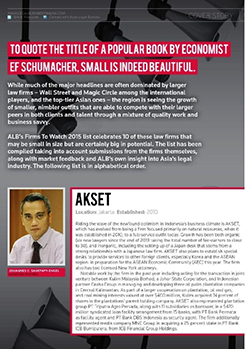
Asian Legal Business February 2015 issue: ALB Firms To Watch 2015
AKSET listed on ALB’s Firm’s To Watch 2015, a list celebrates 10 of law firms that are certainly big in potential, on Asian Legal Business February 2015 issue.

Asian Legal Business February 2015 issue: ALB Firms To Watch 2015
Restrictions on Expatriates in Mining Sector
Since the issuance of the Labor Law (Law No. 13 of 2003), the Minister of Manpower (the “MOM”, formerly the Minister of Manpower and Transmigration—the “MOMT”) has issued 12 regulations regulating or re-regulating positions that are open for expatriates in 12 specific business sectors and one regulation on restricted positions in all business sectors, as set out in MOMT Decree No. 40 of 2012 on Certain Positions Restricted for Expatriates (“MOMT Decree No. 40/2012”).
Positions restricted under MOMT Decree No. 40/2012 are as follows:

* Under the Manpower Law, expatriates are not permitted to occupy positions “in charge of personnel.” MEMR has on at least one occasion interpreted this restriction to mean that all companies must have at least one Indonesian Director, because if not, an expatriate director will be indirectly in charge of personnel issues. We are of the view that this is an overly broad interpretation, which does not reflect the position of the MOM itself. In practice, as long as human resources functions are properly delegated to an Indonesian HR Manager, this should be sufficient to satisfy the manpower requirements.
**The reference to “Chief executive officer” created confusion for employers because many of them in practice use the term “Chief executive officer” to describe positions like President Director or similar top management in their organizations. Although the MOMT never issued any official clarification or circular letter on this, the Minister at the time went on record stating that as long as a chief executive officer did not perform personnel or other restricted functions, the position could be occupied by an expatriate.
Specifically for the mining sector, there have been no new regulations on positions for expatriates since MOMT Decree No. KEP-61/MEN/1983 on Limitation of Expatriate Usage in Mining and Energy Sector, Sub Sector of General Mining (“MOMT Decree No. 61/1983”), which remains in effect pending proposed amendments that we learned about in November 2014.
The following table sets out the positions that are open or closed to expatriates under MOMT Decree No. 61/1983:

We understand that there is a plan that the MOM will issue a new regulation on positions that are restricted and open for expatriates in the mining sector as follows:

Until the new regulation is issued, positions for expatriates in mining shall still refer to MOMT Decree No. 61/1983 and MOMT Decree No. 40/2012.
In accordance with Government Regulation No. 57 of 2014 on Development, Management, and Protection of Language and Literature as well as Increasing the Function of Indonesian Language, expatriates will be required to be able to communicate in Indonesian prior to being employed in Indonesia. In practice we understand that this requirement has not yet been implemented.
February 11, 2015
Copyright © 2015 AKSET. All rights reserved.
Minister of Manpower Clarifies Statute of Limitation for Employee Claims
The Minister of Manpower (MOM) has finally issued a directive on the statute of limitations for employees to file claims for payments allegedly owed by employers, which was revoked in September 2013, when the Indonesian Constitutional Court granted judicial review of Article 96 of the Manpower Law (Law No. 13 of 2003).
On January 17, 2015, the MOM issued Circular Letter No. 1/MEN/I/2015, which interprets the Constitutional Court’s decision to mean that there is no statute of limitations whatsoever for employees to claim against their employers in respect of the employment relationship.
For purposes of implementation, the Circular Letter sets an absolute bar on claims for events prior to September 19, 2011, which is two years before the date of the Constitutional Court decision, because before Article 96 was stricken, the statute of limitations on employee claims was two years after the right to payment arose.
Although the unlimited time for employees to file claims poses a serious challenge for employers going forward, at least for now, they will not be vulnerable to an onslaught of claims relating to the distant past. In addition, the Indonesian Civil Code (ICC) and other manpower laws and regulation may provide specific statutes of limitation which remain in force, for example ICC Article 1603t, which provides a one year statute of limitation for claims of wrongful termination.
To reduce the risk of unexpected litigation, we recommend obtaining a full waiver of claims from outgoing employees whenever employment is discontinued, whether by mutual agreement, resignation, or termination in the Industrial Relations Court.

Asian Legal Business January 2015 Edition – Year in 2015: Indonesia
Abadi Abi Tisnadisastra’s view on Asian Legal Business January 2015 Edition – Year in 2015: Indonesia

Asian Legal Business January 2015 Edition – Year in 2015: Indonesia
New Regional Government Law Consolidates Authority to Issue Mining Licenses in Central and Provincial Governments
Law No. 23 of 2014 regarding Regional Governance (2014 Regional Law) was enacted on October 5, 2014, to redefine, yet again, relations between, and authorities among, the Central, Provincial and Local Governments, as previously stipulated under Law No. 32 of 2004 on Regional Governance, as lastly amended by Law No. 12 of 2008.
The 2014 Regional Law contains detailed provisions on the relationship between the different levels of government and clear-cut divisions of authority between the Central and Regional Governments over 32 different sectors, including:
- Food
- Transportation
- Cooperatives, and micro, small and medium enterprises
- Investment
- Marine and fishery affairs
- Agriculture
- Forestry
- Energy and mineral resources
- Trade and industry
♦ IMPACT ON THE MINING SECTOR
The Appendix of the 2014 Regional Law divides authorities between the Central Government and Provincial Governments over mining. The most notable change is that Regency and City Governments are now excluded from having any authority over mining activities. Under the 2009 Mining Law, domestic mining companies operating in a single Regency obtained their IUP from the Regent; this licensing authority now belongs to the Governor. Foreign-owned (PMA) mining companies continue to be under the jurisdiction of the Central Government, as was the case under existing mining regulations.


♦ GOVERNMENT CONFIRMS IMPACT ON LOCAL GOVERNMENT
On December 16, 2014, the Directorate General of Minerals and Coal of the MEMR held a public forum to socialize the new law, in which they clarified that after issuance of the Regional Law, the Regency and City Governments are no longer authorized to issue IUP. Such Governments will continue processing IUP applications that were submitted before the enforcement date of the 2014 Regional Law (October 2, 2014) and will have authority to issue technical recommendations for IUP that will be granted in the future by the Provincial and Central Governments.
Local governments also retain supervisory authority over all licenses issued by them prior to the 2014 Regional Law, until expiration.
However, pending the issuance of implementing regulations by the Ministry of Home Affairs and MEMR or the transfer of documentation from the Regency and City Governments to the Provincial Government (or to the MEMR, for PMA companies), the Regency and City Governments should remain authorized in issuing approvals for extending and upgrading IUP.
The Regional Law requires that such a transfer must be completed within two years, by October 2016.
- CONCLUSION
There are significant differences between the 2014 Regional Law and the 2009 Mining Law, although as previously mentioned many of the provisions contained in the 2014 Regional Law were already in place pursuant to the most recent implementing regulations of the Mining Law. We have been advised that an upcoming amendment to the 2009 Mining Law will rectify many of the inconsistencies.
January 14, 2015
Copyright © 2015 AKSET. All rights reserved.


OJK RE-REGULATES MULTI - FINANCE SECTOR
On November 19, 2014, the Financial Services Authority (Otoritas Jasa Keuangan – “OJK”) issued 20 regulations governing banking, capital markets, and non-bank financial institutions. Four of the regulations relate to the multi-finance sector (considered a non-bank financial industry), which was previously regulated by the Ministry of Finance (“MOF”).
The new regulations cover:
- Arrangement of Multi-Finance Company Business (Reg. No. 29/POJK.05/2014)
- Licensing and Organization of Multi-Finance Companies (Reg. No. 28/POJK.05/2014)
- Good Corporate Governance for Multi-Finance Companies (Reg. No. 30/POJK.05/2014)
- Arrangement of Sharia Multi-Finance Business (Reg. No. 31/POJK.05/2014)
(collectively, “New Regulations”)
The multi-finance sector was previously regulated under Presidential Regulation No. 9 of 2009 on MultiFinance Institutions and MOF Regulation No. 84/PMK.012/2006 on Multi Finance Companies (“Old Regulations”). The New Regulations elaborate more detailed requirements in response to the rapid growth in the multi-finance sector in recent years.
♦ ARRANGEMENT OF MULTI-FINANCE BUSINESS
OJK 29/2014 defines a multi-finance company as an entity that finances the procurement of goods or services. Permitted business activities include: (i) investment financing; (ii) working capital financing; (iii) multipurpose financing; and/or (iv) any other financing business subject to OJK approval. Investment, working capital and multipurpose financing can be provided in various ways (subject to the regulations for each type), such as finance leasing, sale and leaseback, and factoring.
Unlike the Old Regulations, which classified multi-finance company operations as leasing, factoring, credit card, and consumer finance, the New Regulations allow a multi-finance company to provide operating leasing and fee-based activities (subject to OJK reporting obligations). Fee-based activities include marketing financial services products, such as mutual funds and micro-insurance.
Multi-finance companies are prohibited from engaging in banking, issuing promissory notes, or providing security, and they must maintain financial soundness at all times, including an equity ratio (comparison of adjusted capital and adjusted assets) of 10%, calculation of which will be further governed by OJK .
Several general requirements under the New Regulations are the same as under the Old Regulations:
- maintaining a receivables to assets ratio of at least 40%
- minimum equity of a multi-finance company in the form of PT is Rp100 billion and in the form of
cooperative is Rp50 billion - submitting monthly reports and audited annual financial report to OJK
♦ LICENSING AND ORGANIZATION
A multi-finance company must be established in the form of a cooperative or a limited liability company (PT), in which the shareholding can be owned by (i) Indonesian citizens; (ii) Indonesian business entities; (iii) Indonesian legal entities; (iv) foreign entities or foreign institutions (v) Indonesian state government; and/or (vI) regional government. The maximum foreign shareholding (either direct or indirect) is 85% of the paid-up capital. Wording relating to financing (pembiayaan) must be included in the name of the company.
In order to commence operations, a multi-finance company must apply for a Multi-Finance Business License from OJK (“OJK License”). The application review period has been reduced from 60 days (under the Old Regulations) to 30 days (under the New Regulations). Upon issuance of the OJK License, the company must commence operations within two months.
A multi-finance company’s organizational structure must at least have the following functions: (i) administration and bookkeeping; (ii) marketing, financing feasibility analysis and collection; (iii) risk management, including internal control; and (iv) application of know-your-customer principles.
♦ GOOD CORPORATE GOVERNANCE
Multi-finance companies must follow basic principles of good corporate governance, including transparency, accountability, responsibility, independence and fairness. A guideline and standard operating procedure must be made in order to implement these principles.
In addition, the primary parties of the multi-finance company, i.e., controlling shareholders, directors, commissioners, foreign manpower, and sharia supervisory body (if applicable) are required to pass the OJK Fit & Proper test prior to holding their positions. Provisions on the Fit & Proper test come from OJK Regulation No. 4/POJK.05/2013 on Fit and Proper Test for the Primary Parties of Insurance Companies, Pension Funds, Multi-Finance Companies and Underwriting Companies.
A multi-finance company having assets of more than Rp200 billion to have, among others: (i) at least three Directors; (ii) two Commissioners and at least one Independent Commissioner; (iii) audit committee; (iv) a function assisting the Commissioners in monitoring and ensuring the effectiveness of the internal control system and the implementation of internal and external auditors’ duties. For multi-finance companies having assets less than Rp200 billion, the New Regulations only require them to have at least two Directors.
Multi-finance companies having foreign ownership (whether direct or indirect) must have at least 50% Indonesia-citizen directors. In the event there is an odd number of directors, the number of Indonesian-citizen directors must be greater than the number of foreign-citizen directors.
♦ SHARIA FINANCING BUSINESS
One of the substantial developments is a new separate regulation on sharia multi-finance business. General provisions on company establishment, equity requirements and restrictions are essentially the same as for general multi-finance companies; nevertheless, sharia-based principles are provided in details under the New Regulations, especially as relates to operations of sharia financing companies.
December 10, 2014
Minimum Wage for DKI Jakarta Province Increased to Rp2,700,000 for 2015
The Governor of DKI Jakarta has determined a new Provincial Minimum Wage (“UMP”) that applies to every employer in DKI Jakarta, except those covered by special sectoral minimum wages. The UMP is stipulated under Governor of DKI Jakarta Regulation No. 176 of 2014 regarding Provincial Minimum Wage for 2015, dated November 17, 2014 (“Governor Regulation”).
Based on the Governor Regulation, the UMP for DKI Jakarta Province in 2015 will be Rp2,700,000/month, starting from January 1, 2015. This is an increase of almost 11% over the 2014 UMP of Rp2,441,301/month, which was stipulated under Governor of DKI Jakarta Regulation No. 123 of 2013 regarding ProvincialMinimum Wage for 2014.
The increase is lower than that for surrounding regions, such as Banten and Jawa Barat, where the UMP will increase almost 21% and 18%, respectively. In the event an employer believes it is unable to pay the new UMP, the employer may request a suspension from the relevant manpower service office no later than 10 (ten) days before the UMP becomes effective on January 1, 2015.
December 1, 2014