
BKPM Issued New Regulation on Guidelines on the Provision of Business Licensing Services through OSS System
To improve the implementation of the licensing services provided through Online Single Submission (“OSS System”), on April 1, 2020, the Capital Investment Coordinating Board (Badan Koordinasi Penanaman Modal or “BKPM”) issued the BKPM Regulation No. 1 of 2020 on Guidelines for the Implementation of Integrated Electronic Business Licensing Services (“Regulation 1/2020”).
This Regulation 1/2020 was also issued to implement Article 94 (1) of Government Regulation No. 24 of 2018 dated June 21, 2018 on Electronic Integrated Business Licensing Services (“GR 24/2018”) and Presidential Instruction No. 7 of 2019 dated November 22, 2019 on Acceleration of the Ease of Doing Business as well as to set out the norms, standards, procedures, and criteria of the issuance of the licenses in OSS system 1.1, for the already existing BKPM regulations regarding OSS.
As this Regulation 1/2020 covers broad and technical aspects of the OSS System 1.1, we set out below the key points under Regulation 1/2020.
- Investment Value
Article 6 of Regulation 1/2020 now requires a foreign investment company (Penanaman Modal Asing or “PMA”) to fulfil the amount of total investment value of more than Rp10,000,000,000 (ten billion Rupiah), excluding land and buildings. The foregoing applies for each business activity (5-digit KBLI), per relevant project. Furthermore, the amount of issued capital must be equivalent to the relevant paid-up capital and should amount to at least Rp2,500,000,000 (two billion five hundred million Rupiah).
In addition to the above, Regulation 1/2020 provides detailed total amount of investment value for certain PMA companies that engage in the following business sectors:
- For wholesale business activities, the total investment value shall be more than Rp10,000,000,000 (ten billion Rupiah) excluding land and buildings, for each 2-initial digits of the KBLI;
- For food and beverage services business activities (subject to Negative Investment List), the total investment value shall be more than Rp10,000,000,000 (ten billion Rupiah), excluding land and buildings, within one regency/municipality; and
- For construction business activities (subject to Negative Investment List), the total investment value shall be more than Rp10,000,000,000 (ten billion Rupiah), excluding land and buildings, for each construction activity.
Although the Regulation 1/2020 is silent on when the realization of such investment should be made by PMA companies, as prescribed under Article 6(5) of BKPM Regulation No. 6 of 2018 dated July 20, 2018 on Guidelines and Procedures of Investment Licensing and Facility as lastly amended by BKPM Regulation No. 5 of 2019 dated July 29, 2019 on Amendment of BKPM Regulation No. 6 of 2018 dated July 20, 2018 on Guidelines and Procedures of Investment Licensing and Facility, such realization shall be performed within one year as of the issuance of the business license.
- Main and Supporting Project
Article 15 of Regulation 1/2020 now provides that business actors may have a supporting project, provided that (i) such supporting project is outside the business classification stated in its business license, (ii) such project serves as a supporting activities to the main project, and (iii) such project does not generate profit.
The supporting project shall be required to obtain Business Licenses and/or Commercial and Operational License as applicable.
- New Function of Business Identification Number
With the issuance of Regulation 1/2020, the Business Identification Number (Nomor Induk Berusaha or “NIB”) now also functions as evidence of initial submission of Mandatory Manpower Report (Wajib Lapor Ketenagakerjaan or “WLTK”) for the company that has not submitted its WLTK and has not previously obtained NIB.
- Category of Business License and Commercial and Operational License
Regulation 1/2020 has categorized types of Business and Commercial and Operational License into several classification as follow.
| Type | Business Licenses | Description |
| 1 | Business License or Commercial and Operational Licenses without Commitment requirement | Licenses that are effective immediately after the issuance by OSS System |
| 2 | Business License or Commercial and Operational Licenses with technical requirement | Licenses that are issued priorly by the OSS System, but are not effective until the applicable requirements are fulfilled |
| 3 | Business License or Commercial and Operational Licenses with fee requirements | |
| 4 | Business License or Commercial and Operational Licenses with technical and fee requirements |
- Representative Office Registration through OSS System
Under Regulation 1/2020, the OSS System also accommodates the application for the registration of Foreign Trade Company Representative Office (Kantor Perwakilan Perdagangan Asing), Foreign Construction Services Companies (Badan Usaha Jasa Konstruksi Asingi), Franchise Business, Futures Trade, and Administrative Branch Office.
- Merger of Companies
In the event of merger, the surviving company may now request to merge the business licenses of the ceased company into the surviving company. A merger should be implemented in accordance with a deed of merger which has obtained a prior approval from the Minister of Law and Human Rights. Once the relevant deed of merger data has been submitted, the OSS system will then issue a business license for the merger.
Further, the surviving company shall comply and satisfy any commitment set forth in business license and/or commercial and operational License of the merging company, in accordance with the prevailing laws and regulations.
- Submission During OSS Force Majeure Situation
In the event where OSS System is unable to function due to force majeure, the submission and/or administrative services for investment may be done manually, rather than through the system. The force majeure situation shall be determined by the Head of BKPM. Any data and information that are processed during the force majeure situation shall be uploaded into the OSS System by the Business Actor after the end of the force majeure situation.
- Transitional Provision
By the effective date of Regulation 1/2020:
- The provisions set forth within the existing principle license, investment registration, investment licenses, business license commercial or operational license remain valid as long as there is no conflict or not regulated specifically by Regulation 1/2020;
- Investment Value shall not be applicable to PMA Company that obtained a valid investment licenses prior to the enactment of GR 24/2018, as long as there is no change of business activities;
- Business actors shall obtain NIB, regardless of the still-valid TDP, API, and Customs access; and
- Any application relating to NIB, new business license, or commercial or operational license shall be carried out through OSS System.
May 13, 2020
Copyright © 2020 AKSET. All rights reserved.

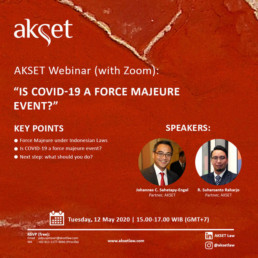
AKSET Webinar: Is Covid-19 a Force Majeure Event?
AKSET presents its first webinar with the topic Force Majeure related to Covid-19 outbreak. The webinar will be presented by our partners, Mr. Johannes Sahetapy-Engel and Mr. Suharsanto Raharjo, from our Litigation and Employment practice.
We believe this presentation will be useful for every business actors following the Covid-19 outbreak. The discussion will not only from theoretical but also from practical perspective as well.
Held on:
Tuesday, 12 May 2020
Time: 15.00 - 17.00 WIB (GMT+7)
For registration and information, please contact:
Email: pdpuspitasari@aksetlaw.com
Whatasapp: +62 812-1177-9060 (Priscilla)


Indonesian Government Introduces New and Integrated Submission Procedure for Companies’ Annual Financial Report
On March 19, 2020, the Minister of Trade (“MOT”) issued MOT Regulation No. 25 of 2020 on Annual Company Financial Reports (“MOT Reg. 25/2020”). MOT Reg. 25/2020 revokes the previous regulatory framework stipulating the annual financial report submission, i.e., Minister of Industry and Trade Decree No. 121/MPP/Kep/2/2002 dated February 25, 2002 (“Decree 121/2002”) and has entered into force on the date of its promulgation.
MOT Reg. 25/2020 sets forth a new procedure for business entities (that fulfill certain criteria to submit their annual financial reports to MOT) in submitting their annual financial reports based on the original requirement under Decree 121/2002. This new procedure is in line with the Indonesian Government’s intention to establish seamless submission of licenses and compliances process into the integrated Online Single Submission (“OSS”) system.
- SUBMISSION REQUIREMENT
MOT Reg. 25/2020 requires Companies to submit Annual Financial Report (“LKTP”) to the Ministry of Trade through the Directorate General of Domestic Trade (“Directorate General”). Companies under the MOT Reg. 25/2020 are defined as any type of business with permanent and continuous activities having the aim to obtain profit, undertaken by individuals or business entities in the form of legal or non-legal entities, as well as being established and domiciled within the territory of the Republic of Indonesia.
Based on the definition of Companies as above, MOR Reg. 25/2020 requires all Companies with the following status to submit LKTP:
- Limited Liability Companies (or PT) having fulfilled either one of these criteria:
- Being a Publicly Listed Company;
- Having a line of business in managing public funds;
- Issuing a letter of acknowledgement of indebtedness;
- Having total assets of at least Rp25,000,000,000 (twenty five billion Rupiah); or
- Being a debtor required to submit annual financial report to banks for audit purpose;
- Foreign Companies, having a domicile and running its business in the territory of the Republic of Indonesia, including their branch offices, auxiliary offices, subsidiary companies, agents, and representatives of such companies having authority to enter into agreements;
- State-Owned Companies (PERSERO), Public Service Companies (PERUM), and Region-Owned Companies (“Companies”).
Previously, Decree 121/2002 only required submission of LKTP to be conducted by head offices. MOT Reg. 25/2020 seems to broaden the definition and try to clear some uncertainty on categories of companies being required to submit LKTP.
Similar with Decree 121/2002, Companies are required to submit its LKTP after it has been audited by a public accountant and approved by the General Meeting of Shareholders or any of the authorized company organ based on laws and regulations. Submission of LKTP must be conducted at the latest six months after the financial year of a Company ends.
- THE NEW AND INTEGRATED SUBMISSION SYSTEM
Under MOT Reg. 25/2020, Companies having obtained their Business Identification Number (“NIB”) are required to submit their LKTP online through the Licensing Information System (“SIPT”) which has been integrated to the OSS system. In turn, the Directorate General will issue an LKTP Submission Receipt (“LKTP Receipt”) within 5 (five) days of the LKPT being duly submitted. In the previous regime, the Companies had to perform submission of their LKTP physically to the Directorate of Business Development and Company Registration at the MOT.
Furthermore, MOT Reg. 25/2020 also acknowledges LKTP submission required by other institutions. Therefore, if a Company has submitted its LKTP to: (i) regulators, (ii) authorities regulating submission of financial reports, (iii) Minister of State-Owned Enterprises, and/or (iv) Minister of Finance, the Company will be deemed to have submitted its LKTP. Companies will be required to submit the submission receipt through SIPT in order to obtain the LKTP Receipt.
- THE OPENNESS AND TRANSPARENCY OF COMPANIES’ FINANCIAL INFORMATION
The LKTP data submitted by the Companies constitutes open information and accessible to the public by submission of written request and payment of certain fees pursuant to regulations. The foregoing is also applicable to any ministerial body and/or state institution without the requirement to pay any fees.
- ADMINISTRATIVE SANCTIONS
Any incompliance with respect to the obligation to submit LKTP will be subject to administrative sanction of 3 (three) written warnings, each given with a period of 14 (fourteen) days in between each warning. Failure to comply with such warnings will result in revocation of business license for the Companies operating in trade sector, or recommendation of revocation of business license for the Companies with non-trade sector businesses.
Furthermore, if the Companies fail to submit LKTP in a complete and valid manner, the Companies will also be subject to administrative sanction of 3 (three) written warnings, each given with a period of 14 (fourteen) days in between each warning and followed by the revocation of the LKTP Receipt. Should the Companies fail to correct the submission within 14 (fourteen) days after the LKTP Receipt revocation, the Director General will impose an administrative sanction of license revocation or recommendation of license revocation, as relevant.F
April 27, 2020
Copyright © 2020 AKSET. All rights reserved.
Are INGOs’ Operations Exempted From PSBB?
- On Large-Scale Restriction Measures
Due to the current outbreak of the novel corona virus disease (“Covid-19”), the Government of Indonesia recently implemented the Large-Scale Social Restrictions (Pembatasan Sosial Berskala Besar or “PSBB”) with the issuance of the Minister of Health (the “MOH”) Regulation No. 9 of 2020 dated April 3, 2020 on Guidelines for Large-Scale Social Restrictions for the Acceleration of the Management of the Covid-19 (“Regulation 9/2020”).
Law No. 6 of 2018 dated August 8, 2018 on Health Quarantine (“Law 6/2018”) defines the PSBB as the restriction of certain activities of the residents in an area suspected to be infected by a disease (in our case, the Covid-19) and/or an area that is contaminated to a certain degree, in order to prevent the possibility of the spreading of the disease or the contamination (in this case, the Covid-19).
Following Regulation 9/2020 and MOH Decree No. HK.01.07/MENKES/239/2020, the Regional Government of DKI Jakarta Province implements the PSBB measures within the territory of DKI Jakarta based on the Governor Regulation No. 33 of 2020 dated April 9, 2020 on the Implementation of Large-Scale Social Restrictions for the Management of the Covid-19 in the DKI Jakarta Province (“Regulation 33/2020”). Under the DKI Jakarta Governor Decree No. 380 of 2020 dated April 9, 2020 on the Enforcement of the Implementation Large-Scale Social Restrictions for the Management of the Covid-19 in the DKI Jakarta Province (“Decree 380”), the PSBB is effective as of April 10, 2020 until April 23, 2020. The PSBB may be extended by the DKI Jakarta Governor for 14 (fourteen) days. Under the DKI Jakarta Governor Decree No. 412 of 2020 dated April 22, 2020, the PSBB in Jakarta is now extended until May 7, 2020 and shall be extended until May 21, 2020 in the event that there are still new cases of Covid-19.
The implementation of the PSBB includes: (i) schools and workplaces closure; (ii) restrictions of religious activities; (iii) restrictions of activities at public places or facilities; (iv) restrictions of activities in social and culture; (v) restrictions of modes of transportation; and (vi) restrictions of other activities specifically related to defense and security. Accordingly for the DKI Jakarta Province, under Regulation 33/2020, all “non-essential” businesses are required to temporarily suspend their activities at the workplaces. Regulation 33/2020 further elaborates that during the workplace closure, an employer shall replace the working process from workplace or offices to working from home.
There are certain categories that constitute “essential” businesses which are exempted from the workplace closure under Regulation 33/2020. One of the businesses which is exempted from the workplace closure is local and international social organizations (organisasi kemasyarakatan) that engage in the disaster and/or social sectors. In other words, local and international social organizations that engage in the disaster and/or social sectors whose offices are located within the DKI Jakarta Province may continue their operations, subject to certain protocols elaborated below.
- Workplace Closure Exemption for International Non-Governmental Organizations
Please note that Regulation 33/2020 does not define or determine the scope of (i) local and international social organizations, and (ii) the disaster and/or social sectors.
Social organizations (organisasi kemasyarakatan) are defined in Law No. 17 of 2013 dated July 22, 2013 on Social Organizations as lastly amended by Government Regulation In Lieu of Law No. 2 of 2017 dated July 10, 2017 on Amendment of Law No. 17 of 2013 on Social Organizations (“Law 17/2013”) as organizations which are established and formed voluntarily by the society based on common aspiration, wills, needs, interests, activities, and objectives to participate in the development to achieve the objective of Republic of Indonesia based on Pancasila. Law 17/2013 specifies that social organizations shall be voluntary, social, independent, non-profit, and democratic in nature.
With regard to foreign social organizations, Government Regulation No. 59 of 2016 dated December 6, 2016 on Social Organizations Established by Foreign Nationals (“GR 59/2016”) clarifies that foreign social organizations shall consist of:
- A foreign foundation, or a similar form, headquartered in a country that has diplomatic relations with Indonesia. The foreign foundation may be (a) an International NGO to implement its activities with its own funding, or (b) an implementing agency to implement a certain program on behalf of a foreign donor or any development agency; and
- A foundation (yayasan) (i.e., the Foreign Foundation) established under Indonesian laws by any foreign party (an individual or an entity) with or without any Indonesian party (an individual or an entity).
Foreign social organizations noted above are required to obtain principal permits issued by the Ministry of Foreign Affairs and the operational permits. Based on the above, it appears that international social organizations referred to in Regulation 33/2020 are foreign social organizations under GR 59/2016.
Let us now discuss the definition of disaster and social sectors. Pursuant to Article 1 point 1 of Law No. 24 of 2007 dated April 26, 2007 on Management of Disasters, a disaster is defined as an event or a series of events that is threatening and disturbing the community life and livelihood, caused by natural and/or non-natural as well as human factor which results in human fatalities, environmental damage, loss of material possession, and psychological impact. On the other hand, we note that there is no specific definition on the word of “social” under the laws. In this regard, we refer to the definition of “social” provided by the official dictionary of the Ministry of Education and Culture which defines social as something related to the society. In practice, we understand that social sector involves any activities for the interest of human. Therefore, such definition may be interpreted in a broad manner.
- Further Provisions on Exemption of Workplace Closure
Based on the above, foreign social organizations in DKI Jakarta Province may open their offices in Jakarta as they are eligible for the exemption of workplace closure under Regulation 33/2020. In continuing the operation of their offices, INGOs that are exempted from the workplace closure are subject to certain health protocols set out in Regulation 33/2020.
Further to the above, the Department of Manpower, Transmigration, and Energy (Dinas Tenaga Kerja, Transmigrasi, dan Energi or “Disnakertrans”) of DKI Jakarta Province recently issued Decree No. 837 of 2020 dated April 17, 2020 on Technical Guidelines for Implementation of Large-Scale Restriction (PSBB) on Working Activity in Workplace (“Decree 837/2020”). In general, Decree 837/2020 provides the measures regarding technical implementation of the PSBB on working activity and the reporting requirement for offices/workplaces that are exempted from the workplace closure.
Any violation of the above may subject the INGOs to sanctions under prevailing laws and regulations. Decree 837/2020 is effective for the period of implementation of the PSBB is effective in the DKI Jakarta Province.
April 27, 2020
Copyright © 2020 AKSET. All rights reserved.
Precautionary Steps Taken to Maintain the Stability of Indonesian Financial Systems During COVID-19
The Novel Coronavirus Disease (“COVID-19”) pandemic has caused the country’s economic growth to slow down and the financial system to worsen. As an effort to maintain stability of the financial system and the national economy, the Government of Indonesia issued the Government Regulation in lieu of Law No. 1 of 2020 dated March 31, 2020 on the State Financial and the Financial System Stability Policies in Relation to the Handling of the Coronavirus Disease 2019 (COVID-19) Pandemic and/or to Overcome Threats that are Potentially Harmful to the National Economy and/or the Financial System Stability (“Perppu 1/2020”)
Perppu 1/2020 sets out policies which, among others, expand the authority of the relevant authorities in Indonesia that supervise and make policies to create the safety net for the financial and monetary conditions of the country, including, KSSK, BI, OJK, and LPS (all terms as defined below).
In this Newsflash, we focus on the financial system stability policy set out under Perppu 1/2020. Please visit our website for our Newsflash with regard to the tax policy set out under Perppu 1/2020 that we have discussed separately.
- FINANCIAL SYSTEM STABILITY COMMITTEE’S LEGAL IMMUNITY
Initially, the Financial System Stability Committee (Komite Stabilitas Sistem Keuangan — “KSSK”) was formed under Law 9/2016 (defined below). KSSK consists of the Minister of Finance, the Governor of Bank Indonesia (“BI”), the Chairman of the Board of Commissioners of the Financial Services Authority (Otoritas Jasa Keuangan — “OJK”) and the Chairman of the Board of Commissioners of Indonesian Deposit Insurance Corporation (Lembaga Penjamin Simpanan — “LPS”), each of them represents their respective institutions to supervise, control and handle any Systemic Bank issues during both normal or financial crisis situations.
Under Perppu 1/2020, KSSK’s authority under Law No. 9 of 2016 on Prevention and Control of Financial System Crisis effective on April 15, 2016 (“Law 9/2016”) is expanded. Under Perppu 1/2020, KSSK is now authorized to determine any scheme for incentives from the Government to tackle issues in financial institutions and issues with regard to the stability of the financial systems that threaten the national economy.
Article 27 of Perppu 1/2020 provides one interesting point. This provision grants legal immunity to KSSK’s members and its member institutions in performing the tasks prescribed in Perppu 1/2020 in good faith regardless of the amount of expenditure spent for the actions stipulated under Perppu 1/2020. In fact, under Perppu 1/2020 such expenditure will not be considered state’s loss. Therefore, no civil or criminal legal action may be conducted against KSSK’s decision. Any decision or action by KSSK will neither be considered an administrative court object of assessment. We note that this provision is being challenged at the Constitutional Court.
Perppu 1/2020 further grants each of KSSK’s member institutions various forms of authority intended to help maintain the stability of Indonesia’s financial system.
- BI REGAINS SOME CRUCIAL AUTHORITIES
Perppu 1/2020 now grants BI several authorities that were previously revoked by Law 9/2016, as follows:
- to provide a short term loan or funding to banks based on the sharia principles, both to Systemic or non-Systemic Banks based on BI and OJK’s assessment of banks’ soundness level and solvability — assessed by OJK, as well as banks’ collateral sufficiency and repayment ability — assessed by BI and OJK;
- to provide a special emergency liquidity loan (pinjaman likuiditas khusus) to a Systemic Bank that does not meet the requirement for the foregoing short term loan and or funding with the approval from KSSK; and
- to buy Government Bonds (Surat Utang Negara — “SUN”) and/or Government Sharia Bonds (Surat Berharga Syariah Negara “SBSN”) from the primary market issued for particular purpose, specifically in relation to COVID-19 pandemic.
In addition to the foregoing, Perppu 1/2020 allows BI to do the following actions:
- to purchase or repurchase (repo) of government securities owned by LPS to fund the cost of handling solvability issues for Systemic or non-Systemic Banks;
- to regulate the obligation to receive and use foreign exchange for residents including provisions regarding the foreign exchange’s delivery, repatriation, and conversion in order to maintain macroeconomic and financial system stability; and
- to provide funding to corporate or private sectors by repurchasing (repo) SUN or SBSN owned by corporate or private sector via banks.
Previously during the economic crisis in 2008, Bank Century’s bailout by BI cost the Government trillions of Rupiah. Learning from this, the Government had limited BI’s authority in giving incentives for banks. BI was only allowed to provide short term loans and or funding for Systemic Banks with a very high threshold. In addition to receiving such funding from BI, Systemic Banks must also provide high-quality collateral in the form of high-rating securities that are liquid or loan assets rated as Current. Further, BI used to only be allowed to purchase or conduct repo transactions of Bovernment bonds owned by LPS. Also, buying SUNs and SBSNs from the primary market was prohibited.
- MORE POWER GRANTED TO OJK
Perppu 1/2020 provides a more significant role to OJK. On top of holding the crucial role in deciding to provide short term loans or funding for banks, OJK is allowed to give written orders to financial institutions to perform mergers, consolidations, acquisitions, integrations, and/or conversions.
In respect of the capital markets, OJK is authorized to determine exemptions for certain parties from performing the disclosure obligation as a part of the effort in preventing and handling the financial crisis. Further, OJK may enact regulations concerning the use of information technology for holding General Meetings of Shareholders or other meetings that are mandatory for financial service business actors. This policy is also in line with policies issued by OJK on similar issues under OJK Circular Letter No. S-92/D.04/2020 dated March 18, 2020 on the Relaxation on the Reporting Obligations and the Implementation of General Meetings of Shareholders.
- LPS’ EXTENSION OF AUTHORITY
Perppu 1/2020 also expands LPS’ authority during the COVID-19 pandemic by allowing LPS to:
- undertake joint preparation by conducting exchange information and/or conduct joint inspection with OJK against banks that are suspected to have solvability issues;
- take the following actions:
- perform sell or conduct repo of Government bonds to BI,
- issue bonds,
- receive loans from another party, and/or
- receive loans from the Government,
in case LPS is considered to have liquidity issues in handling failing banks;
- decide to save or not to save failing banks that are non-Systemic by considering, among others, the economic condition, availability or appetite of investors, banks’ complexity of issues and the efficacy in handling those issues, including but not limited to the consideration on the least cost test; and
- regulate and implement deposit insurance policies for a group of customers based on the source of fund and/or implement such policy with regard to a particular savings portfolio with a predetermined insured amount, that will be regulated in a Government Regulation.
***
Perppu 1/2020 is valid as of March 31, 2020. However, in accordance with the Constitution and applicable laws, the House of Representatives (Dewan Perwakilan Rakyat or “DPR”) will decide on its next hearing whether to approve Perppu 1/2020 into a law. If the DPR decides to cancel Perppu 1/2020, then Perppu 1/2020 will immediately be cancelled.
April 24, 2020
Copyright © 2020 AKSET. All rights reserved.
Minister of Finance Further Regulates Approvals for Tax Allowances
On February 11, 2020, the Minister of Finance (the “Minister”) enacted Minister Regulation No. 11/PMK.010/2020 of 2020 dated February 11, 2020 on the Implementation of Government Regulation No. 78 of 2019 on the Income Tax Allowances for Investments in Certain Industries and/or Certain Regions (the “Minister Regulation”). The Minister Regulation revokes the Minister Regulation No. 89/PMK.010/2015 of 2015 dated April 28, 2015 on Procedures to Impose Income Tax Concessions for Investment in Certain Field and/or Regions, Including Transfer of Assets and Sanctions for Domestic Taxpayers Receiving Concessions. The Minister Regulation acts as an implementing framework of Government Regulation No. 78 of 2019 dated November 13, 2019 on Granting of Income Tax Allowance for Investments in Certain Industries and/or Regions (“GR 78”).
As elaborated on our Newsflash concerning GR 78, GR 78 encompasses the provisions on (i) forms for the granting of the income tax allowances (the “Tax Allowance”), (ii) requirements for the granting of the Tax Allowance to corporate taxpayers (the “Taxpayers”), and (iii) requirements to apply for and obtain the Tax Allowance. Please find below the salient points of the Minister Regulation.
v Requirements and Procedures for Determination of Tangible Fixed Asset Values
The Minister Regulation re-addresses the requirements for tangible fixed asset as a basis for the calculation of the Tax Allowance set out in GR 78. In addition, the Minister Regulation stipulates that the relevant assets do not include tangible fixed assets acquired by way of operating lease or financial lease before the option right over such asset is executed.
Further, GR 78 provides that provisions on the procedure to determine tangible fixed asset will be further regulated in a Minister regulation, where in fact, the Minister Regulation assigns this matter to the Director General of Taxation (the “Director General”). Until now, the Director General has not issued the relevant regulation on this issue.
v Procedures for Applications to Obtain Tax Allowance
GR 78 sets out an updated list of the business activities that are eligible to apply for the Tax Allowance. The updated lists comprises 183 business sectors. GR 78 also introduces the simplified procedures for applying for and obtaining the Tax Allowance through the Online Single Submission (“OSS”) System.
According to the Minister Regulation, the OSS System will notify an applicant if its business activity is eligible to obtain the Tax Allowance. If the Taxpayer is eligible, it must submit the following requirements through the OSS System prior to the Commercial Production Starting Date:
a. a digital copy of the shareholder’s fiscal statement letter; and
b. a digital copy of the fixed asset’s details in the capital investment value plan.
Once the required documents have been completely submitted in the OSS System, the Minister will issue the decision to grant the Tax Allowance within 5 (five) business days since the receipt of documents.
v Utilization of Tax Allowance
The utilization of the Tax Allowance is subject to its form, as follows:
|
Form of Tax Allowance |
Utilization of Tax Allowance |
|
Deduction of net income by 30% of the investment value in the form of tangible fixed assets, including the land used for the main business activities, granted in 6 (six) years divided into 5% each year. |
A Taxpayer must apply in order to utilize this form of the Tax Allowance by applying through the OSS System. The Utilization of this Tax Allowance shall be stipulated by the Director General, subject to a field investigation. |
|
Accelerated depreciation over tangible fixed assets and accelerated amortization over intangible assets obtained for the investment, granted within certain period and tariff. |
The utilization of this form of Tax Allowance shall be conducted in accordance with the Income Tax Law. |
|
Income tax over the dividends paid to foreign Taxpayers other than permanent establishments in Indonesia at the rate of 10% (ten percent) or lower, subject to the applicable tax treaty. |
The utilization of this form of Tax Allowance shall commence as of the decision to approve the Tax Allowance is issued and shall expire when the Taxpayer no longer meets the requirements in the relevant decision. |
|
Compensation for losses suffered for more than 5 years but less than 10 years. |
A Taxpayer shall apply to the Director General through the OSS System in order to utilize this form of Tax Allowance. The Director General will issue the decision to compensate for losses after conducting the relevant field investigation. |
***
April 24, 2020
Copyright © 2020 AKSET. All rights reserved.
Recent Land Related Services due to the COVID-19 Outbreak
To implement series of instructions issued by the Government of the Republic of Indonesia as well as to prevent the spread of the Covid-19 in Indonesia, Minister of Agrarian Affairs and Spatial Planning/Head of National Land Agency (the “Minister”) issued Circular Letter No. 3/SE-100.TU.03/III/2020 dated March 20, 2020 on Land Services for the Prevention of the Spread of Corona Virus Disease 2019 (Covid-19) (“Circular Letter”). The Circular Letter was also issued to ensure and maintain the continuity of various land related services provided by the Land Offices (Kantor Pertanahan) in Indonesia during the Covid-19 outbreak. Such land related service procedures should be implemented by taking into account the actual condition of the relevant Land Office as well as policies implemented by the local government.
- Type of Land Related Services
During the Covid-19 outbreak, Land Offices will be providing the following land related services under certain conditions:
- Mortgage (i.e., registration, transfer, deletion (roya), change of name and/or data correction), Land Value Zone (Zona Nilai Tanah), certificate checking and/or Statement Letter of Land Registration (Surat Keterangan Pendaftaran Tanah, SKPT) services, shall be conducted electronically, which is basically in line with the provisions under (i) Minister of Agrarian Affairs and Spatial Planning/Head of National Land Agency Regulation No. 5 of 2017 dated April 25, 2017 on Electronically Land Information Services and (ii) Minister of Agrarian Affairs and Spatial Planning/Head of National Land Agency Regulation No. 9 of 2019 dated June 21, 2019 on Electronically Integrated Mortgage Services.
- Any other land related services (e.g., registration of data maintenance services and any other land information) will be conducted through Online Service Counter Application (Aplikasi Layanan Loket Online). The submission of the required documents will observe the schedule determines by the relevant Land Office.
- Any particular and urgent land related applications that are not yet available to be submitted through the Electronic Service and/or Online Service Counter Application, may be submitted physically to the relevant Land Office by observing the safety procedures.
- Any land related services which requires ground attendance and physical interaction will be ceased or limited depending on the actual situation on the ground.
- Any land activities (e.g., counseling, socialization, etc.) that involves society gathering will be ceased or limited depending on the actual situation on the ground.
- Effective Date
The Circular Letter was initially valid until April 5, 2020 and may be extended. As a further implementation, the Minister further issued Letter No. TU.03/554-100/III/2020 dated March 27, 2020 confirming that the Circular Letter is still valid.
- Implementation of the Land Related Services
Although the Minister through the Circular Letter has applying these procedures to the Land Offices (e.g., several land related services may be processed through an electronic system, physical application to Land Offices is still possible), it is important to note that there might be several Land Offices that are yet to implement these procedures. For instance, we understand that there are several Land Offices that are completely closed due to Covid-19 outbreak or do not have a fully integrated electronic system to support the relevant online land related services.
In order to avoid any interruption on the relevant land related service applications, it is recommended to coordinate with the Land Deed Official (Pejabat Pembuat Akta Tanah, PPAT) to ensure that the relevant land related services application is feasible to be conducted to the relevant Land Office during this Covid-19 outbreak.
***
April 23, 2020
Copyright © 2020 AKSET. All rights reserved.
Handling COVID-19 Outbreak in Construction Services Sector
On March 27, 2020, the Minister of Public Works and Housing (“MOPWH”) issued the MOPWH Instruction No. 02/IN/M/2020 on Protocol of Prevention of the Corona Virus Disease 2019 (COVID-19) Outbreak in Construction Service Works (the “MOPWH Instruction”). This MOPWH Instruction serves as a follow up to President Joko Widodo's direction on March 15, 2020 related to the mitigation efforts and determination of COVID-19 as an Extraordinary Event (Kejadian Luar Biasa or “KLB”) by the Minister of Health.
The MOPWH Instruction mainly revolves around the question on the continuity of construction work. The MOPWH Instruction stipulates that construction works may be suspended due to force majeure only if:
-
- it is considered high-risk due to its location being near the epicenter of the outbreak,
- there has been a confirmed case of COVID-19 and/or a worker having the status as patient under surveillance (Pasien Dalam Pengawasan or “PDP”) for COVID-19, or
- there has been a regulation from the local or central government suspending the construction work due to force majeure.
However, if construction work is deemed crucial to continue due to its nature and urgency in handling social and economic impacts from COVID-19, such work may continue if:
-
- it obtains an approval from the MOPWH,
- it implements the protocol of COVID-19 prevention with high discipline and submits a periodical report to the COVID-19 Prevention Task Force, and
- it must suspend its operation if a worker is found to be infected with COVID-19 or become a PDP.
Further, the MOPWH Instruction stipulates key policies as follows:
- The Scheme for Protocol on Prevention of COVID-19 in Construction Service Works
Based on the MOPWH Instruction, the following points are the protocol scheme that must be conducted during construction work:
-
- the establishment of a COVID-19 Prevention Task Force;
- the identification of potential risks of COVID-19 in the field;
- the provision of health facilities in the field; and
- the implementation of COVID-19 prevention in the field. For ease of reference, below is the protocol mechanism on prevention of COVID-19 outbreak for construction services:

- The Actions to Take for Suspended Contracts
The MOPWH Instruction provides that in the event a construction contract is suspended due to force majeure, the following conditions shall apply:
- Establishing the mechanism for work suspension;
- Establishing the mechanism for changes in contract specifications; and
- Compensation in the form of fulfilling (i) the payroll of the construction workers during the suspension period, and (ii) the payment obligation to sub-contractor, producer, and supplier during the suspension period. This requirement is in line with the Minister of Manpower Circular Letter No. M/3/HK.04/III/2020 dated March 17, 2020 on the Employee Protection and Business Sustainability on the Prevention of COVID-19 (the “Circular Letter”) which emphasizes that workers/employees are still entitled to receive their payroll during the COVID-19 outbreak situation.
The MOPWH Instruction further provides that if a construction contract needs to continue due the work’s nature and urgency, the implementation of COVID-19 prevention in the field can be proposed as part of an additional cost for the implementation of Construction Safety Management System (Sistem Manajemen Keselamatan Konstruksi or “SMKK”) through an addendum of the construction contract.
- The Protocol on Prevention of COVID-19 for Goods/Services Procurement in Construction Services
For goods/services procurement in construction services, the MOPWH Instruction further provides for ease and expansion access through both online and offline procurement process. This provision is intended to minimize the risk of spreading the virus by taking into account requirements on goods/services procurement in the construction services sector.
We note that while the MOPWH Instruction is indeed issued during the COVID-19 outbreak in Indonesia, this instruction also enables the implementation of construction services to run more effectively and efficiently even after the pandemic period has passed. Overall, this MOPWH Instruction addresses the concern on performing construction work during COVID-19 outbreak so that this issue will not interfere with the infrastructure development in Indonesia.
***
April 23, 2020
Copyright © 2020 AKSET. All rights reserved.
KPPU: Law Enforcement Through Electronic Means
On April 6, 2020, the Indonesia Business Competition Supervisory Commission (Komisi Pengawasan Persaingan Usaha or “KPPU”) issued the (i) KPPU Regulation No. 1 of 2020 dated April 6, 2020 on Case Handling Electronically (“KPPU Reg. 1/2020”); and (ii) KPPU Decree No. 12/KPPU/Kep.1/IV/2020 dated April 6, 2020 on Case Handling in the event of an Emergency Disaster due to the COVID-19 Outbreak in Indonesia (“KPPU Decree 12/2020”). These two policies are issued by KPPU in relation to the Large-scale Social Restrictions (Pembatasan Sosial Berskala Besar or “PSBB Policy”) ordered by the Indonesian Government due to the COVID-19 outbreak in Indonesia.
These two policies aim to address concern over limitations for KPPU in conducting supervision and law enforcement duties due to the issuance of the PSBB Policy. Pursuant to KPPU Reg. 1/2020 and KPPU Decree 12/2020, KPPU has the ability to implement supervision and law enforcement through Electronic Media. KPPU Reg. 1/2020 defines Electronic Media as all electronic interaction facilities used by KPPU, not limited to the visual teleconference and electronic mail (e-mail).
We also note that while KPPU Reg. 1/2020 is indeed issued during the COVID-19 outbreak in Indonesia, this regulation enables KPPU to further conduct its law enforcement effort through electronic means outside the context of this pandemic, which allows more efficiency in the competition law sector.
Important issue contained in KPPU Decree 12/2020 is as follows:
- Recommencement of Law Enforcement Activities by KPPU while Prioritizing the Use of Electronic Media
The KPPU Decree 12/2020 revokes two previous decrees: KPPU Decree 10/2020 and KPPU Decree 11/2020, which were issued to suspend the law enforcement activities by KPPU from March 17 to April 6, 2020. The revocation of these two Decrees recommences all previously suspended law proceeding at KPPU upon the issuance of KPPU Decree 12/2020 on April 6, 2020.
In conjunction with the recommencement of law enforcement activities, KPPU Decree 12/2020 further mandates for law enforcement activities to prioritize the use of electronic media. While the use of electronic means is in line with the PSBB Policy for physical distancing, because the mandate under this KPPU Decree 12/2020 is only to prioritize but not migrate all law enforcement activities to electronic media, KPPU may still be able to conduct face-to-face legal proceedings.
Meanwhile, key policies contained in KPPU Reg. 1/2020 are as follows:
- Notification Assessment and Partnership Supervision
Through KPPU Reg. 1/2020, all written notification to be submitted to KPPU may be conducted by way of Electronic Media. These notifications consist of written consultation notification, assessment, KPPU opinion, notice stipulation, as well as partnership supervision. All rules concerning these written notifications will still refer to the KPPU regulations on assessment for post-acquisition/merger notification obligation as well as regulations on partnership supervision currently in force.
- Implementation of Legal Proceedings for Anti-Trust Matters through Electronic Media
KPPU Reg. 1/2020 further provides mechanisms to conduct legal proceedings for examination of late submission for mergers and acquisition notification requirement, examination of alleged violation of partnership agreements, and other anti-trust cases through Electronic Media. In conducting these legal proceedings, KPPU introduces Electronic Domicile, where KPPU regards an e-mail address as official domicile for parties involved in legal proceedings with KPPU. This determination of Electronic Domicile allows KPPU to send hearing summons and conduct other hearing correspondences to and using this Electronic Domicile. Further, hearings will be conducted through the Electronic Media.
Although KPPU Reg. 1/2020 does not specify the Electronic Domicile of KPPU in conducting examination of late submission for M&A notification requirement, examination for alleged violation of partnership agreement, as well as other anti-trust cases, KPPU website does provide guidance that submission of report for alleged violations to be submitted through ‘pengaduan@kppu.go.id’, while clarification and consultation to be submitted through ‘infokom@kppu.go.id’.
KPPU Reg. 1/2020 also provides that the panel of judges in a legal proceeding may render its decision through Electronic Media, and that any decision rendered using this method is legally deemed to have been read in a public hearing that is attended by the parties. After announcement of KPPU decision for a particular proceeding, KPPU may publish the copy of its decision and conduct enforcement of such decision through Electronic Media as well.
- Issues
The KPPU Reg. 1/2020 is a highly appreciated initiative from KPPU to allow a more efficient conduct of its authorities and the process of its law enforcement activities especially during this pandemic situation. However, as in many other new systems being developed, there will be questions from both practical and theoretical aspects in performing legal proceedings through electronic means. One of them, for example, is the procedure for cross-examinations during the proceedings. For this reason, it will be crucial for KPPU at this stage to provide further guidance on the procedures as well as good communication to ease the legal enforcement process using the Electronic Media, so that the intention of the KPPU Reg. 1/2020 can be well delivered.
***
April 15, 2020
Copyright © 2020 AKSET. All rights reserved.
Bank Indonesia Provides an Incentive for Banks During COVID-19 Outbreak
In order to mitigate the uncertain economic situation due to the COVID-19 outbreak in Indonesia, Bank Indonesia (“BI”) issued a new Regulation No. 22/4/PBI/2020 dated March 26, 2020 on the Incentives for Banks Granting Provision of Funds For Specific Economic Activities to Support the Handling of Economic Impacts due to Corona Virus Outbreak (“BI Reg. 22/2020”).
Through BI Reg. 22/2020, BI provides an incentive (as described below) for conventional banks, sharia banks and sharia business units (altogether “Banks”) carrying out certain funding activities.
- Type of Funding Activities
Banks will be entitled to receive an incentive as stipulated under BI Reg. 22/2020 if it carries out the following funding activities:
- Export activities (e.g., export credit or financing);
- Import Activities (e.g., productive import credit or financing);
- L/C;
- Micro, small and medium business activities (e.g., micro, small and medium credit or financing); and/or
- Other prioritized economic activities as stipulated by BI.
- Type of Incentive
BI will grant the incentive in the form of a relaxation on the fulfillment obligation of daily Minimum Statutory Reserves (Giro Wajib Minimum) in Rupiah and foreign currency that must be fulfilled by Banks (the “Incentive”). The Incentive will be granted to Banks on a monthly basis and will commence on April 16, 2020. The granting of the Incentive will be valid until December 31, 2020.
- Procedure of the Incentive Granting
For BI to determine the eligibility of Banks in receiving the Incentive, Banks need to provide the relevant data with respect to the above funding activities to BI on a monthly basis. The relevant data may be sourced from:
- Conventional banks’ monthly report;
- Monetary and financial system monthly stability report of sharia banks and sharia business units;
- Conventional banks’ integrated report; and/or
- Other reports or data as stipulated by BI.
BI will use the reported data as a basis in granting the Incentive to Banks. BI may also liaise with the government and/or the Financial Services Authority (Otoritas Jasa Keuangan, OJK) in granting the Incentive to the Banks.
More detailed provisions on BI Reg. 22/2020 will be further regulated in a Regulation of Members of Board of Governors.
***
April 14, 2020
Copyright © 2020 AKSET. All rights reserved.