


Does Covid-19 Outbreak Excuse Performance of Obligations?
- General
With the outbreak of the novel corona virus disease (now known as the “Covid-19”) and the restrictions or limitations imposed by Governments in various countries, it is imperative for Indonesian companies to revisit all of their agreements to ensure if the companies have any valid excuse for non-performance of their obligations under the relevant agreements.
This Brief provides a general guidelines on non-performance of agreements due to unforeseen events and force majeure under Indonesian laws. Please note that this Brief shall not be considered legal advice in any particular circumstance. Legal advice must be sought for any particular circumstance.
Indonesia is a civil law jurisdiction. So, all the rules and regulations are codified, including the rules and regulations on agreements or contracts.
The provisions on agreements (including excuses for non-performance of agreements) are primarily governed in the Indonesian Civil Code (the “Code”) that we inherited from the Dutch when Indonesia became independent in 1945. There are certain laws and regulations that may be relevant to specific agreements or contracts such as construction services contracts, employment contracts, and the like. We do not discuss these specific agreements in this Brief.
- Certain Principles under the Code
Freedom of Contract
Under Article 1338 of the Code, parties are free to determine their rights and obligations in an agreement (subject to applicable laws and regulations and norms and customs), including the provisions relating to non-performance of obligations under the agreement. So, parties are permitted to set out any and all provisions regarding non-performance of obligations and the excuses therefor.
In addition to the above, Article 1338 of the Code expressly provides that an agreement may not be withdrawn or amended without the consent of the parties thereto.
Explicit Terms
Article 1342 of the Code provides that if a provision of an agreement is clear and express, no parties are allowed to interpret, or depart from, such provision. So, if the wording of an agreement is clear and express, no party is allowed to interpret or depart from the meaning of such wording.
- Excuses of Non-Performance; Unforeseen Events and Force Majeure
Under Article 1244 of the Code, a force majeure may be an excuse for non-performance under an agreement. Below is an unofficial translation of Article 1244 of the Code:
“If there is any reason for such, is debtor shall be liable for costs, damages and interests if the debtor is unable to prove, that the non-performance or the late performance of such obligation, is caused by an unforeseen event, for which the debtor is not responsible and the debtor does not act in bad faith.”
Based on the above, in order for a party to argue this Article the following elements must be met:
- the event is unforeseen and may not be predicted at the time the agreement is entered into;
- the event is not caused by the party; and
- the party acts in good faith.
In addition, Article 1245 of the Code provides that no liability arises if the non-performance is due to a force majeure or an accident so that (a) the debtor does not perform, or is late in performing, his obligation, or (b) the debtor performs an action that the debtor is not permitted to do. An unofficial translation of Article 1245 of the Code is as follows:
“The debtor needs not compensate for costs, damages or interests, if a force majeure or an accident prevented him from giving or doing an obligation, or because of such reasons he committed a prohibited act.”
The Code does not provide the definitions (or examples) of the ‘unforeseen event’ in Article 1244 of the Code, or the ‘force majeure’ and the ‘accident’ in Article 1245 of the Code. In general, however, it is understood that the elements noted in (i), (ii) and (iii) above need to be met to claim the ‘unforeseen event’ in Article 1244 of the Code, or the ‘force majeure’ and the ‘accident’ in Article 1245 of the Code. For the purpose of this Brief, all these events are called force majeure.
- Typical Force Majeure Events in Agreements
Normally, agreements will include or set out certain events to qualify as force majeure. As noted above, under Article 1338 of the Code parties are free to determine the types of force majeure. Force majeure events typically include wars, acts of God, riots, natural disasters, governmental acts, and so forth.
In any event, on the basis of Articles 1244 and 1245 of the Code, when a force majeure clause is not specifically provided in an agreement, a party should still be able to declare that it cannot perform its duties or obligations under the agreement on grounds of force majeure subject to the conditions set out in Articles 1244 and 1245 of the Code.
- Is Covid-19 a Force Majeure Event?
In our view, the Covid-19 outbreak is certainly unforeseen. No party is able (acting in good faith) to predict whether (or when) the Covid-19 is going to occur. So, if a party is prevented from performing its obligation under an agreement due to the Covid-19, and such party does not cause the Covid-19, and the party acts in good faith, such party should be able to claim force majeure. Accordingly, such party should be excused under Articles 1244 or 1245 of the Code.
Furthermore, any government acts following the Covid-19 (e.g., any lockdown or any travel restriction) which prevents a party from performing its obligations under an agreement, and such party does not cause the said government act, and such party acts in good faith, then such party should also be able to claim force majeure. Accordingly, such party should also be excused under Articles 1244 or 1245 of the Code.
However, if an agreement expressly excludes virus outbreaks or any pandemic or any Government action related thereto, then no party should be able to claim a force majeure event due to the Covid-19 outbreak. Consequently, the parties must continue to perform their respective obligations under the relevant agreements.
- What to do next?
We set out below the steps that a party should take in view of the Covid-19 outbreak in order to claim a force majeure event and seek an excuse for non-performance:
- To make a list of agreements of a party and to identify the obligations that the party has to perform thereunder and the deadlines for such performance;
- In consultation with the in-house counsel or an external counsel, to identify if there is any force majeure clause in the agreements, and to determine if there is any limitation of force majeure events;
- To immediately thereafter notify the other party or parties of any non-performance due to the Covid-19 if there are no limitations on force majeure events; and
- To take all actions to mitigate and reduce any loss to the party and the other party or parties.
***
March 24, 2020
Copyright © 2020 AKSET. All rights reserved.

OJK Takes Action to Stimulate Uncertain Market Conditions
The Indonesian Financial Services Authority (“OJK”) recently issued two letters, namely: OJK Circular Letter No. 3/SEOJK.04/2020 dated March 9, 2020 on Additional Conditions Constituting Significantly Fluctuating Market On the Implementation of Shares Buyback of Issuers or Publicly Listed Companies (“OJKCL 3/2020”) and OJK letter No. S-89/D.04/2020 dated March 16, 2020 to provide detail and explanation to the OJKCL 3/2020 (“OJK Letter 89/2020”).
The OJKCL 3/2020 and OJK Letter 89/2020 are issued to stimulate and to improve the recent unexpected plunge in the global and local market, due to (i) the decline of the Joint Share Price Index (“IHSG”) by 18.46%, and (ii) the recent worldwide outbreak of Coronavirus Disease (“COVID-19”). The expectation from the issuance of OJKCL 3/2020 and OJK Letter 89/2020 is to give more flexibility for Issuers and Publicly Listed Companies (jointly referred as the “Publicly Listed Companies”) in carrying out shares buyback during the current market condition.
- Conditions on Significantly Fluctuating Market
To refresh, in 2013 OJK issued a rule governing buyback of shares in the event where market conditions significantly fluctuates. OJK Regulation No. 2/POJK.04/2013 on Share Buybacks of Issuers and Publicly Listed Companies in Significantly Fluctuating Market Conditions (“OJK Reg 2/2013”) defines Significantly Fluctuating Market as a condition where: (a) there is a 15% of collective decline to the IHSG for 3 (three) consecutive market days; or (b) additional conditions determined by OJK.
The decline of IHSG by 18.46% and COVID-19 outbreak meets additional fluctuating market condition as referred in OJK Reg 2/2013. OJKCL 3/2020 determined that the Significantly Fluctuating Market Conditions is effective as of the date of the OJKCL 3/2020 – March 9, 2020 – and shall cease to exist when the OJKCL 3/2020 is revoked.
- Implementation of Buyback Shares During Significantly Fluctuating Market
With the OJKCL 3/2020 in effect, a Publicly Listed Company which: (i) will buy back; or (ii) are currently carrying out the buyback; or (iii) has possessed its shares (treasury) based on the prevailing regulations in the Capital Market sector; are allowed to carry out buyback of shares under, among others, the following mechanism:
- such Publicly Listed Company may buy back its shares without the approval of the General Meeting of Shareholders;
- the maximum number of shares that can be bought back is up to 20% of the paid-up capital, with the condition that at least 7.5% of such Publicly Listed Company continued to be held by public;
- such Publicly Listed Company may buyback the shares under this mechanism after carrying out disclosure of information to Indonesia’s Stock Exchange (“IDX”) and OJK. This disclosure of information can be carried out at any time until 7 (seven) Market days after the OJKCL 3/2020 is revoked – while the shares buyback itself may be conducted within the period of 3 (three) months after the disclosure of information.
- Implementation of the Resale of the Purchased Shares Through Buyback (Refloat)
For refloat, the pricing for such resale must be determined by:
- If the resale of shares purchased through buyback is being carried out via regular market on the IDX, then as stipulated under OJK Reg 2/2013, the price cannot be a lower price than the average price of the buyback, with additional consideration that the price cannot be a lower price than (whichever the highest):
- share’s closing price in the regular market 1 (one) day before the resale date; or
- closing value of daily trading in the IDX during the last 90 (ninety) days before the resale date.
- If the resale of shares purchased through buyback is being carried out via negotiation market on the IDX, the price must refer to the following (whichever the highest):
- average price of the buyback; or
- average price of the closing value of daily trading in the IDX during the last 90 (ninety) days before the resale of the shares.
Furthermore, if the resale of shares purchased through buyback is carried out via the IDX (either through regular market or negotiated market), the obligation to disclose the identity of the recipient of the refloat shares as stipulated by Article 16 paragraph (3) letter a of OJK Reg 2/2013 shall not be applicable, as such requirement only applies to the refloat carried out outside the IDX.
The maximum value of the refloat shares via the continuous auction market in the IDX each day shall not exceed 20% of the total value of the bought back shares. Contrarily, such limitation is not applicable for the refloat shares carried out via the negotiated market.
Further, OJK Letter 89/2020 also provides that the foregoing mechanism may also be applied to the refloat of shares bought back under the other significantly fluctuating market events determined by OJK previously.
- Indonesian Stock Market Update
Following the issuance of OJKCL 3/2020, there have been many reports on shares buyback initiative by several major Publicly Listed Companies – consisting of banks, construction as well as mining companies. As of March 16, 2020, there are several Publicly Listed Companies which have announced their plan to carry out the shares buyback, amongst other, PT Bank Rakyat Indonesia (Persero) Tbk., PT Bank Negara Indonesia Tbk., PT Bank Pan Indonesia Tbk., PT Kalbe Farma Tbk., etc.
March 19, 2020
Copyright © 2020 AKSET. All rights reserved.
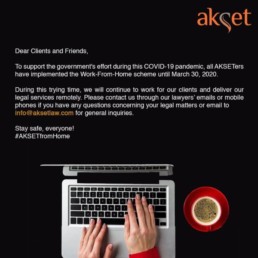
#AKSETfromHome
To support the government's effort during this COVID-19 pandemic, all AKSETers have implemented the Work-From-Home scheme until March 30, 2020.
During this trying time, we will continue to work for our clients and deliver our legal services remotely.
Please contact us through our lawyers’ emails or mobile phones if you have any questions concerning your legal matters or email to info@aksetlaw.com for general inquiries.
Stay safe, everyone!
#AKSETfromHome

Information from AKSET
Dear All AKSET Clients and Friends,
We trust this finds you well. As you may know, the COVID-19 reached Indonesia a few days ago. Since then, the number of infected persons has exceeded 110. In addition, there is a possibility of lock down of Jakarta, the Capital of Indonesia.
In view of the Outbreak, our offices have implemented a reduced working hour program and the work from home scheme for our attorneys and staff. While we continue to perform the work from outside our offices, there will likely be certain delays in our delivering our work or responding to your inquiries. We sincerely apologize for this unintended delay. Kindly rest assured that we will minimize any disruption of our services to our clients.
If you wish to reach your contact at AKSET, please do not hesitate to reach his or her cellular phone number or via email.
We wish the Outbreak will pass and things return to normal shortly.
With sincere regards.
AKSET Management

Recent Regulatory Development: Privacy and Personal Data
Late in 2019, in the span of 2 (two) months, Indonesian Government issued 2 (two) regulations which contain provisions relating to personal data protection. Our team look at the recent regulatory development on Privacy and Personal Data in Indonesia.
Author from AKSET: Abadi Abi Tisnadisastra, Prihandana Suko Prasetyo Adi, and Noor Prayoga Mokoginta

Recent Regulatory Development: Privacy and Personal Data
OJK Re-Introduces Rules to Accommodate Rising M&A Trends in Banking Sector
On December 26, 2019, the Indonesian Financial Services Authority (“OJK”) issued and enacted OJK Regulation No. 41/POJK.03/2019 of 2019 on Mergers, Consolidations, Acquisitions, Integrations and Conversions of Banks (“OJK Reg. 41/2019”). OJK Reg. 41/2019 combines and revives the rules concerning mergers, consolidations, and acquisitions (“MCAs”) of commercial banks (the “Bank”). With these new rules, OJK Reg. 41/2019 replaces Bank Indonesia (“BI”) Board of Directors Decrees No. 32/50/KEP/DIR on Requirements and Procedures to Purchase Shares of Banks, and No. 32/51/KEP/DIR on Requirements and Procedures for Mergers, Consolidations, and Acquisitions of Banks (collectively, the “BI Decrees”). OJK Reg. 41/2019 also introduces several other new concepts to add and make relevant rising trends in relation to corporate restructuring arrangement in the financial service business, particularly banking.
New Framework for Bank’s Integration and Conversion
OJK Reg. 41/2019 now enables and makes clear procedure for “Integration” and “Conversion”.
Integration is defined as legal action conducted by foreign bank branch office (kantor cabang dari bank yang berkedudukan di luar negeri/”KCBLN”) and a Bank by transferring the assets and liabilities of the KCBLN to a Bank, followed by revocation of the KCBLN’s license.
Conversion is defined as legal action conducted by KCBLN to convert its license into a commercial banking license, followed by revocation of the said KCBLN’s license.
Introduction of New Concept for Controller and Acquisition
OJK Reg. 41/2019 adds provision stating that a transfer of control occurs when: (1) an acquisition of shares causes the acquirer’s share-ownership to be the largest in the Bank, or (2) ownership of shares that does not constitute the largest in the Bank, but is able to determine, directly or indirectly, management in a Bank.
Recognition of More OJK’s Involvement
OJK Reg. 41/2019 now makes clear requirement to obtain OJK’s blessing in conducting MCAs, Integration, and Conversion, before the Bank’s shareholders approve the corporate actions are conducted. Previously, the BI Decrees require OJK’s approval only after obtaining shareholders’ approval from the merging/consolidating Banks or the target Bank (for acquisition). However, in practice, parties will have always conducted discussion with OJK in order to gauge OJK’s preliminary view on the proposed MCAs. With the issuance of OJK Reg. 41/2019, preliminary discussion with OJK is now explicitly required.
Similar with MCAs, proposed Integration and Conversion must also be initiated by preparing an integration plan and submitting preparatory documents to be submitted to OJK.
Following OJK’s blessing, MCAs, Integration, and Conversion must then be announced in national newspaper and similar procedures as in the BI Decrees must be undertaken.
Acknowledgement for Acquisition through Rights Issue
OJK Reg. 41/2019 stipulates that Bank acquisitions are carried out by taking over shares that have been issued and/or will be issued by the Bank, which results in the transfer of control in the Bank to the acquiring party. With this provision, it is now expressly allowed for acquisition to be conducted through rights issue.
Rules over Listed Banks
Similar to Controlling shareholders of the Bank owning shares that are not through the stock exchange, OJK Reg. 41/2019 stipulates that any shareholders of the Bank owning shares through the stock exchange and meeting the criteria of a Controller must undergo a fit and proper test. OJK Reg. 41/2019 also requires any party to divest its shares in the Bank if such party, when prohibited by laws from owning shares in the Bank, is proven to own shares in the Bank in the stock exchange. This provision seems to address possible scenarios where a party holds a Bank's shares in the stock exchange by skipping the fit and proper test procedures or bypassing the shareholding restriction requirement for the Bank.
February 17, 2020
Copyright © 2020 AKSET. All rights reserved.
Updated List of Restricted Positions for Expatriates
On December 31, 2019, the Minister of Manpower (“MOM”) enacted Decree No. 349 of 2019 on Certain Positions Restricted for Expatriates (“Decree 349”). Decree 349 revokes and replaces Decree No. 40 of 2012 dated February 29, 2012 concerning the same matter (“Decree 40”). Decree 349 sets out 18 positions restricted for expatriates while Decree 40 listed 19 positions. The single difference between both decrees is that Decree 349 removes the Chief Executive Officer position from the restricted positions list. Therefore, 18 positions listed under Decree 349 is the same as the remaining positions listed under Decree 40.
Note that Decree 349 is not the implementation of Article 42(5) of Law No. 13 of 2003 dated March 25, 2003 on Manpower that provides positions that are available for expatriates. The compilation of the positions available for expatriates are set out under Decree No. 228 of 2019 dated August 27, 2019 on Certain Positions Available to Expatriates (“Decree 228”).
In addition to reference to the International Standard Classification of Occupations (“ISCO”), Decree 349 refers to the Indonesian Standard Classification of Occupations (Klasifikasi Baku Jabatan Indonesia or “KBJI”). The updated list of restricted positions for expatriates set out in Decree 349 is as follows:
| No. | ISCO/KBJI Code | Position |
| 1 | 1210 | Personnel Director |
| 2 | 1232 | Industrial Relations Manager |
| 3 | 1232 | Human Resources Manager |
| 4 | 1232 | Personnel Development Supervisor |
| 5 | 1232 | Personnel Recruitment Supervisor |
| 6 | 1232 | Personnel Placement Supervisor |
| 7 | 1232 | Employee Career Development Administrator |
| 8 | 4190 | Personnel Declare Administrator |
| 9 | 2412 | Personnel and Careers Specialist |
| 10 | 2412 | Personnel Specialist |
| 11 | 2412 | Career Advisor |
| 12 | 2412 | Job Advisor |
| 13 | 2412 | Job Advisor and Counseling |
| 14 | 2412 | Employee Mediator |
| 15 | 4190 | Job Training Administrator |
| 16 | 2412 | Job Interviewer |
| 17 | 2412 | Job Analyst |
| 18 | 2412 | Occupational Safety Specialist |
February 17, 2020
Copyright © 2020 AKSET. All rights reserved.
OJK Improved Regulation on Quality Assessment of Asset for Commercial Banks
To maintain the soundness level of banks through the protection of banks’ quality of asset and loan-loss provisions, the Indonesian Financial Services Authority (Otoritas Jasa Keuangan - “OJK”) enacted OJK Regulation No. 40/POJK.03/2019 on Quality Assessment of Asset for Commercial Banks that came into effect on January 1, 2020 (“POJK 40/2019”). This POJK 40/2019 replaces and synchronizes (i) Bank Indonesia (“BI”) Regulation No. 14/15/PBI/2012 on Asset Quality Assessment of Conventional Bank, (ii) POJK No. 14/POJK.03/2018 on Quality Assessment of Conventional Bank to for the Improvement of Growth in Real Estate Sector and Foreign Exchange, (iii) Bank Indonesia Directors’ Decision Letter No. 23/68/KEP/DIR on Productive Assets Quality and Reserves Structure, (iv) BI Circular Letter No. 15/28/DPNP on Quality Assessment of Conventional Bank, and (v) BI Circular Letter No. 4/241/UPPK/PK on Overdrafts due to Interest/Stamp Duty on Loans (collectively, the “Previous Regulations”).
Continuing the Previous Regulations, POJK 40/2019 governs the procedure for banks’ quality assessment of asset, loan-loss provisions and credit restructuring. Adopting the previous concept in assessing the quality of their assets, banks are required to make an evaluation based on two categories of assets namely:
- productive asset which includes, among others, credit, placements, securities and derivative receivables; and
- non-productive asset which includes acquired collateral (Aset Yang Diambil Alih), dormant property and inter-office accounts and suspense accounts.
Similar to the Previous Regulations, in terms of collectability, the new POJK 40/2019 maintains the 1 (one) to 5 (five) classification with 1 (one) being Current (Lancar) to 5 (five) being Loss (Macet). The same rule of loan-loss provisions is also restated. Essentially, banks are required to maintain loan-loss provisions over their productive and non-productive asset in order to prevent potential losses arising from their assets. The calculating procedure for loan-loss provisions is as follows.
- For productive assets classified as Current, banks shall set aside 1% (one percent) to be accounted for their general loan-loss provisions. This excludes outstanding credit facility which is part of Administrative Account Transaction, government issued securities and productive assets backed by cash collateral.
- As for the calculation for loan-loss provisions of non-productive assets and productive assets classified other than Current, banks shall apply the following:
- 5% (five percent) for assets classified as Special Mention (Dalam Perhatian Khusus),
- 15% (fifteen percent) for assets classified as Sub-Standard (Kurang Lancar),
- 50% (fifty percent) for assets classified as Doubtful (Diragukan); and
- 100% for assets classified as Loss.
- Bonds and/or sharia bonds which are not issued through public offering and securities and/or shares securitized by or subject to shares as its underlying asset classified as Loss and shall be calculated based on Loss classification.
The above calculation shall be made after the subtraction of assets’ collateral.
- Key Changes from the Previous Regulations
Aside from reinstating the Previous Regulations as set out above, the new POJK 40/2019 now gives room for securities listed in off-shore stock exchange to be considered as productive asset, includes apartment unit with fiduciary security as asset collateral that can be subtracted for loan-loss provisions, provides more detailed reporting guideline for credit restructuring and implements two-stages approach in sanction enforcement that will be elaborated below.
Productive Asset: Room for Securities Listed in Off-Shore Stock Exchange
POJK 40/2019 explicitly allows securities that are being actively traded in off-shore stock exchange as productive asset with Current classification provided that such off-shore stock exchange is among the top 25 (twenty-five) biggest capitalization capital market value in the world.
Loan-Loss Provisions: Apartment Unit with Fiduciary Security as An Additional Asset Collateral Subtraction
POJK 40/2019 adds the list of asset collateral that can be subtracted in calculating loan-loss provisions set out in the Previous Regulations by including apartment unit securitized by fiduciary security.
Credit Restructuring: A More Detailed Guideline
OJK now provides a detailed form of credit restructuring report which was not stipulated in the Previous Regulations. The form requires banks to report the type of credit restructuring as well as debtors’ credit condition before and after the restructuring. Further the reporting procedure for credit restructuring also refers to the sanctions set out in OJK Regulation No. 12/POJK.03/2019 on Conventional Bank Report Through OJK Reporting System dated April 5, 2019, where incompliance is subject to additional sanctions in the form of fines.
Sanction: Two-Stages Enforcement Approach
Unlike the Previous Regulations, POJK 40/2019 now imposes sanction for non-compliance in two stages namely (i) written warning, before (ii) additional sanctions in the form of suspension of business activities and/or prohibition of banks to participate as primary parties within financial institutions. Banks will only be subjected to additional sanctions if they have received written warning and remain to ignore such written warning.
February 12, 2020
Copyright © 2020 AKSET. All rights reserved.
Supervisory Board of KPK – Implementing Regulations
Last year, the Parliament and the Government amended Law No. 30 of 2002 dated December 27, 2002 on Corruption Eradication Commission (“KPK”) with Law No. 19 of 2019 dated October 17, 2019 (collectively, the “KPK Law”). Such amendment to the KPK Law created public backlash due to the fear of attempts to weaken KPK. One of the provisions is the establishment of a Supervisory Board of KPK. As regulated in the KPK Law, the Supervisory Board serves as a body to oversee the work of KPK. The Board members will be appointed by the President of Indonesia.
Following the establishment of the Supervisory Board of KPK, the President of Indonesia issued Presidential Regulation No. 91 of 2019 dated December 31, 2019 on the Implementing Body of the Supervisory Board of KPK (“PR 91/2019”). The summary of key stipulations in PR 91/2019 is as follows:
| Issue | PR 91/2019 |
| Duties and responsibilities
|
In carrying out its duties, the Supervisory Board creates an implementing body called the Secretariat of the Supervisory Board. The Secretariat would be led by the Head of the Secretariat and the body will be directly under the responsibility of the Head of the Supervisory Board.
The Secretariat caries out the function of, among others: a. receiving and administering any permission to wiretap, search, and/or confiscate; b. facilitating the preparation of drafting the code of ethics for KPK chairman and employees; c. facilitating any public report on a alleged code of ethics violation by KPK chairman and employees; d. facilitating the enactment of the Supervisory Board’s hearing; and e. facilitating the work evaluation for KPK chairman and employees. |
| Appointment | The Head of Secretariat shall be appointed by the Secretary General of KPK based on a recommendation from the Supervisory Board. |
In addition to PR 91/2019, the Government issued Government Regulation No. 4 of 2020 dated January 16, 2020 on the Procedures to Appoint the Head and Members of the Supervisory Board of KPK (“GR 4/2020”). The summary of key stipulations in GR 4/2020 is as follows:
| Issue | GR 4/2020 |
| Membership | The Supervisory Board consists of five members, one of which is assigned as the Head of Supervisory Board. The term of office of the members is four years and may be extended for another period of four years. |
| Appointment and termination of appointment | The Head and the members of the Supervisory Board are appointed by the President. In appointing the Head and members of the Supervisory Board, the President is assisted by a Selection Panel.
The Selection Panel consists of nine members, five of whom are from the Central Government and the remaining four are from the public. One member from the Central Government acts as the head of the Selection Panel and another member serves as the deputy. Members of the Selection Panel are determined based on a Presidential Decree. The Selection Panel will conduct a series of tests to the candidate members of the Supervisory Board, which candidacy will be open for the public. When the panel selection determines the selected candidates, the Selection Panel will deliver these names to the President. The President will further deliver these names to the House of Representatives for consultation. Upon consultation, the President would have fourteen working days to determine the Head and members of the Supervisory Board. The Head and members of the Supervisory Board can resign or be terminated if: a. they pass away; b. the period of office has ended; c. they committed inappropriate conduct; d. they are sentenced to imprisonment because of a criminal act based on a court decision that is final and binding; e. they resign voluntarily in writing; and/or f. they are unable to carry out the work for three consecutive months. Termination of the appointment of the Head and members of the Supervisory Board will be based on a Presidential Decree. |
- Recent Development: Issuance of other Presidential Regulations
Other than PR 91/2019 and GR 4/2020, the President and the Government plan to issue certain regulations relating to the new provisions in the KPK Law. The new regulations include:
- Government Regulations on:
- Results of Search and Confiscation in respect of Corruption; and
- Transfer of KPK Employees as State Civil Apparatus.
- Presidential Regulations on:
- Supervision on the Eradication of Corruption;
- Salaries and Allowances for KPK Employees;
- Financial and Facility Rights for the Supervisory Board of KPK; and
- Organization and Work Procedures for the Chairman and Implementing Body of KPK.
To date, these regulations have not been issued by the President or the Government.
February 11, 2020
Copyright © 2020 AKSET. All rights reserved.