
Religious Holiday Allowance Payment in 2024
On March 15, 2024, the Minister of Manpower issued Circular Letter No. M/2/HK.04/III/2024 regarding Implementation of Religious Holiday Allowance for Workers in Companies (the “Circular Letter”). The issuance of the Circular Letter revolves on the importance of providing for the needs of the workers and their families during the upcoming religious holiday of Idul Fitri. The obligation to pay the Religious Holiday Allowance (in Indonesian, Tunjangan Hari Raya or the “THR”) is regulated under Government Regulation No. 36 of 2021 on Wages (“GR 36/2021”), and Minister of Manpower Regulation No. 6 of 2016 on THR for Workers in Companies (“MOMR 6/2016”).
In this Newsflash, we set out several key points regarding the implementation of the THR in 2024 and the Government’s policies to ensure the payment of the THR is carried out lawfully.
♦ Implementation of THR Policy in 2024
According to the Circular Letter, every employer must pay the THR to their workers. The THR must be paid in full and may not be paid in installments. Further, the THR must be paid at the latest of 7 (seven) days prior to the religious holiday and it shall be given to the following:
-
-
- Workers who have been working for 1 (one) month without any interruption or more; and
- Workers who are employed under an indefinite term employment agreement (in Indonesian, Perjanjian Kerja Waktu Tidak Tertentu) or a fixed term employment agreement (in Indonesian, Perjanjian Kerja Waktu Tertentu).
-
The amount of the THR is given as follows:
-
-
- For workers with a working period of 12 (twelve) months consecutively or more, shall be given 1 (one) month of salary.
- For workers with a working period of 1 (month) consecutively, but less than 12 (twelve) months, shall be given proportionately based on the following calculation:
-

In the event the workers whose works are based on a freelance agreement, 1 (one) month of salary shall be calculated as follows:
-
-
- Workers with a working period of 12 (twelve) months or more, 1 (one) month of salary shall be calculated based on the average salary of the last 12 (twelve) months before the religious holiday.
- Workers with a working period less than 12 (twelve) months, 1 (one) month of salary shall be calculated based on the average wage obtained each month during the working period.
-
For workers whose salary is set based on the unit of output, the Circular Letter provides that the 1 (one) month salary shall be calculated based on the average salary of the last 12 (twelve) months before the religious holiday. For companies that set the amount of the THR greater than the amount of the minimum THR, then the THR shall be paid to the workers based on the employment agreement, company regulation, collective work agreement, or common practice.
To ensure the payment of the THR is carried out lawfully, the Government encourages companies to pay the THR in accordance with applicable laws and regulations before the due date. To anticipate complaints in the payment of the THR, each provincial and regent/city area is expected to establish a Command Post (Posko Satgas) for consultations services and law enforcement of the THR which is integrated through https://poskothr.kemnaker.go.id.
♦ Administrative Sanctions
GR 36/2021 and MOMR 6/2016 provide administrative sanctions that may be imposed on employers if they fail to comply with the THR payment.
An employer that is late in paying the THR payment to their workers may be imposed a monetary fine in the amount of 5% (five percent) of the total THR that must be paid from the due date. Note that the imposition of such a fine does not eliminate the obligation of the employers to pay the THR.
Moreover, an employer that fails to pay the THR may be subject to the following administrative sanctions under GR 36/2021:
-
-
- Written reprimand;
- Restriction of business activities;
- Temporary suspension of part or all the production tools; and
- Suspension of business activities.
-
AKSET
Please contact Johannes C. Sahetapy-Engel [jsahetapyengel@aksetlaw.com] or Thomas P. Wijaya [twijaya@aksetlaw.com] for further information
Disclaimer:
The foregoing material is the property of AKSET and may not be used by any other party without prior written consent. The information herein is of general nature and should not be treated as legal advice, nor shall it be relied upon by any party for any circumstance. Specific legal advice should be sought by interested parties to address their particular circumstances.
Any links contained in this document are for informational purposes and are available and relevant at time this publication is made. We provide no liability whatsoever in respect of any information or content in such links.

Religious Holiday Allowance Payment in 2024

Regulation on Import of Non-New Lithium Batteries and Non-Hazardous Waste
On December 11, 2023, the Minister of Trade (the “MOT”) issued Regulation No. 36 of 2023 on Import Policies and Arrangements which Regulation was supposed to be effective on March 10, 2024 (“Regulation 36/2023”). However, on March 5, 2024, the MOT issued Regulation No. 3 of 2024 on the Amendment of Regulation 36/2023 (“Regulation 3/2024”). The amendments under Regulation 3/2024 do not change the effective date of Regulation 36/2023, i.e., March 10, 2024.
Regulation 3/2024 is issued to optimize the implementation of the import of certain goods under Regulation 36/2023. Regulation 3/2024 amends eight articles, adds four articles of Regulation 36/2023, and amends and restates Appendices I – VII of Regulation 36/2023 entirely.
Although Regulation 36/2023, as amended by Regulation 3/2024, regulates provisions for a variety of imported goods, this Newsflash focuses on the import provisions of Non-new Lithium Batteries and Non-Hazardous and Toxic Waste as Industrial Raw Materials (the “Non-hazardous Waste”).
♦ Import of Non-New Lithium Batteries
The allowance to import the non-new lithium batteries is made to support the acceleration of the battery electric vehicle (“BEV”) industry development as the non-new lithium batteries may only be imported by a manufacturer in the lithium battery and/or metal material goods recovery industry in the relation to the BEV development, e.g., non-new lithium batteries used as raw material in the lithium battery industry.
The types of non-new lithium batteries that may be imported are (i) non-new secondary lithium batteries in intact condition that may not be used as intended due to certain reasons, and (ii) remains and scrap generated during the production of lithium batteries.
We note that there are no substantial differences between Point V of Appendix II regarding the requirements for the import of non-new lithium batteries, including its scraps, under Regulation 3/2024 and previously regulated under Regulation 36/2023.
The non-new lithium batteries may only be imported by a company that holds a producer importer license in the form of a Producer Importer Identification Number (in Indonesian, Angka Pengenal Importir Produsen or an “API-P”). The API-P holder shall obtain a valid (i) environmental license or related, and (ii) Industrial Business License or related license, from the authorized institutions.
The issuance of the producer importer business license is made based on the result of the technical coordination meeting to ensure the capability of a company in managing the imported non-new lithium battery. The government institutions that organize and attend the technical coordination meeting will depend on the locations of the delivery of the imported goods in Indonesia, such as in a bonded zone, special economic zone, or any other area.
As an example, for the import of lithium batteries to a Free Trade Zone and Free Port (in Indonesian, Kawasan Perdagangan Bebas dan Pelabuhan Bebas or a “KPBPB”), the meeting shall be organized by the Head of KPBPB Authority Management and attended by the respective ministers responsible for administering governmental affairs in the field of trade, industry, investment, and environment and forestry.
♦ Import of Non-Hazardous and Toxic Waste as Industrial Raw Materials
Similar to the provisions for the import of non-new lithium batteries above, there are no substantial differences between Point VI of Appendix II regarding the requirements for the import of Non-hazardous Waste, including the scraps of its relevant groups (e.g., paper, metal, rubber, textile, and glass) under Regulation 3/2024 and previously regulated under Regulation 36/2023.
As a reference, Appendix II of Regulation 3/2024 stipulates that Non-hazardous Waste is the residue of a business/activity in the form of scrap or residues that are not classified or categorized as hazardous and toxic waste.
The import approval for Non-hazardous Waste is subject to the requirement in commodity balance. If the commodity balance has yet to be determined, the requirement for an import approval by the API-P holder are (i) documents proof as a registered exporter, (ii) a statement letter from the originating country of the exporter, (iii) a statement letter from the importer, (iv) a recommendation/verification result report from the Ministry of Environment and Forestry, and (v) a recommendation/master list/verification result report from the Ministry of Industry.
In addition, the criteria of Non-hazardous Waste that may be imported are (i) it does not originate from landfill activities, (ii) it is not garbage and not mixed with garbage, (iii) it is not contaminated with hazardous waste, and (iv) it is homogeneous.
Further, the import of Non-hazardous Waste shall only originate from exporters registered in their respective originating country and shall only be imported through certain ports, among others, Tanjung Priok Port in Jakarta, Tanjung Emas Port in Semarang, and Tanjung Perak Port in Surabaya.
AKSET
Please contact Johannes C. Sahetapy-Engel (jsahetapyengel@aksetlaw.com), Radiansyah S. Yamin (ryamin@aksetlaw.com), Andi Manggoana Wira Tenri (atenri@aksetlaw.com), or M. Fatih Satria Kasmaliputra (mkasmaliputra@aksetlaw.com) for further information.
Disclaimer:
The foregoing material is the property of AKSET and may not be used by any other party without prior written consent. The information herein is of general nature and should not be treated as legal advice, nor shall it be relied upon by any party for any circumstance. Specific legal advice should be sought by interested parties to address their particular circumstances.
Any links contained in this document are for informational purposes and are available and relevant at time this publication is made. We provide no liability whatsoever in respect of any information or content in such links.
Regulation on Import of Non-New Lithium Batteries and Non-Hazardous Waste
Government Issues Regulation to Accelerate the Development of National Game Industry
Following up on our previous Newsflash on Minister of Communications and Informatics No. 2 of 2024 dated January 24, 2024, on Classification of Games (AKSET Newsflash - New Regulation on Classification of Games), Presidential Regulation No. 19 of 2024 on Acceleration of National Game Industry Development was issued on February 12, 2024 (“PR 19”).
The enactment of PR 19 relates to the economic potential of the game industry that needs to be strengthened by involving various stakeholders in an effort to amplify the creative and digital economy. PR 19 also provides direction, foundation, and legal certainty for all parties involved in the development of the national game industry.
We set out below the key provisions under PR 19:
A. Definition of National Games
PR 19 defines national games as game products that are owned by Indonesian citizens or Indonesian legal entities which are evidenced by a registration certificate of creation of intellectual property certificate.
B. Implementation of Acceleration of National Game Industry Development
The acceleration of the national game industry development shall serve as a guideline for (i) the Central Government and the Regional Governments to implement sectoral policies and follow up on the National Game Industry Development Acceleration Program (the “Program”) and (ii) other stakeholders in carrying out the Program.
In implementing the acceleration of the national game industry development, the Central Government and/or the Regional Governments may cooperate with educational institutions, business sectors, industrial sectors, community networks, and/or media.
PR 19 also introduces the forming of the acceleration of a national game industry development team (the “Team”) which consists the relevant ministries/institutions as its members. The Team consists of a director (in Indonesian, pengarah) and a daily implementor (in Indonesian, pelaksana harian).
The director of the Team is chaired by the Coordinating Minister of Maritime and Investment Affairs, while the chairman of the daily executor of the Team is the Minister of Tourism and Creative Economy/Head of Tourism and Creative Economy Agency.
PR 19 stipulates different duties for the director and the daily executor of the Team. However, as a whole, the Team has the following duties: (i) carry out coordination and synchronization, (ii) direct steps and policies to resolve problems and obstacles, (iii) develop comprehensive strategies and implementation of public communication, (iv) carry out monitoring and evaluation, and (v) provide recommendations on changes to the Program.
C. National Game Industry Development Acceleration Program
Elaboration on the Program is stipulated under the Appendix of PR 19. The Appendix of PR 19 stipulates the background, principles, vision and mission, purpose, and direction of policy, strategy, program details, and stakeholders in relation to the Program.
Further, the Appendix of PR 19 stipulates 7 (seven) program details for the acceleration of the national game industry development, which also sets out the activities, targets, year of completion, responsible parties, and relevant stakeholders. The 7 (seven) programs are highlighted below:
i. Developing human resources for the national game industry
This program includes, among others, training and assistance for human resources that is adjusted to the competence needed and increasing human resources in the gaming sector, including business, marketing, branding, and positioning, and scholarships.
ii. Opening access for financing and capital for the national game industry
This program includes, among others, preparation of schemes for financing from investors through matching fund and venture capital and drafting regulations that opens inclusive payment on the distribution platform (among others, Apple Store, Google Play Sote, and Steam) to grant access for third party payments.
iii. Increasing promotion and opening of access to the national game market
This program includes among others, provision of captive market for the national game products and promotional synergy with e-commerce in Indonesia.
iv. Provision of adequate and competitive technology infrastructure to support the national game industry development
This program includes, among others, creating a development center for technology and acceleration of games development and development of networks in the game industry.
v. Drafting laws and regulations to strengthen the ecosystem of the national game industry
It is worth noting that under this program, one of the intended forms of activity is the drafting of laws and regulations that encourages foreign game publishers with great economic impact to establish a legal entity in Indonesia.
Further, the target for the foregoing activity is (i) to have a separate business classification code (in Indonesian, Klasifikasi Baku Lapangan Usaha Indonesia or KBLI) for game publishers and (ii) to form a regulation that obligates foreign game publishers to establish a legal entity in Indonesia and/or form a partnership with domestic legal entity/company.
vi. Development of hardware industry for national games
This program consists of expansion of laws and regulations on domestic component level (in Indonesian, Tingkat Komponen Dalam Negeri or TKDN) of hardware to incorporate elements of software (games) in its calculation and encouragement of collaboration between the manufacture industry and the national game industry with the purpose of developing intellectual property-based business.
vii. Activation of National Games in Regional and Global Areas
This program consists of increasing activation and appreciation of national game manufacturers by participating in the implementation of national, regional, and global level activities and creation of professional and sustainable regular activation schemes to support the development of national game.
We view that PR 19 should be beneficial for the acceleration of the national game industry development. However, its implementation remains to be seen. Particularly with respect to the regulation that will require foreign game publishers to establish a legal entity Indonesia or at least form a partnership with local Indonesian companies, which is targeted to be published in 2024. We will issue further updates as relevant.
AKSET
Please contact Johannes C. Sahetapy-Engel (jsahetapyengel@aksetlaw.com) or M. Fatih Satria Kasmaliputra (mkasmaliputra@aksetlaw.com) for further information.
Disclaimer:
The foregoing material is the property of AKSET and may not be used by any other party without prior written consent. The information herein is of general nature and should not be treated as legal advice, nor shall it be relied upon by any party for any circumstance. Specific legal advice should be sought by interested parties to address their particular circumstances.
Any links contained in this document are for informational purposes and are available and relevant at time this publication is made. We provide no liability whatsoever in respect of any information or content in such links.
New Regulation on Classification of Games
On January 24, 2024, the Minister of Communications and Informatics (the “MOCI”) enacted MOCI Regulation No. 2 of 2024 on Classification of Games (“Regulation 2/2024”). Regulation 2/2024 revokes the previous regulation governing online games, namely MOCI Regulation No. 11 of 2016 dated July 15, 2016 on Classification of Electronic Interactive Games.
Regulation 2/2024 was enacted to facilitate the use of information technology and protect the public interests of all forms of disruptions as a result of any misuse of information and electronic transactions that disrupts public order. Further, the Government needs to protect the public in the use of information technology products in the form of games in accordance with the cultural characteristics and norms in Indonesia.
Under Regulation 2/2024, games are defined are software where users may interact via hardware to play and get audiovisual feedback, while the classification of games is defined as an activity of grouping of games based on content and user age through an assessment carried out independently by the publisher (i.e., a publisher of games) and the result shall be subject to the conformity testing (in Indonesian, uji kesesuaian) by the game classification examiner.
Note that a publisher of games is any individual, business entity, and/or legal entity which markets gaming products (a “Publisher”).
We set out below the key provisions under Regulation 2/2024:
A. Classification Procedures
Article 4(1) of Regulation 2/2024 stipulates that a Publisher shall register as a Private Electronic System Provider (in Indonesian, Penyelenggara Sistem Elektronik Lingkup Privat or PSE Lingkup Privat) through the OSS system in accordance with the applicable laws and regulations.
Thereafter, the Publisher shall carry out (i) the classification of games independently and (ii) include the result of such classification of games based on the conformity test on the description, packaging, and advertising of the games.
The classification of games is carried out independently by filling out an online assessment through a website maintained by the MOCI or an electronic system connected the website maintained by the MOCI.
The MOCI will then issue the result of the classification of games after the Publisher has completed the classification of games independently.
Note that the Publisher is only allowed to market the games after the MOCI has issued the result of the classification of games as referred above.
B. Classification Threshold
Based on Regulation 2/2024, games are classified based on the following age group of users:
-
-
- 3 (three) years or more;
- 7 (seven) years or more;
- 13 (thirteen) years or more;
- 15 (fifteen) years or more; and
- 18 (eighteen) years or more.
-
The above age groups are determined based on content categories consisting of (i) cigarettes and/or electronic cigarettes, alcoholic beverages, psychotropics, and/or other addictive substances, (ii) violence, (iii) blood, mutilation, and cannibalism, (iv) use of language, (v) character appearance, (vi) pornography, (vii) gambling simulation and/or activities, (viii) horror, and (ix) online interaction.
Regulation 2/2024 also regulates the criteria that shall be complied with for each age group of users. For example, Article 9 of Regulation 2/2024 stipulates that games classified into the age group 3 (three) years or more shall fulfill the following criteria, among others, the contents therein shall not show violence, do not use foul language, profanity, and/or adult humor, and do not contain gambling simulation and/or activities.
C. Games Not Fit for Classification
Pursuant to Article 14 of Regulation 2/2024, games will not be classified if it contains the following contents:
-
-
- Visual and/or audio of pornography;
- Game activity based on luck or any kind of gambling that enables the use of legal means of payment, foreign currency, electronic money, or intangible commodities in the form of digital assets that can be traded and exchanged to legal means of payment and providing/supporting/facilitating disbursement (cash out) features; and/or
- Violation of applicable laws and regulations.
-
D. Conformity Test
As mentioned above, the result of the classification of games shall be subject to a conformity test carried out by the game classification examiner (the “Examiner”). The Examiner shall be a legal entity that has the expertise to carry out the conformity test and shall be determined by the MOCI.
In the case that there is no Examiner yet, the conformity test shall be carried out by the MOCI.
E. Public Participation
Regulation 2/2024 provides the right to the game users and the public to report any discrepancies in the result of the classification of games to the MOCI, (i) online through a website maintained by the MOCI or an electronic system connected the website maintained by the MOCI or (ii) offline to the Directorate General of Informatics Application (in Indonesian, Direktorat Jenderal Aplikasi Informatika) of the MOCI.
F. Administrative Sanctions
Regulation 2/2024 stipulates certain administrative sanctions that may be imposed by the MOCI to the Publisher, which form shall be subject to the type of violation conducted by a Publisher.
For example, in the event that a Publisher does not carry out the independent classification of games and/or market or advertise games that are not yet classified, the MOCI imposes administrative sanction in the form of game access termination.
G. Other Relevant Provisions
Pursuant to Article 22(1) of Regulation 2/2024, a Publisher shall carry out the classification of games at the latest 2 (two) years as of the enactment of Regulation 2/2024.
Separately, Regulation 2/2024 provides that for the games that are already classified outside Indonesia and is marketed in Indonesia, such games shall fulfill the classification of games at the latest 2 (two) years as of the enactment of Regulation 2/2024.
On that note, the above provisions shall be complied with at the latest by January 24, 2026.
Please be informed that Regulation 2/2024 expressly stipulates that certain provisions shall be further governed by a separate MOCI Regulation, such as further provisions on a Publisher and the Examiner with regard to its supervision by the MOCI.
AKSET
Please contact Johannes C. Sahetapy-Engel (jsahetapyengel@aksetlaw.com) or M. Fatih Satria Kasmaliputra (mkasmaliputra@aksetlaw.com) for further information.
Disclaimer:
The foregoing material is the property of AKSET and may not be used by any other party without prior written consent. The information herein is of general nature and should not be treated as legal advice, nor shall it be relied upon by any party for any circumstance. Specific legal advice should be sought by interested parties to address their particular circumstances.
Any links contained in this document are for informational purposes and are available and relevant at time this publication is made. We provide no liability whatsoever in respect of any information or content in such links.
New Regulation on Classification of Games
Increase of Alcoholic Beverage Excise Rates
Starting from January 1, 2024, the Minister of Finance (the “MOF”) has implemented an increment on excise rates for alcoholic beverages which was announced in the MOF Regulation No. 160 of 2023 dated December 28, 2023 on Excise Rates for Ethyl Alcohol (“EA”), Drinks Containing Ethyl Alcohol (“MMEA”), and Concentrates Containing Ethyl Alcohol (“KMEA”) (the regulation hereinafter referred to as “Regulation 160/2023”).
We set out below certain key points of Regulation 160/2023.
♦ Background
The increase in the excise rates as set out in Regulation 160/2023 applies for MMEA, either which are produced locally or imported. Director of Communication and User Guidance for Customs and Excise Services at the Ministry of Finance, Nirwala Dwi Heryanto, said that the increase in the MMEA excise rate aims to reduce the prevalence of alcoholic beverage consumption, especially among minors who are increasingly growing. Based on his records, the prevalence of MMEA consumption aged over 10 (ten) years continues to grow from 3% (three percent) in 2007 to 3.3% (three point three percent) in 2018. In addition, the average growth in MMEA production in the last 10 (ten) years is 2.4% (two point four percent).
♦ Drinks Containing Ethyl Alcohol (MMEA)
As a comparison, we set out below the excise rates for MMEA under the previous regulation, namely MOF Regulation No. 158/PMK.010/2018 dated December 13, 2018 on Excise Rates for EA, MMEA, and KMEA (the “Regulation 158/2018”), and under Regulation 160/2023.

♦ Ethyl Alcohol (EA) and Concentrates Containing Ethyl Alcohol (KMEA)
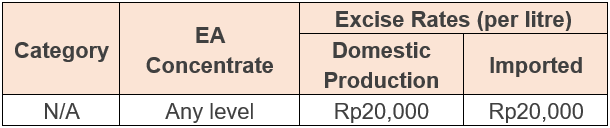
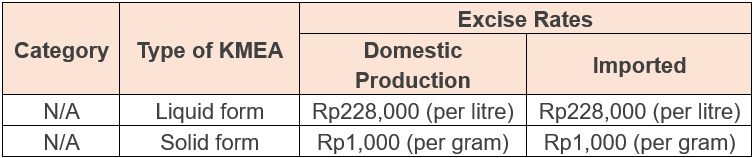
As a note, the excise rates for EA and KMEA under Regulation 160/2023 remain the same as Regulation 158/2018. However, Regulation 160/2023 differentiates the form for the excise rates of KMEA in the form of liquid and solid forms. Below are the excise rates for EA and KMEA.
- Excise Rates for Ethyl Alcohol (EA)
- Excise Rates for Concentrates Containing Ethyl Alcohol (KMEA)
AKSET
Please contact Inka Kirana (ikirana@aksetlaw.com), Adhitya Ramadhan (aramadhan@aksetlaw.com), or Ayu Nandini Prameswari (aprameswari@aksetlaw.com) for further information.
Disclaimer:
The foregoing material is the property of AKSET and may not be used by any other party without prior written consent. The information herein is of general nature and should not be treated as legal advice, nor shall it be relied upon by any party for any circumstance. Specific legal advice should be sought by interested parties to address their particular circumstances.
Any links contained in this document are for informational purposes and are available and relevant at time this publication is made. We provide no liability whatsoever in respect of any information or content in such links.
Increase of Alcoholic Beverage Excise Rates
New Basic Price Formula for Certain Types of Fuel Oil
On December 8, 2023, the Minister of Energy and Mineral Resources (the “MEMR”) issued Decree No. 439.K/MG.01/MEM.M/2023 of 2023 on the Basic Price Formula for Certain Types of Fuel Oil (“Decree 439/2023”). Decree 439/2023 revokes the MEMR Decree No. 148 K/12/MEM/2020 of 2020 on the Basic Price Formula for Certain Types of Fuel Oil and Specific Types of Fuel Oil for Assignments (“Decree 148/2020”).
Under Decree 439/2023, it is stipulated that the basic price formula for certain types of fuel oil determined by the MEMR is as follows:
- For Kerosene with a formula of 102.49% (one hundred two point forty nine percent) Kerosene Market Index Price + Rp263.00/liter (two hundred sixty three Rupiah per liter); and
- For Gas Oil with a formula of 100% (one hundred percent) Gas Oil Market Index Price + Rp868.00/liter (eight hundred sixty eight Rupiah per liter).
The above basic price formula shall be used as a basis to determine the basic price of every liter of certain types of fuel oil. Decree 439/2023 became effective as of December 8, 2023 and the prices may be evaluated in due course.
AKSET
Please contact Johannes C. Sahetapy-Engel (jsahetapyengel@aksetlaw.com), and Ammarsyarif G. Goenawan (agoenawan@aksetlaw.com) for further information.
Disclaimer:
The foregoing material is the property of AKSET and may not be used by any other party without prior written consent. The information herein is of general nature and should not be treated as legal advice, nor shall it be relied upon by any party for any circumstance. Specific legal advice should be sought by interested parties to address their particular circumstances.
Any links contained in this document are for informational purposes and are available and relevant at time this publication is made. We provide no liability whatsoever in respect of any information or content in such links.
New Basic Price Formula for Certain Types of Fuel Oil
Utilization of Biomass Fuel as Fuel Mixture in Steam Power Plants
To accelerate the achievement of renewable energy targets in the national energy, reducing greenhouse gas emissions, and encouraging economic development through the role of the community in the provision of biomass as fuel in a Steam Power Plant (in Indonesian in short, a “PLTU”), the Minister of Energy and Mineral Resources (“MEMR”) issued Regulation No. 12 of 2023 dated November 27, 2023 on the Utilization of Biomass Fuel as Fuel Mixture in Steam Power Plants (“Regulation 12/2023”).
We set out below the key provisions of Regulation 12/2023.
♦ Key Definitions
The key definitions provided under Regulation 12/2023 are as follows:
- Biomass Fuel (Bahan Bakar Biomassa or “B3m”) is defined as solid fuel in whole or in part which most of it originates from organic materials with certain standards and quality.
- Mixture of B3m (hereinafter referred to as Cofiring Biomass) is defined as a combustion activity in a PLTU between coal and one or more different B3m at the same time with a certain ratio to replace certain amount of coal with taking into account the quality of the fuel as needed.
- A PLTU is defined as a power plant that utilizes coal as its fuel.
♦ Utilization of Biomass in PLTUs
Article 2(1) of Regulation 12/2023 provides that the utilization of B3m in a PLTU is divided into 2 (two) categories, as follows:

Regulation 12/2023 provides that B3m for a PLTU shall fulfill the standards and quality in accordance with the Indonesian National Standard (Standar Nasional Indonesia or “SNI”).
In the event the SNI is not yet available and/or not in accordance with the required standards and quality, the MEMR, through the Director General of New, Renewable Energy and Energy Conservation (the “Director General”), may determine the B3m standards and quality for a PLTU by considering the following:
- the technology development;
- a manufacturer’s capabilities ;
- the capabilities and needs of consumers;
- specific conditions at each PLTU; and
- the Application of Health, Safety and Environment (HSE) Measures.
♦ Implementation of Cofiring Biomass
The utilization of B3m for a PLTU shall be carried out through Cofiring Biomass carried out by the Cofiring Biomass users, as follows:
- a holder of a business license to supply electricity for integrated public interest (Izin Usaha Penyediaan Tenaga Listrik untuk Kepentingan Umum or an “IUPTLU”);
- a holder of a business license to supply electricity for public interest in the electricity sector; and/or
- a holder of a business license to supply electricity for its own interest (Izin usaha Penyediaan Tenaga Listrik untuk Kepentingan Sendiri or an “IUPTLS”).
collectively referred to as the “Users.”
The implementation of Cofiring Biomass by a IUPTLU holder shall be carried out in accordance with the Business Plan for Electricity Provision (Rencana Usaha Penyediaan Tenaga Listrik or “RUPTL”).
Further, an IUPTLU and an IUPTLS holders shall convey the plan to implement the Cofiring Biomass in accordance with the RUPTL to the MEMR at the latest in October before the following year. Thereafter, the Director General shall evaluate the details of the plan on the implementation of the Cofiring Biomass.
In the implementation of Cofiring Biomass, the Users shall provide the B3m. The provision of B3m is carried out by way of procurement of goods or services determined by the Users and implemented under the B3m supply agreement with the provider.
♦ B3m Price Determination
The Users conduct the procurement of B3m through the purchase of B3m from a provider based on (i) the highest benchmark price (harga patokan tertinggi); or (ii) agreed price (harga kesepakatan).
The highest benchmark price is applicable (i) for the purchase of B3m by PT PLN (Persero) as the IUPTLU holder; and (ii) for the holder of a business license to supply electricity that collaborates with PT PLN (Persero).
Further, the highest benchmark price is calculated with the coal price formula multiplied by the price coefficient value B3m (k) times the factor calorific value correction (fc), with the highest benchmark price is FOB B3m price, and the coal price as the basis for the calculation is an average FOB coal price.
♦ Reporting Obligation
The Users are required to convey a written report to the MEMR through the Director General with a copy to the Director General of Electricity and Director General of Minerals and Coal every 3 (three) months, containing the following:
- the PLTU Data which implements Cofiring Biomass;
- the type, volume, and calorific value of B3m, and B3m price including its percentage against coal;
- the total electricity production produced from the Cofiring Biomass; and
- the total greenhouse gas emissions reduction value.
AKSET
Please contact Johannes C. Sahetapy-Engel (jsahetapyengel@aksetlaw.com), Radiansyah Suryomahendro Yamin (ryamin@aksetlaw.com), and M. Raehan A. Fadila (mfadila@aksetlaw.com) for further information.
Disclaimer:
The foregoing material is the property of AKSET and may not be used by any other party without prior written consent. The information herein is of general nature and should not be treated as legal advice, nor shall it be relied upon by any party for any circumstance. Specific legal advice should be sought by interested parties to address their particular circumstances.
Any links contained in this document are for informational purposes and are available and relevant at time this publication is made. We provide no liability whatsoever in respect of any information or content in such links.
Utilization of Biomass Fuel as Fuel Mixture in Steam Power Plants
Effective Rates For Article 21 Income Tax
On December 27, 2023, the Government of Indonesia issued Regulation No. 58 of 2023 on Article 21 Income Tax Deduction Rates for Income arising from Works, Services, or Activities of Individual Taxpayers (“GR 58”). GR 58 became effective as of January 1, 2024. Following the issuance of GR 58, on December 29, 2023 the Minister of Finance issued Regulation No. 168 of 2023 on Implementation Guidelines for Withholding of Income Tax arising from Works, Services, or Activities of Individual Taxpayer (“Regulation 168”).
Article 21 Income Tax rates are governed in Law No. 7 of 1983 dated December 31, 1983 on Income Taxes as lastly amended by Government Regulation in Lieu of Law No. 2 of 2022 dated December 30, 2022 on Job Creation which is made into a law under Law No. 6 of 2023 dated March 31, 2023 (collectively, the “Income Tax Law”). In relation to this, GR 58 and Regulation 168 were issued mainly to simplify the implementation of Article 21 income tax calculation and withholding in relation to works, services, or activities of individual taxpayers in Indonesia.
GR 58 provides the categories of taxpayers and deduction rates for several income tax brackets for each of the taxpayer categories. In this regard, the highlight of GR 58 lies in the introduction of monthly and daily effective rates as the basis to deduct income tax from the monthly or daily payment received by an employee.
Furthermore, as an implementing regulation of GR 28, Regulation 168 provides more detailed guidelines on the calculation of Article 21 Income Tax deductions.
♦ Article 21 Income Tax Deduction Rate and Effective Rates
Pursuant to Article 2 of GR 58, the Article 21 Income Tax deduction rates comprise 2 (two) types of deductions, namely:
- Article 21 Income Tax rates under Article 17(1) letter a of the Income Tax Law (the “Article 17 Rates”); and
- Article 21 Income Tax effective rates (the “Effective Rates”).
The Effective Rates may be in the form of (i) the Monthly Effective Rates, or (ii) the Daily Effective Rates. Under Regulation 168, it is stipulated that the Monthly Effective Rates shall be applicable for the deduction of an individual taxpayer who receives his/her income monthly. While the Daily Effective Rates shall be applicable for an individual taxpayer who receives his/her income on a daily or weekly basis.
The application of the Monthly Effective Rates depends on the amount of gross monthly income of a taxpayer based on the income of the taxpayer and is also based on the marriage status and the number of the dependent(s) of the taxpayer in the beginning of the tax year period. For this purpose, GR 58 classifies taxpayers into 3 (three) categories, namely Categories A, B, and C.
♦ Category A Monthly Effective Rates
Category A applies to the gross monthly income received by individuals with the following marital statuses and the number of dependents:
- Single without any dependent (tanggungan);
- Single with 1 (one) dependent; or
- Married without any dependent.
The Monthly Effective Rate for this category starts from 0% for the gross monthly income of up to Rp5,400,000 up to 34% for the gross monthly income of more than Rp1,400,000,000.
♦ Category B Monthly Effective Rates
Category B applies to the gross monthly income received by individuals with the following marital statuses and the number of dependents:
- Single with 2 (two) dependents;
- Single with 3 (three) dependents;
- Married with 1 (one) dependent; or
- Married with 2 (two) dependents.
The Monthly Effective Rate for this category starts from 0% for the gross monthly income of up to Rp6,200,000 up to 34% for the gross monthly income of more than Rp1,405,000,000.
♦ Category C Monthly Effective Rates
Category C applies to the gross monthly income received by individuals that are married with 3 (three) dependents.
The Monthly Effective Rate for this category starts from 0% for the gross monthly income of up to Rp6,600,000 up to 34% for the gross monthly income of more than Rp1,419,000,000.
♦ Daily Effective Rates
The Daily Effective Rates apply to the gross income that are received daily, weekly, in units, or for the completion of work (borongan).
The Daily Effective Rate for the gross daily income of up to Rp450,000 is at 0% (zero percent) and for at 0,5% for the gross daily income of more than Rp450,000.
♦ Subject of Effective Rates
Based on Article 3 of GR 58, the Article 21 Income Tax deduction and the Effective Rates explained above shall be applicable for the deduction of the Article 21 Income Tax of individuals, including government officials, civil workers, Indonesian national army forces, police forces, including the retirees.
Further in Article 3 of Regulation 168, the deduction of Effective Rates also include, among others, retirees, ex-employees (who still receive income for past works), members of board of directors or commissioners who receive their income in untimely manner, as well as event participants.
AKSET
Please contact Johannes C. Sahetapy-Engel (jsahetapyengel@aksetlaw.com) or Rizky Rakhmadita (rrakhmadita@aksetlaw.com) for further information.
Disclaimer:
The foregoing material is the property of AKSET and may not be used by any other party without prior written consent. The information herein is of general nature and should not be treated as legal advice, nor shall it be relied upon by any party for any circumstance. Specific legal advice should be sought by interested parties to address their particular circumstances.
Any links contained in this document are for informational purposes and are available and relevant at time this publication is made. We provide no liability whatsoever in respect of any information or content in such links.
Effective Rates For Article 21 Income Tax
Enactment of Law on Second Amendment to EIT Law
This Newsflash is a continuation of our previous Newsflash with respect to the Second Amendment to Law No. 11 of 2008 on Electronic Information and Transactions as amended by Law No. 19 of 2016 (the “EIT Law”). As noted in our previous Newsflash, the House of Representatives (in Indonesian language, Dewan Perwakilan Rakyat or DPR) approved the bill on the Second Amendment of the EIT Law (the “Approved Bill”) on December 5, 2023. Thereafter, the President had 30 (thirty) days to enact the Approved Bill into a Law.
On January 2, 2024, the President enacted Law No. 1 of 2024 on the Second Amendment of the EIT Law (“Law 1/2024”).
We found no major differences between the Approved Bill ad Law 1/2024, save for an addition of the amendment of Article 45B of the EIT Law as we set out below. For further details on the amendments stipulated under Law 1/2024 (previously referred to as the Approved Bill), please refer to our previous Newsflash: AKSET Newsflash - Further Amendments to EIT Law Approved by DPR.
Under Law 1/2024, Article 45B of the EIT Law is slightly amended so that the criminal sanction stipulated under such Article applies to any party that intentionally and without rights sends any Electronic Information and/or Electronic Documents directly to the victim which contains a threat of violence and/or fear as referred to in Article 29 of the EIT Law. Prior to Law 1/2024, there was no wording of “directly to the victim” in Article 45B of the EIT Law.
Please note that Law 1/2024 expressly stipulates that certain provisions shall be further governed by a Government Regulation, such as, provision regarding Electronic Certification services, protection of children who use or access Electronic System, and administrative sanctions for the failure to provide the foregoing protection. We will monitor the development and issue further updates as relevant.
AKSET
Please contact Johannes C. Sahetapy-Engel (jsahetapyengel@aksetlaw.com), Clara Anastasia So (canastasia@akstlaw.com), or M. Fatih Satria Kasmaliputra (mkasmaliputra@aksetlaw.com) for further information.
Disclaimer:
The foregoing material is the property of AKSET and may not be used by any other party without prior written consent. The information herein is of general nature and should not be treated as legal advice, nor shall it be relied upon by any party for any circumstance. Specific legal advice should be sought by interested parties to address their particular circumstances.
Any links contained in this document are for informational purposes and are available and relevant at time this publication is made. We provide no liability whatsoever in respect of any information or content in such links.
Enactment of Law on Second Amendment to EIT Law
Business Licensing for the Utilization of Wild Plants and Animals
On November 22, 2023, the Minister of Environment and Forestry (the “MOEF”) issued Regulation No. 15 of 2023 on Business Licensing on Utilization of Wild Plants and Animals (“Regulation 15”). Regulation 15 is issued to provide sustainability, potential, support, and diversity of wild plants and animals in Indonesia. Further, Regulation 11 is issued following the determination of risk-based business licensing with regard to the utilization of wild plants and animals as stipulated under Government Regulation No. 5 of 2021 on Implementation of Risk Based Licensing (“GR 5/2021”).
We set out below certain key points of Regulation 15.
♦ Sub-Sectors of Utilization of Wild Plants and Animals and Risk-Based Business Licensing
Under GR 5/2021 and Article 2 of Regulation 15, the utilization of wild plants and animals (tanaman dan satwa liar or “TSL”) consists of 5 (five) different sub-sectors which are determined based on the analysis of their respective business risks, namely:
- Business Licensing for Conservational Institution for Public Interest;
- Business Licensing for TSL Breeding;
- Business Licensing for Domestic TSL Distribution;
- Business Licensing for International TSL Distribution; and
- Business Licensing for TSL Exhibition.
All of these sub-sectors may be conducted by obtaining a business license for each of the sub-sectors above based on its risk level.
Under Article 4 of Regulation 15, there are 2 (two) types of risks with regard to the utilization of TSL, namely (i) the medium-high risk business, and (ii) the high risk business. Regulation 15 stipulates that the sub-sectors above are all in the medium-high risk, aside from the Conservational Institution for Public Interest. For the activity of Conservational Institution for Public Interest, Regulation 15 determined it as a high-risk business.
For medium-high risk business, the business licensing shall consist of (i) a Business Identification Number (Nomor Induk Berusaha or a “NIB”), and (ii) a Standard Certificate. While for the high-risk business, the business licensing includes (i) an NIB, and (ii) the permits.
An application of the business licensing for the utilization of TLS shall be conducted by a company through the Online Single Submission System (the “OSS System”) administered by the Ministry of Investment/Capital Investment Coordinating Board.
Regulation 15 also stipulates extensive provisions on the procedures, requirements, and guidelines for the applications and/or amendments or renewals of the business licensing for each of the sub-sectors above.
♦ Rights, Obligations, and Limitations of Sub-Sectors
Once a company obtains the business license for the relevant sub-sector for the utilization of TSL, the company has certain rights, obligations, and prohibitions with respect to its business relating to TSL.
We set out below the rights, obligations, and prohibitions for each of the sub-sectors for the utilization of TLS.
Conservational Institutions for Public Interest

TSL Breeding
 TSL Distribution

TSL Exhibition

♦ Monitoring, Evaluations, and Sanctions
The MOEF shall monitor the implementation of the utilization of TSL activities in accordance with the standards of implementation set out under Regulation 15. In this regard, the MOEF also has the authority to conduct evaluation to assess and examine the implementation of the utilization of TSL and the fulfillment of obligations for the holder of the business license for each of the sub-sectors as set out above. This evaluation may be conducted routinely, incidentally, or at the end of the business license period for at least once a year.
Further, the MOEF may impose administrative sanctions for company that conducts the activities of the utilization of TSL based on the provisions under the Regulation 15.
Administrative sanctions may be in the forms of (i) q written warning, (ii) suspension of service from the MOEF, (iii) a monetary fine, (iv) suspension of business, and/or (v) revocation of a business license. The procedures on the imposing of each level of administrative sanctions above are stipulated further in Regulation 15.
AKSET
Please contact Johannes C. Sahetapy-Engel (jsahetapyengel@aksetlaw.com), Thomas P. Wijaya (twijaya@aksetlaw.com), or Rizky Rakhmadita (rrakhmadita@aksetlaw.com) for further information.
Disclaimer:
The foregoing material is the property of AKSET and may not be used by any other party without prior written consent. The information herein is of general nature and should not be treated as legal advice, nor shall it be relied upon by any party for any circumstance. Specific legal advice should be sought by interested parties to address their particular circumstances.
Any links contained in this document are for informational purposes and are available and relevant at time this publication is made. We provide no liability whatsoever in respect of any information or content in such links.