
Safeguards for Addictive Substances
On July 26, 2024, the Government of the Republic of Indonesia issued Government Regulation No. 28 of 2024 ("GR 28/2024"), which serves as an implementing regulation for Law No. 17 of 2023 on Health (the “Health Law”). GR 28/2024 encompasses a broad scope of provisions concerning the implementation of the stipulations in the Health Law.
Due to the extensive range of provisions covered under GR 28/2024, this Newsflash will discuss solely on the safeguards for addictive substances.
The lack of law enforcement and implemented regulation on safeguarding addictive substances may disturb and endanger the health of individuals, families, society, and the environment. Therefore, one of the main purposes of GR 28/2024 is to implement Article 152(1) and (2) of the Health Law, which revolves in the safeguards for addictive substances. GR 28/2024 mandates that the production, distribution, and use of addictive substances shall be directed accordingly.
We set out the key points under GR 28/2024 relating to the safeguards for addictive substances.
♦ Scope of Addictive Substances
Under GR 28/2024, the scope of addictive substances encompasses both tobacco and non-tobacco products. This includes cigarettes or other addictive substances that may cause harm to the individual users and/or the communities and may be in a solid, liquid, and gas form. These products include:
- Tobacco Products in the form of (i) cigarette, (ii) cigar, (iii) leaf cigarette, (iv) sliced tobacco, (v) solid and liquid tobacco, and (iv) other tobacco processing products, such as electronic cigarette.
- Non-tobacco Products, such as electronic cigarette containing nicotine and/or other materials not deriving from the processing of tobacco but possess the same or similar nature.
♦ Key Provisions in Producing, Importing, Distributing, and Selling Addictive Substances
In relation to the production, import, distribution, and sale of addictive substances, GR 28/2024 stipulates that any person, including corporation who intends to do such actions must comply with several provisions. These provisions include, for example:
 ♦ Compulsory Non-Smoking Area
GR 28/2024 stipulates that regional governments are obliged to determine and implement non-smoking areas within their respective region. In this case, non-smoking areas consist of (i) healthcare facilities, (ii) educational places, (iii) children’s playground, (iv) worship places, (v) public transportation, (vi) workplace, as well as (vii) public places and other designated places.
Note that the central government would conduct supervision towards the compliance in the implementation of non-smoking areas through the Health Information System that is integrated with the National Health Information System.
♦ Supervision of Advertisement related to Addictive Substances
GR 28/2024 also introduces supervision towards advertisement related to Addictive Substances, specifically for tobacco products and electronic cigarettes. The supervision will be carried out by different government institutions depending on the type of advertisement as follows:


♦ Restrictions and Sanctions
GR 28/2024 restricts certain parties to conduct the following actions related to Addictive Substances:
- Sponsorship by producer or importer of tobacco products and electronic cigarettes to an institutional and/or individual activity must not promote, use trademark and logos, or provide free, discounted, or prizes of tobacco products and electronic cigarettes, or other related products.
- The restrictions for sponsorship above apply to a corporate social responsibility (CSR) event with additional restrictions, that it shall not be covered and published by the media and include persons under 21 years old.
- Restriction to show in printed media, broadcast media, and digital media related to commercial activities, advertisements, or influence people to smoke.
- Restriction to give tobacco products, electronic cigarettes, and/or identical goods free of charge to children, teenagers, and pregnant women.
- Restriction to instruct or order anyone under 21 years old to sell, buy, or consume tobacco products and electronic cigarettes.
Non-compliance with the restrictions above may be subject to administrative sanctions in the form of (i) verbal warning, (ii) written warning, (iii) temporary suspension of activities; and/or (iv) termination of access to electronic information and/or electronic documents.
The abovementioned administrative sanctions may be imposed by MOH, relevant ministers/heads of institutions, and Regional Governments in accordance with their authority.
♦ Counselling Services and Pharmacology Intervention
Under GR 28/2024, the central and regional governments must provide counseling services and pharmacology intervention for quitting smoking at healthcare facilities, which may be done through telehealth and telemedicine.
AKSET
Please contact Adhitya Ramadhan (aramadhan@aksetlaw.com), Andi Manggoana Wira Tenri (atenri@aksetlaw.com), or Justin Amadeus (jamadeus@aksetlaw.com) for further information.
Disclaimer:
The foregoing material is the property of AKSET and may not be used by any other party without prior written consent. The information herein is of general nature and should not be treated as legal advice, nor shall it be relied upon by any party for any circumstance. Specific legal advice should be sought by interested parties to address their particular circumstances.
Any links contained in this document are for informational purposes and are available and relevant at time this publication is made. We provide no liability whatsoever in respect of any information or content in such links.

Safeguards for Addictive Substances

A Closer Look at the Standards of Medical Services under GR 28/2024
On July 26, 2024, the Government of the Republic of Indonesia issued Government Regulation No. 28 of 2024 ("GR 28/2024"), which serves as an implementing regulation for Law No. 17 of 2023 on Health (“Health Law”). GR 28/2024 encompasses a broad scope of provisions concerning the implementation of the stipulations in the Health Law.
Due to the extensive range of provisions covered under GR 28/2024, this Newsflash will discuss solely on the standard for medical services provision.
GR 28/2024 provides a significant development regarding the medical services regulation in Indonesia. Further, GR 28/2024 comprehensively outlines standards for both primary and advanced medical services, addressing critical aspects such as healthcare quality, access, and the integration of modern technology into medical practice. GR 28/2024 introduces new provisions for medical services in remote areas, the use of telemedicine, and the role of digital health technologies. These changes are intended to enhance the effectiveness of medical services while ensuring they align with evolving global standards.
This Newsflash focuses on the updated standards for primary and advanced medical services, the medical services in special areas, and the technology in the healthcare sector.
♦ Primary and Advanced Medical Services
As mentioned above, GR 28/2024 establishes comprehensive standards for both primary and advanced medical services. Primary medical services (Pelayanan Kesehatan Primer) are the medical services closest to the community, serving as the first point of contact for health services. While advanced medical services (Pelayanan Kesehatan Lanjutan) focus on specialized care for patients, while also considering earlier treatments and maintaining overall patient’s health condition provided by the competent medical workforce.
Primary medical services aim to meet the community's health needs at every stage of life by enhancing the determinants of health or factors that may impact health, such as social, economic, commercial, and environmental factors.
Primary medical services are provided by community health centers (Puskesmas) or equivalent primary care providers in the area. These services are delivered through a coordinated medical network system to improve coordination between different healthcare levels, reduce delays and enhances patient outcomes, especially for specialized care. One of the forms of coordinated medical network system is a referral system, where medical service facilities refer patients to advanced centers when necessary.
The referral system is conducted through 3 (three) types of referrals, namely:
- Vertical referral
A vertical referral is a referral from a medical service facility to another facility with a higher level of capability that aligns with the patient's medical needs. - Horizontal referral
A horizontal referral is a referral from a medical service facility to another facility at the same level of care but with specific competencies that the referring facility does not possess. - Back-referral
A back-referral is the process of referring patients who have completed treatment at a higher-level medical service facility back to a lower-level facility for continued care or further treatment.
♦ Medical Services in Special Areas
A key aspect of GR 28/2024 is its focus on standardizing the quality of care across healthcare facilities. While the previous regulation, Government Regulation No. 47 of 2016 on Traditional Health Services (“GR 47/2016”), provided certain guidance, GR 28/2024 revoked GR 47/2016 and sets forth more comprehensive standards for patient care, which aims to address disparities in healthcare quality between urban and rural regions.
GR 28/2024 highlights the importance of delivering medical services in special areas, such as remote areas, border zones, islands, as well as in health-problems areas or underserved areas (these areas referred to as “Special Areas”). GR 28/2024 recognizes the distinct challenges encountered in these areas, including inadequate infrastructure, challenging geographical conditions, and a shortage of healthcare professionals. It assigns responsibility to both central and regional governments to ensure that residents in these regions have access to quality medical services.
While the focus on healthcare accessibility in remote and underserved areas was already regulated in GR 47/2016, GR 28/2024 introduces substantial updates to these provisions. For instance, it introduces integrated health information systems that enable effective monitoring and linkage of medical services to national databases. This initiative aligns with the government’s vision to improve healthcare delivery for marginalized communities and to tackle infrastructural challenges, such as the lack of adequate facilities and resources in Special Areas.
Medical facilities in Special Areas must be adapted to meet the specific conditions and issues of each area. Further, Article 547 of GR 28/2024 stipulates that all health data recording and reporting for all healthcare facilities in these areas must be integrated into the national health information system. In this regard, the implementation for this provision will be regulated in a separate Minister of Health regulation.
♦ Technology in Healthcare Sector
Previously, provisions regarding technology in healthcare sector were regulated under Government Regulation No. 46 of 2014 on Health Information Systems, which was revoked by GR 28/2024. On that note, GR 28/2024 introduces provisions for the integration of Information and Communication Technology (ICT) to enhance access to and the quality of medical services in Indonesia. This includes incorporating telemedicine and telehealth into the delivery of medical services.
Telemedicine facilitates remote clinical services, which enable healthcare professionals to diagnose and manage diseases without requiring patients to travel. Meanwhile, telehealth encompasses a broader range of services, including both clinical and non-clinical consultations. GR 28/2024 further stipulates the requirements for medical service facilities offering telemedicine and telehealth, including the need for adequate infrastructure, reliable internet connectivity, and adherence to national data security standards.
AKSET
Please contact Adhitya Ramadhan (aramadhan@aksetlaw.com), M. Fatih Satria Kasmaliputra (mkasmaliputra@aksetlaw.com), or Azzahra Saffanisa S. (asudiardiputri@aksetlaw.com) for further information.
Disclaimer:
The foregoing material is the property of AKSET and may not be used by any other party without prior written consent. The information herein is of general nature and should not be treated as legal advice, nor shall it be relied upon by any party for any circumstance. Specific legal advice should be sought by interested parties to address their particular circumstances.
Any links contained in this document are for informational purposes and are available and relevant at time this publication is made. We provide no liability whatsoever in respect of any information or content in such links.
A Closer Look at the Standards of Medical Services under GR 28/2024
Administrative Fines for Non-Compliance of Take-Down Obligation to User Generated Content Private Electronic System Organizers
On March 5, 2024, the Minister of Communication and Informatics (the “Minister”) issued Decree No. 172 of 2024 on Guidelines for the Implementation of Non-Tax State Revenues Deriving from the Imposition of Administrative Fines for Mandatory Fulfillment Violation of User Generated Content Private Electronic System Organizers to Perform Take-Downs (“Decree 172/2024”).
Based on the Minister’s Regulation No. 5 of 2020 dated November 16, 2020, but entered into force as of November 24, 2020, on Electronic System Organizers in the Private Sector as amended by the Minister’s Regulation No. 10 of 2021 dated November 10, 2021 (collectively, “Regulation 5/2020”), a User Generated Content (“UGC”) Private Electronic System Organizer (a “UGC ESO”) is a private Electronic System Organizer (an “ESO”) in which the provision, broadcasting, uploading and/or exchange of Electronic Information and/or Electronic Documents (collectively, the “Contents”) is conducted by the electronic system users. An example of a UGC ESO is an online application, such as Instagram, Twitter or X, and Facebook.
As electronic system users of UGC ESOs have full control in providing, broadcasting, uploading, and/or exchanging the Contents, they may potentially disperse the Contents that are prohibited by laws and regulations. In response to such potential issue, Regulation 5/2020 requires UGC ESOs to conduct moderation to ensure their electronic systems do not contain or facilitate the prohibited Contents, including to perform take-downs of any prohibited Content. UGC ESOs are subject to administrative fines in accordance with the applicable laws and regulations on non-tax state revenue, if they fail to perform the take-downs.
On that note, based on Government Regulation No. 43 of 2023 dated September 19, 2023, but entered into force as of November 19, 2023, on Types and Tariffs for Types of Non-Tax State Revenue applicable to the Ministry of Communication and Informatics (“GR 43/2023”), administrative fines acquired from UGC ESOs due to non-performance of the take-downs shall be considered Non-Tax State Revenues. However, Regulation 5/2020 and GR 43/2023 do not provide technical provisions related to the imposition of such administrative fines.
To supplement these regulations, Decree 172/2024 is issued. Decree 172/2024 sets out the technical provisions relating to (i) the formula to impose administrative fines, (ii) the procedure to impose administrative fines, (iii) the procedure for any objection to pay administrative fines, and (iv) the simulation to impose administrative fines.
In this Newsflash, we set out the key points of Decree 172/2024.
♦ Formula to Impose Administrative Fines
Decree 172/2024 stipulates that the formula to impose administrative fines on UGC ESOs shall be calculated based on the amount of violations points multiplied by the administrative fine tariffs. In this regard, the amount of violation points is determined based on the following formula:

Within the calculation of violation points, each index has a certain value ranging from 0 to 1 point as determined under Decree 172/2024. The following table provides a description regarding such indexes:

After the amount of violation points have been determined, it shall be multiplied with the administrative fine tariffs in the amount of Rp100,000 (one hundred thousand Rupiah) to determine the total amount of the administrative fines.
♦ Procedure to Impose Administrative Fines
Based on Decree 172/2024, administrative fines shall be imposed to UGC ESOs through the following procedural sequence:


♦ Objection to Pay Administrative Fines
Under Decree 172/2024, the UGC ESOs are given an opportunity to file an objection to pay the administrative fines imposed by the Minister. This is carried out through conveying an official written letter which consists of the following:
- the relevant Content that is not taken-down by the UGC ESO; and
- the assessment result that the relevant Content does not contradict with the laws and regulations.
Note that an objection may be filed by the UGC ESOs (i) after the second Warning Letter is received electronically, (ii) before the third Warning Letter is conveyed but has taken-down the prohibited Content and deliver payment commitment, or (iii) after the third Warning Letter is received electronically.
After the Minister receives the objection, the Minister shall conduct an examination by way of summoning the relevant UGC ESO to:
- report that the UGC ESO has allegedly violated the take-down obligation;
- provide an opportunity to hear the information, self-defense, and/or opinions from the UGC ESO; and
- inform the administrative sanctions that may be imposed due to the violation.
The Minister shall then notify the relevant UGC ESO regarding the result of the examination. In this case, administrative fines may still be imposed if the objection is rejected by the Minister.
♦ Simulation to Impose Administrative Fines
Decree 172/2024 also provides a simulation to impose administrative fines on private UGC ESOs as shown in the following table:

AKSET
Please contact Johannes C. Sahetapy-Engel (jsahetapyengel@aksetlaw.com), M. Fatih Satria Kasmaliputra (mkasmaliputra@aksetlaw.com), or Justin Amadeus (jamadeus@aksetlaw.com) for further information.
Disclaimer:
The foregoing material is the property of AKSET and may not be used by any other party without prior written consent. The information herein is of general nature and should not be treated as legal advice, nor shall it be relied upon by any party for any circumstance. Specific legal advice should be sought by interested parties to address their particular circumstances.
Any links contained in this document are for informational purposes and are available and relevant at time this publication is made. We provide no liability whatsoever in respect of any information or content in such links.
Updated Regulation on Franchises in Indonesia
On September 2, 2024, the Indonesian government issued and enacted Government Regulation No. 35 of 2024 regarding Franchises (“GR 35/2024”). Previously, franchises in Indonesia were specifically governed under Government Regulation No. 42 of 2007 dated July 23, 2007 (“GR 42/2007”). GR 35/2024 replaces GR 42/2027 entirely.
We set out below key provisions of GR 35/2024.
- Coverage and Criteria of Franchises
Under GR 35/2024, a franchise is an exclusive right owned by an individual or a legal entity on a business system with the criteria stipulated for the purpose of marketing of goods and/or services which system has been proven to succeed and may be utilized and/or used by other parties pursuant to a franchise agreement (the “Franchise Business”).The Franchise Business may be carried out within Indonesia. The relevant parties in a franchise business are mainly (i) a franchisor, which may be an individual or a legal entity granting the right to utilize and/or use the franchise it owns to a franchisee, and (ii) a franchisee, which may be an individual or a legal entity granted the right to utilize and/or use the franchise owned by the franchisor.Franchisors and franchisees may be as follows:- a foreign franchisor;
- a local franchisor;
- a subsequent franchisor of a foreign franchise;
- a subsequent franchisor of a local franchise;
- a franchisee of a foreign franchise;
- a franchisee of a local franchise;
- a subsequent franchisee of a foreign franchise; or
- a subsequent franchisee of a local franchise.
In carrying out the Franchise Business, a franchisor and a subsequent franchisor shall meet the following criteria:
- A business system, which system must be in the form of operational standards and procedures covering various aspects (e.g., human resource management and marketing strategy), which must be provided in writing when the Franchise Business is offered to a franchisee, must be easy to teach and apply, and must include work arrangements and clear cooperation between the franchisee and the franchisor.
- The business has been profitable, which must be proven by (i) the business activities that have been franchised for at least 3 (three) consecutive years, and (ii) the audited financial statements (with no qualifications) for the last 2 (two) years which show that the Franchise Business is profitable.[2] The audited financial statements are exempted for franchisors or subsequent franchisors in a micro and small business.
- Registered intellectual property(ies), which criterion refers to the intellectual properties in the form of trademark, copyrights, patents, trade secrets, industrial designs, and/or circuit layout integrated designs; and
- Sustainable support from the franchisor and/or the subsequent franchisor to the franchisee and/or the subsequent franchisee which criterion refers to a training, operational management, promotion, research, market development, and other types of training.
- Franchise Offering Prospectuses
An offering prospectus is defined as a written statement from a franchisor or a subsequent franchisor to a potential franchisee or a potential subsequent franchisee as the information regarding the Franchise Business. (the “Offering Prospectus”).A franchisor or a subsequent franchisor shall submit the Offering Prospectus to a potential franchisee or a potential subsequent franchisee no later than 14 (fourteen) calendar days prior to signing a franchise agreement.The Offering Prospectus shall comprise at least the following:- the identity of the franchisor or the subsequent franchisor;
- the business legality of the franchisor or the subsequent franchisor;
- the history of the Franchise Business;
- the organizational structure of the franchisor or the subsequent franchisor;
- the business system;
- the number of franchise outlets (unless it is the first franchise);
- a list of franchisees or subsequent franchisees (unless it is the first franchise);
- the rights and obligations of the franchisor or the subsequent franchisor and the franchisee or the subsequent franchisee; and
- the certificate of intellectual property or recorded letter of intellectual property.
The Offering Prospectus must be made in Indonesian language.
- Franchise Agreements
The Franchise Business must be based on a franchise agreement entered into by and between (i) a franchisor and a franchisee, or (ii) a subsequent franchisor and a subsequent franchisee. A franchise agreement is defined as a written agreement by and between a franchisor and a franchisee, or a subsequent franchisor and a subsequent franchisee containing the grant of rights to enjoy economic rights of the Franchise Business for a certain period of time and based on certain requirements (the “Franchise Agreement”).The Franchise Agreement shall comprise at least the following:- the names and addresses of the franchisor or the subsequent franchisor and the franchisee or the subsequent franchisee;
- the intellectual property that is still validly protected;
- the business activities;
- the business system;
- the rights and obligations of the franchisor or the subsequent franchisor and the franchisee or the subsequent franchisee;
- the assistance, facility, operational guidance, training, and marketing provided by the franchisor or the subsequent franchisor to the franchisee or the subsequent franchisee;
- the business territory (or area);
- the guarantee of the franchisor or the subsequent franchisor to the franchisee or the subsequent franchisee to receive compensation and/or grant of rights over the franchise, in case the franchisor or the subsequent franchisor ceases its business activities;
- the term of the Franchise Agreement;
- the fees payment method;
- the ownership and transfer of ownership of the franchise;
- the procedures for the extension and termination of the Franchise Agreement;
- the guarantee from the franchisor or the subsequent franchisor to perform its obligation to the franchisee or the subsequent franchisee; and
- the number of outlets to be managed by the franchisee or the subsequent franchisee.
In addition, the Franchise Agreement may allow a franchisee to appoint a subsequent franchisee. In this regard, a franchisor or a subsequent franchisor may appoint more than 1 (one) franchisee or subsequent franchisee. In such a case, the franchisor or the subsequent franchisor must expressly determine the distribution of business territory to the franchisee or the subsequent franchisee.
- Franchise Registration Certificates
Pursuant to Article 12 of GR 35/2024, a franchisor, a subsequent franchisor, a franchisee, and a subsequent franchisee must obtain a STPW (as defined below) as the business license to support the Franchise Business.A franchise registration certificate (or in Indonesian, Surat Tanda Pendaftaran Waralaba or an “STPW”) is the business license to support the Franchise Business which constitutes a valid proof that an individual or a legal entity has been registered as a franchise businessperson.We set out below the distinction of the STPWs of (i) a franchisor or a subsequent franchisor, and (ii) a franchisee or a subsequent franchisee.STPW of a Franchisor or a Subsequent Franchisor
An STPW of a franchisor or a subsequent franchisor must be obtained by the franchisor or the subsequent franchisor prior to signing the Franchise Agreement. The STPW application is submitted by the franchisor or the subsequent franchisor by enclosing the Offering Prospectus.
STPW of a Franchisee or a Subsequent Franchisee
An STPW of a franchisee or a subsequent franchisee must be obtained prior to it commencing the Franchise Business. The relevant franchisee or subsequent franchisee shall submit the STPW application by filling in a registration form and enclosing the Franchise Agreement.
The application for an STPW above shall be submitted through the Online Single Submission system (“OSS”). The OSS will then issue the relevant STPW on behalf of the Minister of Trade (the “MOT”).
- Obligation to Use Franchise Logo
The Franchise Business in Indonesia sets an obligation to the franchise businesspersons to use a franchise logo. The size and requirements for a franchise logo is specifically governed under the GR 35/2024, among others, the obligation to mention “WARALABA INDONESIA” in the logo.With this respect, the MOT will issue the franchise logo when the following parties obtain their respective STPWs: (i) a local franchisor, (ii) a subsequent franchisor of a foreign franchise, (iii) a subsequent franchisor of a local franchise, (iv) a franchisee of a foreign franchise, (v) a subsequent franchisee of a local franchise, (vi) a subsequent franchisee of a foreign franchise, and (vii) a subsequent franchisee of a local franchise. - Administrative Sanctions
Failure to comply with the requirements and provisions under GR 35/2024 may result in the businesspersons to be subject to administrative sanctions as follows:The applicable administrative sanctions under GR 35/2024 are as follows:- Written warnings;
- Suspension of business activities; and/or restriction of business activities;
- Revocation of an STPW.
Please be informed that the above administrative sanctions are in sequential order. A written warning shall be given to the businesspersons for a maximum of 2 (two) times within the maximum timeframe of 14 (fourteen) business days between the first written warning and the second written warning. If within such 14-day period of time, the businesspersons do not remedy their incompliance, then their Franchise Business shall be suspended for a maximum of 14 (fourteen) business days.
If, upon the suspension of the Franchise Business, the businesspersons demonstrate their compliance with the requirements, then the relevant governmental authorities shall issue a decree of revocation of suspension of business activities. In other words, the Franchise Business Activities may resume. But if the contrary occurs, then the STPW will be revoked.
If an STPW is revoked, the relevant businesspersons may still be able to undertake the Franchise Business in Indonesia. However, they must wait for 5 (five) years as of the stipulation of the revocation of the former STPW to submit a new STPW application.
AKSET
Please contact Johannes C. Sahetapy-Engel (jsahetapyengel@aksetlaw.com) or Almira Siti Nadiva Zulfandiari (azulfandiari@aksetlaw.com) for further information.
Disclaimer:
The foregoing material is the property of AKSET and may not be used by any other party without prior written consent. The information herein is of general nature and should not be treated as legal advice, nor shall it be relied upon by any party for any circumstance. Specific legal advice should be sought by interested parties to address their particular circumstances.
Any links contained in this document are for informational purposes and are available and relevant at time this publication is made. We provide no liability whatsoever in respect of any information or content in such links.
Updated Regulation on Franchises in Indonesia
Unlocking Wellness: Navigating Provisions on Mental Health under GR 28/2024
On 26 July 2024, the Government of the Republic of Indonesia issued Government Regulation No. 28 of 2024 (“GR 28/2024”), an implementing regulation of Law No. 17 of 2023 on Health (the “Health Law”). GR 28/2024 encompasses a broad scope of provisions concerning the implementation of the stipulations outlined in the Health Law.
This Newsflash focuses on incentives for mental health provision, specifically addressing the rights, mental health efforts, and protection of individuals with mental disorders.
Previously, the regulation on mental health was governed under Law No. 18 of 2014 on Mental Health (the “Mental Health Law”). However, the Mental Health Law is revoked and replaced by the Health Law. The issuance of GR 28/2024 aims at strengthening the protection of rights and enhance mental health services in Indonesia since mental health issue remains a critical and growing concern in Indonesia.
♦ Background
The Health Law describes mental health as a condition in which an individual may develop physically, mentally, spiritually, and socially so that the individual is able to recognize his/her own abilities, manage stress, work productively, and contribute to the community.
Mental health efforts are provided proactively, in an integrated, comprehensive, and continuous manner to ensure that everyone may lead a high-quality life, maintain mental well-being without fear or disturbances, and have the opportunity to develop their various intellectual and psychological potentials. Mental health efforts shall be given to People at Risk, People with Mental Disorders, and the society.
♦ Rights of People at Risk and Individuals with Mental Disorders
Under GR 28/2024, People at Risk are defined as individuals having physical, mental, social, economic, developmental, and/or quality of life challenges, which place them at the risk of experiencing mental health issues. While People with Mental Disorders (in Indonesian, Orang dengan Gangguan Jiwa or “ODGJ”) are defined as individuals who experience disturbances in thoughts, behavior, and emotions that manifest as a set of symptoms and/or significant behavioral changes, which can cause suffering and impair their ability to function as a human being, and who are diagnosed with a mental disorder according to established diagnostic criteria.
People at Risk and ODGJs have the right to access mental health services that are easily reachable and meet established standards. They are also entitled to receive honest and complete information about their mental health data and medical actions from healthcare professionals. Additionally, they have the right to an encouraging environment for mental development, protection from all forms of discrimination and stigma, and equal rights as other Indonesian citizens.
Furthermore, ODGJs have the right to access psychotropic medications as indicated by their medical conditions, to give consent to medical actions (except under certain conditions), and to be protected from neglect, violence, exploitation, discrimination. They are also entitled to have their social needs met according to their mental disorder and to manage their own property.
♦ Mental Health Efforts
The mental health efforts provision is one of the new provisions introduced in GR 28/2024. Mental health efforts shall be carried out through promotive, preventive, curative, and/or rehabilitative efforts.
- Promotive Mental Health Efforts
Promotive mental health efforts, as outlined in Article 150, aim at (i) maintaining and enhancing the community's mental health, (ii) eliminating stigma and discrimination against ODGJs, (iii) increasing public understanding and involvement in mental health, and (iv) improving communication, adaptation, and resilience.These efforts include positive parenting, mental health communication and education, creating supportive environments, and boosting community participation. They are implemented across various settings, including families, communities, workplaces, healthcare facilities, institutions, and media.
- Preventive Mental Health Efforts
Preventive mental health efforts aim to prevent mental disorders and suicide. These efforts include preventing mental health issues, early detection, counseling, initial psychological support, and suicide prevention.Pursuant to Article 153 of GR 28/2024, preventive efforts for mental disorders involve preventing mental health issues and relapses, reducing risk factors, and mitigating psychosocial impacts. These efforts are carried out through early detection, counseling, and initial psychological support in various settings such as families, communities, institutions, and healthcare facilities.Furthermore, Article 154 of GR 28/2024 stipulates that preventive efforts for suicide shall include the following:
- Managing risk factors by regulating accurate and responsible reporting about suicide in mass media and social media
- Preventing self-harm thoughts through the development of social-emotional life skills
- Preventing suicide attempts by restricting access to means of suicide, offering counseling via hotlines that provided by the healthcare service facilities, providing support through survivor groups, and addressing physical and mental disorders resulting from suicide attempts.
- Curative Mental Health Efforts
Article 157 of GR 28/2024 provides that curative mental health efforts aim at healing or recovery, reducing suffering, controlling disability, and/or managing symptoms of disease for individuals with mental disorders, including those with addiction, substance abuse, and victims of narcotics, psychotropics, and other addictive substances (the "Individuals with Mental Disorders") who have been diagnosed by a qualified professional.Moreover, Article 158 of GR 28/2024 stipulates that medical actions for curative mental health efforts for the Individuals with Mental Disorders require written consent from such individuals themselves, except in cases where they are deemed incapable of making the decisions.
- Rehabilitative Mental Health Efforts
The rehabilitative mental health efforts include:- Psychiatric/Psychosocial Rehabilitation:
Psychiatric or psychosocial rehabilitation may involve pharmacotherapy, psychotherapy, psychoeducation, independent living skills training, and providing psychological support to both Individuals with Mental Disorders and their families. - Medical Rehabilitation:
Medical rehabilitation is carried out by providing physical therapy based on the needs of Individuals with Mental Disorders. - Social Rehabilitation:
Social rehabilitation focuses on enhancing social skills and establishing and maintaining social support systems for Individuals with Mental Disorders.
- Psychiatric/Psychosocial Rehabilitation:
The rehabilitative mental health efforts aim at preventing or controlling disability, restoring social and occupational functioning, and preparing the Individuals with Mental Disorders for independent living within the community.
♦ Protection of People at Risk and ODGJ
In GR 28/2024, the protection of People at Risk and ODGJs is explicitly addressed. Article 161 of GR 28/2024 stipulates that any forms of restraint, neglect, or violence against People at Risk and ODGJs is strictly prohibited.
Furthermore, GR 28/2024 provides the measures for addressing these actions, including initial management, release, referral, and prevention of repeated restraint cases.
AKSET
Please contact Johannes C. Sahetapy-Engel (jsahetapyengel@aksetlaw.com), Thomas Peter Wijaya (twijaya@aksetlaw.com), or Azzahra Saffanisa S. (asudiardiputri@aksetlaw.com) for further information.
Disclaimer:
The foregoing material is the property of AKSET and may not be used by any other party without prior written consent. The information herein is of general nature and should not be treated as legal advice, nor shall it be relied upon by any party for any circumstance. Specific legal advice should be sought by interested parties to address their particular circumstances.
Any links contained in this document are for informational purposes and are available and relevant at time this publication is made. We provide no liability whatsoever in respect of any information or content in such links.
Business Licensing, Ease of Business, and Investment Incentives Regulation in IKN Amended
The development of the Nusantara Capital City (Ibu Kota Nusantara or the “IKN”) requires support from the Government in various aspects, including the certainty of regulations for the implementation of business activities in IKN. The Government recently issued Government Regulation No. 29 of 2024 on the Amendment to the Government Regulation No. 12 of 2023 (“GR 12/2023”) on Granting of Business Licensing, Ease of Business, and Investment Benefits for Entrepreneurs in the Nusantara Capital City ("GR 29/2024"). The background of the issuance of GR 29/2024 is to adjust the arrangements for the implementation of preparation, development, and relocation of the IKN.
In this Newsflash, we specifically discuss the key points of GR 29/2024.
♦ Basic Requirements for Business Licensing
In accordance with Article 8 of GR 12/2023, the basic requirements for business licensing for entrepreneurs shall include:
- conformity of spatial utilization activity;
- an environmental approval; and
- a building approval and a worthiness certificate.
Based on the provisions above, Article 10(1) of GR 12/2023 (as amended by GR 29/2024) provides environmental approvals are issued based on:
- an environmental feasibility decision, for businesses and/or activities that are required to be equipped by an environmental impact analysis document or an environmental management and monitoring effort; and/or
- a statement of capability for environmental management, for businesses and/or activities that are required to be equipped by a statement of capability for environmental management and monitoring.
Article 10(2) of GR 12/2023 (as amended by GR 29/2024) stipulates that the granting of environmental licenses shall be conducted by the IKN Authority.
Further, Article 13(3) of GR 12/2023 (as amended by GR 29/2024) provides additional provisions on the sources of funding for the assignment of a certified or accredited institution or professional expert for verification of the granting basic licensing requirements and/or sectoral business licenses for certain risk levels in the IKN, as follows:
- the state revenue and expenditure budget,
- the IKN revenue and expenditure budget, and/or
- other legitimate sources in accordance with provisions of laws and regulations.
♦ Granting of Land Titles
The provisions regarding the land titles in IKN are also amended in GR 29/2024. Previously, provisions regarding land titles in IKN were set out in Presidential Regulation No. 75 of 2024 on Acceleration of the Development of the Nusantara Capital (“PR 75/2024”). Please see our newsflash regarding PR 75/2024 in the following link: (https://aksetlaw.com/news-event/newsflash/acceleration-of-development-of-nusantara-capital/).
Article 16 of GR 12/2023 (as amended by GR 29/2024) stipulates that land in the IKN shall be stipulated as state property (Barang Milik Negara or “BMN”) and Assets under the control of the IKN Authority (Aset Dalam Penguasaan Otorita IKN or the “ADP”).
Furthermore, for the land that is included as the ADP shall be granted to the IKN Authority with the Right to Manage (Hak Pengelolaan or an “HPL”). Please also note that Article 16(5) of GR 12/2023 (as amended by GR 29/2024) adds several authorities to the IKN Authority, including the authority to conduct planning, security and maintenance, administration, supervision, and control.
In addition to the above, Article 18 of GR 12/2023 (as amended by GR 29/2024) provides new provisions regarding land titles. It stipulates that the IKN Authority provides assurance of the tenure period for land titles through the first cycle and may grant a second cycle to business actors. Please see below for the details of the cycles of the land titles:
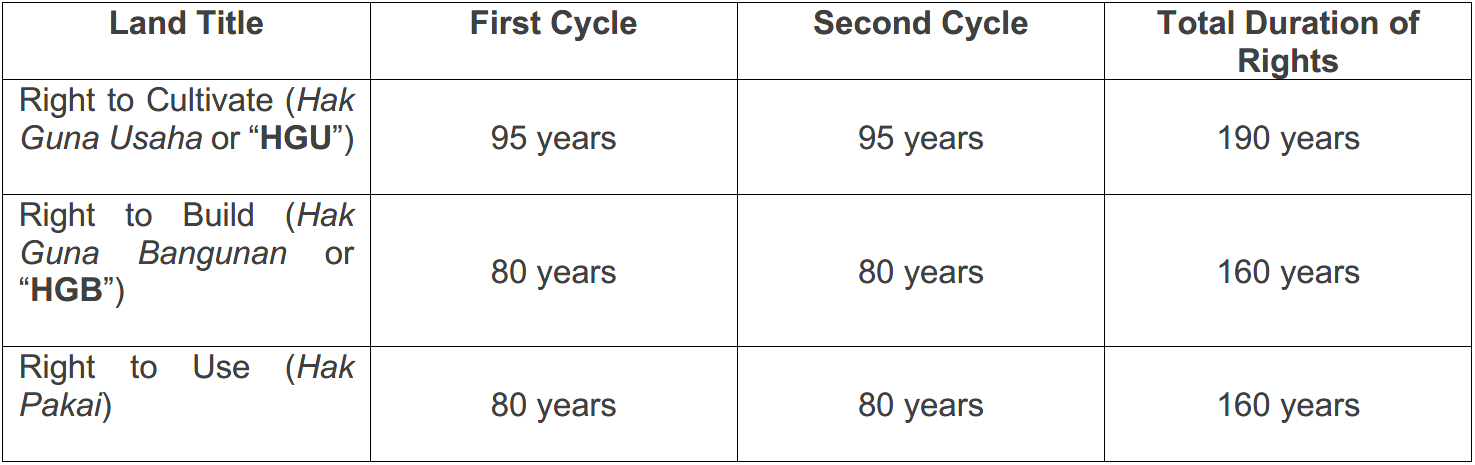
In relation to the above, Article 18(4) of GR 12/2023 (as amended by GR 29/2024) stipulates that the IKN Authority shall conduct an evaluation 5 (five) years after the granting of the first cycle of rights to assess the fulfillment of the following requirements:
- The land is still being properly utilized and managed in accordance with its condition, nature, and the purpose for which the rights were granted;
- The holder of the rights still meets the qualifications to be a rights holder;
- The conditions for granting the rights are being met by the rights holder;
- The land use is still in accordance with the spatial planning; and
- The land is not indicated to be abandoned.
It is further regulated that within 10 (ten) years before the expiration of the first cycle of the rights, an entrepreneur may apply for the granting of the rights for a second cycle as stated in the table above.
♦ Employment of Foreign Workers
GR 29/2024 also adds new provisions regarding the provisions of employment of foreign workers. Articles 22(2a) and (2b) of GR 12/2023 (as amended by GR 29/2024) stipulate that entrepreneurs who conduct business activities in the IKN may employ foreign workers for certain positions in accordance with the applicable laws and regulations. Further, each entrepreneur who employs foreign workers is required to:
- appoint an Indonesian citizen as a companion worker for the foreign worker;
- provide education and job training for the companion worker of the foreign worker in accordance with the qualifications of the position held by the foreign worker; and
- repatriate the foreign worker to their country of origin after the expiration of their employment contract.
♦ Housing and Residential Areas
Regarding the provisions on housing and residential areas, GR 29/2024 primarily amends the regulations concerning incentives for entrepreneurs who are going to fulfill balanced housing obligations in the IKN area.
Article 25 of GR 12/2023 (as amended by GR 29/2024) stipulates that business actors in the field of housing and residential areas who have not yet fulfilled the balanced housing obligations in other regions may fulfill these obligations in the IKN area with taking into account the detailed plans and spatial planning of the IKN. This may be done by applying to the Head of the IKN Authority, with the option to either develop balanced housing in the IKN area or pay a conversion fee for balanced housing fulfillment.
The application must be equipped with a self-declaration of the obligation to fulfill balanced housing and must be copied to the Ministry of Public Works and Housing and the Ministry of Home Affairs. The Head of the IKN Authority shall determine the implementation of the balanced housing obligation and report the results at least once a year to the Ministry of Public Works and Housing and the Ministry of Home Affairs.
These entrepreneurs shall be provided with incentives in the form of:
- Assistance with housing development programs;
- Tax relief for low-cost housing in accordance with the provisions of laws and regulations;
- Assistance with infrastructure, facilities, and public utilities;
- Facilitation of land acquisition for housing development and its expansion;
- Support for accessibility to balanced housing locations within the IKN area;
- Exemption from the Land and Building Acquisition Duty (“BPHTB”);
- Temporary relief from Land and Building Tax (“PBB”); and/or
- Awards for achievements in the field of balanced housing.
The exemption from BPHTB and the temporary relief from PBB shall also apply to consumers and shall be proposed by the Head of the IKN Authority.
♦ Special Regional Tax Incentives and Special Revenues
GR 29/2024 also amends provisions regarding tax incentives and special revenues, as well as implementation of investment activities. Article 26 of GR 12/2023 (as amended by GR 29/2024) stipulates that the IKN Authority is authorized to provide special tax incentives and special revenues for the IKN, as well as facilitate the provision of land, infrastructure, and facilities for investment activities in the IKN. Further, as regulated under Article 67 of GR 12/2023 (as amended by GR 29/2024), the special regional tax incentives and special revenues for the IKN consist of:
- Incentives in the form of reductions, reliefs, or exemptions from the special regional taxes of the IKN; and
- Incentives in the form of reductions, reliefs, or exemptions from the special revenues of the IKN.
Article 68 of GR 12/2023 (as amended by GR 29/2024) stipulates that the facilitation, provision of land, and infrastructure for the implementation of investment activities as mentioned above shall consist of:
- Provision of land or locations for entrepreneurs;
- Provision of infrastructure and facilities;
- Ensuring investment comfort and security; and/or
- Facilitating access to a ready and skilled workforce.
We will keep you updated with the latest information and regulations in relation to the development of the IKN in due course.
AKSET
Please contact Johannes C. Sahetapy-Engel (jsahetapyengel@aksetlaw.com), M. Raehan A. Fadila (mfadila@aksetlaw.com), or Arthur Basa Okuli Nainggolan (anainggolan@aksetlaw.com) for further information.
Disclaimer:
The foregoing material is the property of AKSET and may not be used by any other party without prior written consent. The information herein is of general nature and should not be treated as legal advice, nor shall it be relied upon by any party for any circumstance. Specific legal advice should be sought by interested parties to address their particular circumstances.
Any links contained in this document are for informational purposes and are available and relevant at time this publication is made. We provide no liability whatsoever in respect of any information or content in such links.
Amendments on Infrastructure Financing Through Limited Management Rights Regulation
To optimize State-Owned Goods and assets of State-Owned Enterprises (Badan Usaha Milik Negara or "BUMN") and to finally enhance the operational function of such State-Owned Goods and assets of BUMN, Presidential Regulation No. 32 of 2020 on Infrastructure Financing Through Limited Management Rights was issued in the year 2020.
In relation to the above, Presidential Regulation No. 66 of 2024 regarding Amendment to Presidential Regulation Number 32 of 2020 on Infrastructure Financing Through Limited Management Rights ("PR 66/2024") was recently issued to support the participation of business entities in fulfilling the financing needs for infrastructure provision through limited management rights.
The key amendments under the PR 66/2024 are set out below.
♦ Asset Management Criteria
The asset management can be conducted on the following objects:
- State-Owned Assets (Barang Milik Negara or "BMN") of Ministries/Agencies; and
- Assets of BUMN, which assets are separated state assets owned by and recorded in the financial statements of BUMNs to be used for operational and corporate purposes of BUMNs.
PR 66/2024 also adds new BMN or BUMN assets that may be subject to asset management, among others:
- Health infrastructure;
- Regional infrastructure;
- Tourism infrastructure;
- Government office buildings; and
- Housing infrastructure
In addition to the above assets, the Minister/Head of Agency or the Board of Directors of BUMN may propose other types of infrastructures that may be subject to the asset management.
PR 66/2024 also adjusted the minimum requirements for BMN or BUMN’s assets that are subject to asset management:
- assets which have been declared suitable for operation either partially or fully;
- assets which require partners for the improvement of commercial value and/or operational efficiency in accordance with generally accepted international standards;
- assets which have a useful life of infrastructure assets of at least 10 (ten) years;
- for BMN, shall be recorded in the financial statements of Ministries/Agencies which have been audited based on government accounting standards in the previous period; and
- for BUMN’s assets, shall be recorded in audited books for at least 3 (three) consecutive years based on the guidelines for the statement of Indonesian financial accounting standards.
♦ Asset Management Planning and Initiative of Asset Management by Business Entities
The asset management planning shall be conducted by:
- Minister/Head of Agency as user of BMN in the relevant ministry/agency; or
- The Board of Directors of BUMN as the responsible party for the management of the BUMN assets.
Business entities may submit the asset management initiatives to Ministries/Agencies, that act as the user of BMN and/or BUMN as asset owners, with the following criteria:
- to provide added value to assets that become the object of asset management;
- technically integrated with the master plan of the relevant sector in the event that the asset management includes the development or construction of new assets;
- economically and financially feasible; and
- business entities that submit the initiatives must have sufficient financial capacity to finance the implementation of asset management.
The initiating business entities must submit a feasibility study to the Minister/Head of Agency or Board of Directors of BUMN to be reviewed. Once approved, the Minister/Head of Agency or Board of Directors of BUMN shall prepare the asset management planning. Further, the initiating business entities for asset management on BMN assets are given compensation in the form of the right to make an offer by the initiating business entities to match the best offer (right to match).
♦ BMN Assets Management Transactions
BMN asset management transactions shall include preparation and execution of the transaction. PR 66/2024 does not amend any articles regarding the preparation of the transaction regulations. However, for the execution of the transaction, PR 66/2024 provides a new scheme for selecting Assets Management Business Entities (Badan Usaha Pengelola Aset), which are through the following methods:
- Beauty contest method
Article 1 (13) of PR 66/2024 defines beauty contest as a selection method to select BMN Asset Management Business Entity with the best financial and/or technical offer based on criteria that have been determined by Contracting Agency (“PJPK”). Article 16(3) of PR 66/2024 stipulates that beauty contests may be conducted electronically which is organized by Ministries/Agencies. - Direct appointment
Article 16(4) of PR 66/2024 stipulates that direct appointment shall be conducted in the event of:- expansion of asset management for BMN which was previously managed by the same business entity;
- extension of asset management period by the same business entity; or
- re-beauty contest failed.
Additionally, PR 66/2024 adds new provisions whereby the Assets Management Business Entity shall have deposited all the fund (in the form of an upfront payment) resulting from BMN assets management into the account of Asset Management Public Service Agency (“BLU”), within 6 (six) months at the latest after the Assets Management Business Entity signs the assets management agreement. Other than that, the Asset Management Business Entity may be subject to the obligation to pay the distribution of excess profits (claw-back) as regulated in the asset management agreement and in accordance with the provisions of laws and regulations.
♦ BUMN Assets Management Transactions
Similar with the BMN asset management transactions, the BUMN assets management transactions shall also include preparation and execution of the transactions.
PR 66/2024 also amends the minimum requirements of the asset management agreement of BUMN into as follows:
- Basis of agreement;
- identity of the parties involved in the agreement;
- Asset management object;
- Asset management result;
- Asset management period;
- disbursement of performance guarantees;
- the purpose of asset utilization and prohibitions on the utilization of assets for purposes other than those that have been agreed upon;
- operational and maintenance responsibilities, including the payment of tax and other obligations arising from the utilization of assets;
- the rights and obligations of the party in possession of the asset to supervise and maintain the performance of asset during its use;
- prohibition for Asset Management Business Entities from pledging BUMN’s assets as collateral to third parties;
- procedures for the transfer and/or return of assets; and
- other matters in accordance with the provisions of laws and regulations.
PR 66/2024 further stipulates that the Asset Management Business Entity must have deposited all the funds in the form of upfront payment resulting from the asset management of BUMN into the PJPK account, within a maximum period of 6 (six) months after the Asset Management Business Entity signs the asset management agreement. The asset management of BUMN is also subject to the obligation to pay claw back.
AKSET
Please contact Inka Kirana (ikirana@aksetlaw.com), M. Raehan A. Fadila (mfadila@aksetlaw.com) or Arthur Basa Okuli Nainggolan (anainggolan@aksetlaw.com) for further information.
Disclaimer:
The foregoing material is the property of AKSET and may not be used by any other party without prior written consent. The information herein is of general nature and should not be treated as legal advice, nor shall it be relied upon by any party for any circumstance. Specific legal advice should be sought by interested parties to address their particular circumstances.
Any links contained in this document are for informational purposes and are available and relevant at time this publication is made. We provide no liability whatsoever in respect of any information or content in such links.
Progress and Development of Ibu Kota Nusantara
The development of Ibu Kota Nusantara (“IKN”) as Indonesia’s new capital city is a project that has attracted significant attention, particularly in its construction progress. The Government stipulates the implementation of the preparation, construction, and relocation of the national capital city through Law Number 3 of 2022 as lastly amended by Law Number 21 of 2023 regarding the National Capital (the “IKN Law”).
The development plan for IKN is further regulated in Presidential Regulation Number 63 of 2022 regarding Details of Master Plan for Ibu Kota Nusantara (“PR 63/2022”). In order to accelerate the development of IKN, the President recently issued Presidential Regulation Number 75 of 2024 on Acceleration of Development of IKN (“PR 75/2024”). Please see our Newsflash on PR 75/2024 in Acceleration of Development of Nusantara Capital
We will now provide further updates on the progress in IKN’s development.
♦ Progress of Development
As of July 15, 2024, based on the data from the Ministry of Public Works and Public Housing (the “Ministry of PUPR”), the development progress of IKN is at 87.58% for the physical progress from 2020 to March 2023 and 44.22% for the physical progress from April 2023 to 2024.
Please note that the information on the progress of IKN development has not been fully integrated. The data below is compiled from press releases, news, and articles.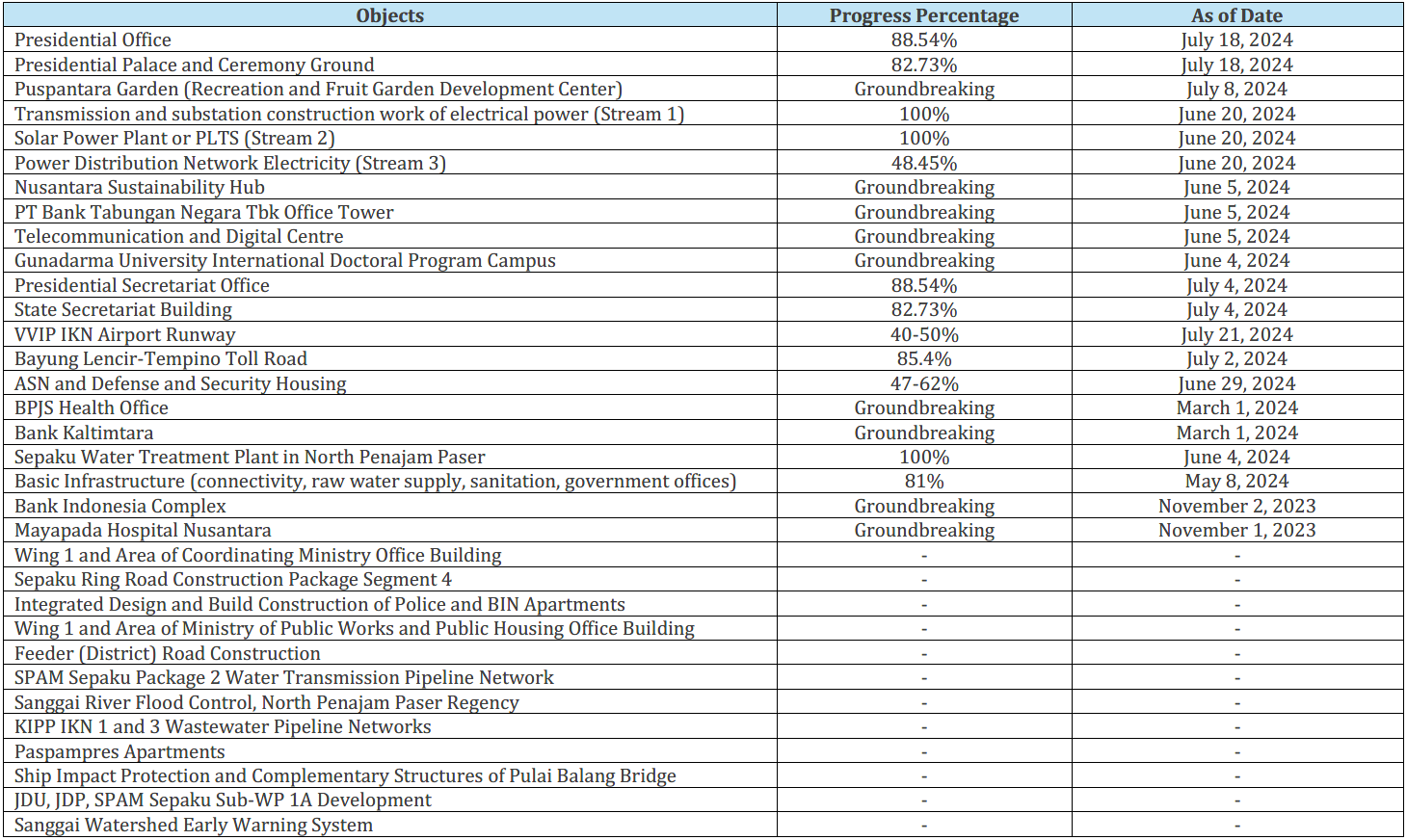 ♦ Investors and Groundbreaking List in IKN
The following are the groundbreaking and a list of investors for the development of IKN that have been executed from September 2023 to June 2024: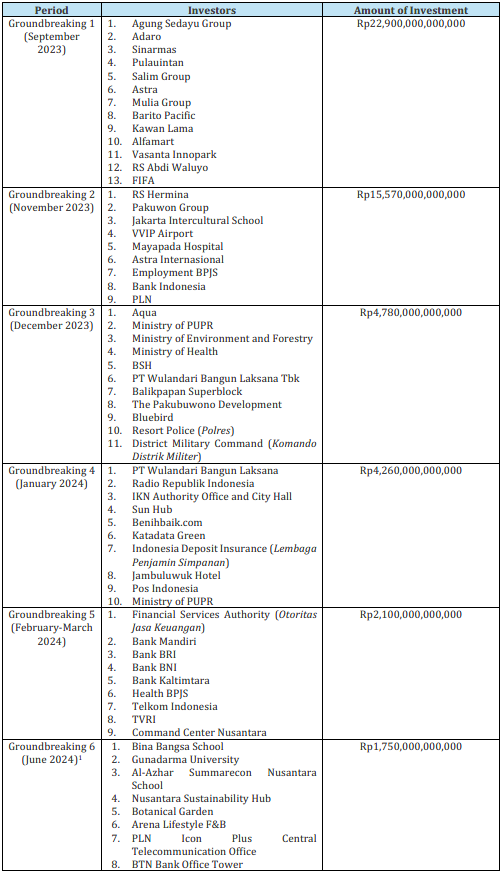 As of July 30, 2024, the President has been working in the IKN for two days. President Joko Widodo is reported to be staying at the Presidential Office in IKN. During the stay, Joko Widodo will be meeting with guests and holding meetings with the officials of IKN.
As the development progresses, we will continue to provide updates on the progress of IKN's development.
AKSET
Please contact Johannes C. Sahetapy-Engel (jsahetapyengel@aksetlaw.com), M. Raehan A. Fadila (mfadila@aksetlaw.com) or Arthur Basa Okuli Nainggolan (anainggolan@aksetlaw.com) for further information.
Disclaimer:
The foregoing material is the property of AKSET and may not be used by any other party without prior written consent. The information herein is of general nature and should not be treated as legal advice, nor shall it be relied upon by any party for any circumstance. Specific legal advice should be sought by interested parties to address their particular circumstances.
Any links contained in this document are for informational purposes and are available and relevant at time this publication is made. We provide no liability whatsoever in respect of any information or content in such links.
Progress and Development of Ibu Kota Nusantara
Acceleration of Development of Nusantara Capital
The President of the Republic of Indonesia recently issued a Presidential Regulation No. 75 of 2024 on the Acceleration of the Development of Nusantara Capital (“Regulation 75/2024”). The background of the issuance of Regulation 75/2024 is to fulfill the provision of basic and/or social services as well as commercial facilities in order to achieve the creation of a habitable city ecosystem in the Central Government Core Area of Nusantara Capital City.
We set out key provisions under Regulation 75/2024 in this Newsflash.
♦ Key Definitions
- The National Capital named Nusantara, hereinafter referred to as the Nusantara Capital (Ibu Kota Nusantara or “IKN”) is defined as a special administrative unit equivalent to a province, whose territory serves as the seat of the National Capital as established and regulated by law.
- The Central Government Core Area (Kawasan Inti Pusat Pemerintahan or “KIPP”) is defined as part of urban area within the strategic national area of the IKN, serving the primary function as the national government center.
- Assets Under the Control of the Nusantara Capital Authority (Aset Dalam Penguasaan or “ADP”) is defined as land within the IKN area that is not related to the administration of the government.
♦ General Overview
Article 2(1) of Regulation 75/2024 provides that the implementation of the acceleration of the development IKN aims to create a livable city ecosystem, particularly in the KIPP, which includes the provision and management of basic and/or social services as well as commercial facilities. The provision and management of basic and/or social services as well as commercial facilities include the following:
 In relation to the table above, Article 4(1) of Regulation 75/2024 provides that in order to accelerate the development of IKN, the Head of IKN Authority conducts the acceleration of the provision of basic and/or social services based on the funding from (i) the State Revenue and Expenditure Budget (Anggaran Pendapatan Belanja Negara or APBN), and (ii) other legitimate sources. In this regard, Article 4(3) of Regulation 75/2024 explains that the funding from other legitimate sources may be conducted through the procurement via direct appointment of entrepreneurs.
♦ Pioneering Entrepreneurs
Regulation 75/2024 also introduces the criteria of pioneering entrepreneurs. Article 5 of Regulation 75/2024 provides that the Head of IKN Authority may determine pioneering entrepreneur(s) for investment purposes from other legitimate sources in accordance with laws and regulations. The following are the criteria for the pioneering entrepreneurs:
- An entrepreneur that has expressed its interest and signed a letter of intent with the IKN Authority; and
- An entrepreneur that is willing to commence the construction in the IKN not later than 5 years from October 31, 2023, which means not later than October 31, 2028.
Furthermore, Article 7(1) of Regulation 75/2024 stipulates that the contribution for the management of ADP payable to IKN Authority by a pioneering entrepreneur may be either (i) at a rate up to Rp0,00, or (ii) be paid in installments.
♦ Determination of Land Value by the Head of IKN Authority
Article 6(1) of Regulation 75/2024 provides that in order to accelerate the implementation of the development of IKN, the Head of IKN Authority determines the land value in the IKN for:
- Management of ADP; and
- Implementation of Investments in the IKN.
Further, Article 6(2) of Regulation 75/2024 provides that the land value determined by the Head of IKN Authority based on the Land Valuation Zone, which follows the determination of the land value by a public appraiser (penilai publik).
Article 1(15) of Regulation 75/2024 provides that Land Valuation Zone is defined as a geographic zone consisting of one or more taxable objects that have a consistent average indicative value, bounded by the boundaries of ownership/possession of taxable objects within the administrative area unit of villages/sub-districts, without being bound by block boundaries.
♦ Certainty of Land Title Period
Article 9(1) of Regulation 75/2024 stipulates that the IKN Authority provides assurance of the period of the land titles through one initial cycle. Subsequently, the IKN Authority may grant a second cycle renewal to entrepreneurs, which possibility may be included in an agreement between the IKN Authority and an entrepreneur. The cycle includes the following:
 Furthermore, Article 9(4) of Regulation 75/2024 stipulates that the IKN Authority shall conduct an evaluation 5 years after the granting of the first cycle of land titles to assess the fulfillment of the following conditions:
- The land is still properly utilized and managed in accordance with its condition, nature, and the purpose for which the title is granted;
- The title holder still meets the requirements to hold the title;
- The conditions for granting the title are being met by the right holder;
- The land use is still in accordance with the spatial planning; and
- The land is not indicated to be abandoned.
The issuance of Regulation 75/2024 to some extent may be fresh air or advancement to the investors as the Government has set a legal certainty of land title periods. We will keep you updated with the latest information and regulations in relation to the development of IKN.
AKSET
Please contact Johannes C. Sahetapy-Engel (jsahetapyengel@aksetlaw.com) or M. Raehan A. Fadila (mfadila@aksetlaw.com) for further information.
Disclaimer:
The foregoing material is the property of AKSET and may not be used by any other party without prior written consent. The information herein is of general nature and should not be treated as legal advice, nor shall it be relied upon by any party for any circumstance. Specific legal advice should be sought by interested parties to address their particular circumstances.
Any links contained in this document are for informational purposes and are available and relevant at time this publication is made. We provide no liability whatsoever in respect of any information or content in such links.
Acceleration of Development of Nusantara Capital
Maternity And Paternity Leaves Are Further Regulated
The Government finally enacted Law No. 4 of 2024 dated July 2, 2024 on Mothers and Children Welfare During the First Thousand Days of Life Phase (the “Mother and Child Law”). The Mother and Child Law contains 9 chapters, 46 articles. The Mother and Child Law came into effect from the date of its enactment.
In this Newsflash, we specifically discuss the provisions regarding maternity and paternity leave, as well as other benefits of working parents regulated under the Mother and Child Law.
♦ General Overview
The Mother and Child Law governs certain rights and obligations of mothers, fathers, as well as children, duties and authorities in administering mothers and children welfare, data and information, funding, and community participation. Under the Mother and Child Law, the term “children” pertains to those within the first thousand days of life, which term is defined as persons whose life begins from the formation of the fetus in the womb until they become 2 years old.
Prior to the issuance of the Mother and Child Law, maternity and paternity leave, miscarriage leave, and their paid leave are governed only under Law Number 13 of 2003 dated March 25, 2003 on Manpower as lastly amended by Government Regulation in Lieu of Law Number 2 of 2022 dated December 20th, 2022 on Job Creation (collectively, the "Manpower Law"). The maternity and paternity leave, miscarriage leave, and other benefits of working parents under the Manpower Law shall continue to apply provided that they do not conflict with the provisions of the Mother and Child Law.
♦ Maternity Leave, Miscarriage Leave, and Salary Structure During Leave Days
The Mother and Child Law stipulates rights for all mothers, such as the right to health services, nutritional security, family planning services, social welfare, accompaniment, a sense of security and comfort, consultation services, psychological services, religious guidance, and education regarding childcare. In addition, every mother has the right to provide exclusive breast milk until a child is 6 months old, and to continue breastfeeding until the child is 2 years old, accompanied by complementary food.
We set out below the comparison of entitlements for female employees under the Manpower Law and the Mother and Child Law:

♦ Paternity Leave
We set out below the comparison of entitlements of male employees between the Manpower Law and the Mother and Child Law:
 In addition to the paternity leave, husbands shall be given sufficient time to accompany their wives and/or children in the following circumstances:
- Wives who experience health problems, health issues, and/or postpartum complications or miscarriage;
- Children who are born while experiencing health problems, health issues, and/or complications;
- The wife who gave birth passed away; and/or
- The newly born children passed away.
♦ Sanctions
Please be informed that the entitlements under the Mother and Child Law for working parents shall constitute employment rights. While the Mother and Child Law does not provide any specific sanctions in the event of noncompliance by employers, please note that Articles 185 and 186 of the Manpower Law stipulate that an employer who violates the provisions of maternity, paternity, and miscarriage leave may be subject to imprisonment between 1 month and 4 years and/or a monetary fine between Rp100 million and Rp400 million.
While the above provisions are in force regardless of whether these provisions are in employment agreements, company regulations, and/or collective labor agreements, we recommend for employers to revisit their employment agreements, company regulations, and/or collective labor agreements, or internal policies to ensure consistency with the Mother and Child Law in their policies and/or internal regulations to ensure compliance with prevailing Indonesian laws and regulations.
AKSET
Please contact Johannes C. Sahetapy-Engel (jsahetapyengel@aksetlaw.com), Thomas P. Wijaya (twijaya@aksetlaw.com), or Arthur Basa Okuli Nainggolan (anainggolan@aksetlaw.com) for further information.
Disclaimer:
The foregoing material is the property of AKSET and may not be used by any other party without prior written consent. The information herein is of general nature and should not be treated as legal advice, nor shall it be relied upon by any party for any circumstance. Specific legal advice should be sought by interested parties to address their particular circumstances.
Any links contained in this document are for informational purposes and are available and relevant at time this publication is made. We provide no liability whatsoever in respect of any information or content in such links.
Maternity And Paternity Leaves Are Further Regulated