
Prevention Of Land Cases Regulation
In the year 2020, the Minister of Agrarian Affairs and Spatial Planning/Head of the National Land Agency (the “Minister”) issued a regulation on the land cases management and settlement. Due to the high number of land cases that tend to occur repeatedly, it is necessary to have a legal instrument that prevents the occurrence of these cases, particularly cases relating to ownership and utilization of land. On April 3, 2024, the Minister issued the Minister of Agrarian Affairs and Spatial Planning/Head of the National Land Agency Regulation Number 15 of 2024 on the Prevention of Land Cases (the “Minister Reg. 15/2024”).
We set out below key provisions under the Minister Reg. 15/2024 in this Newsflash.
♦ Stages of Case Prevention
Article 2 of Minister Reg. 15/2024 stipulates that case prevention is divided into the following stages:
-
- Case identification
Case identification is conducted to determine the causes of cases, whether originating from internal factors (such as the lack of order of land administration, human resources within the Ministry of Agrarian Affairs and Spatial Planning/National Land Agency, Regional Land Offices or Land Offices, or non-integrated information systems), as well as external factors (such as criminal acts in the land sector, document discrepancies, or insufficient public knowledge of land laws).The case identification also involves conducting an inventory and compiling the results of case identification. The inventory involves the following activities:-
- Collecting data: collecting cases handled and resolved in the case management information system within the Ministry;
- Collecting issues: gathering information from mass media sources;
- Collecting academic research findings: gathering data and/or information from normative and/or empirical research related to case data;
- Collecting regulations: gathering laws and regulations related to the case data; and/or
- Collecting data/information from stakeholders and the public.
-
- Case identification
The results of the case identification are compiled into a report detailing inventory findings, relevant parties handling the case, inferred impacts, a summary of findings, and conclusions.
-
- Assessment of identification results
Article 14 of the Minister Reg. 15/2024 stipulates that the assessment of case identification results involves evaluating cases based on (i) urgency, (ii) seriousness, (iii) developments, (iv) complexity, and/or (v) resulting losses. The assessment of case identification results is carried out by analyzing causal factors according to case anatomy and typology and formulating the root issues.The assessment of case identification results is also documented in a report. - Formulation of Recommendations
Article 16 of the Minister Reg. 15/2024 provides that the formulation of recommendations is based on the case identification report. The recommendations include regulatory analysis, policy strategies, cooperation among institutions strategies, and a case prevention work plan. The recommendations are made in a report and signed by the Director General.
- Assessment of identification results
♦ Case Prevention Strategies
Article 17 of the Minister Reg. 15/2024 stipulates that the case prevention strategies are implemented by the Ministry of Agrarian Affairs and Spatial Planning/National Land Agency, Regional Land Office, and Land Office and formulated in the annual working plan. These strategies involve activities such as improving the quality of human resources, enhancing information systems, reviewing regulations, socialization, and/or coordinating and collaboration.
♦ Monitoring and Evaluation
Article 19 of the Minister Reg. 15/2024 stipulates that the monitoring and evaluation are conducted against the implementation of the recommendations as outlined above. Monitoring and evaluation are conducted periodically by the Directorate General at least once a year and the Regional Land Office at least twice a year. The results of the monitoring and evaluation are documented in a report and submitted to the Minister. If any recommendations have not been implemented, the Directorate General will report to the inspectorate general for further investigation.
AKSET
Please contact Inka Kirana (ikirana@aksetlaw.com), M. Raehan A. Fadila (mfadila@aksetlaw.com) or Arthur Basa Okuli Nainggolan (anainggolan@aksetlaw.com) for further information.
Disclaimer:
The foregoing material is the property of AKSET and may not be used by any other party without prior written consent. The information herein is of general nature and should not be treated as legal advice, nor shall it be relied upon by any party for any circumstance. Specific legal advice should be sought by interested parties to address their particular circumstances.
Any links contained in this document are for informational purposes and are available and relevant at time this publication is made. We provide no liability whatsoever in respect of any information or content in such links.

Prevention Of Land Cases Regulation

Mandatory Public Housing Savings for Employees
On May 20, 2024, the Government issued Government Regulation No. 21 of 2024 which amends Government Regulation No. 25 of 2020 dated May 20, 2020 on the Implementation of Public Housing Savings (collectively, the “Government Regulation”). The Government Regulation is the implementing regulation of Law No. 4 of 2016 dated March 24, 2016 on Public Housing Savings (In Bahasa Indonesia, Tabungan Perumahan Rakyat or “Tapera”).
The Tapera is a program created by the Government for the organization of a housing and savings program for low-medium income employees who wish to purchase affordable housing. The Tapera is administered by the Public Housing Savings Management Agency (in Bahasa Indonesia, Badan Pengelola Tabungan Perumahan Rakyat or “BP Tapera”).
In this Newsflash, we will specifically discuss the Tapera provisions from the perspective of private employers (i.e., other than the Government) and private employees. We set out below the key points of the Government Regulation.
♦ Subject of Tapera
The Government Regulation applies to (i) Prospective Civil Servants, (ii) Civil Service Employees, (iii) Indonesian National Armed Forces Soldiers, (iv) Indonesian National Armed Forces Cadets, (v) Members of the Indonesian National Police, (vi) State Officials, (vii) State-Owned Enterprises Employee, (viii) Regional-Owned Enterprises Employee, (ix) Village-Owned Enterprises Employees, (x) Private Employees, (xi) Foreign Nationals working in Indonesia for a minimum of six months, and (xii) Self-Employed Individuals.
The Tapera is mandatory for every private employee who is at least 20 years old or married and earns at least the minimum wage. Employers are required to register their employees as participants of the Tapera program with BP Tapera at the latest on May 20, 2027.
♦ Tapera Contributions
The amount of the Tapera contribution for participants is determined by a specific percentage of their reported monthly salary for employees. According to the Government Regulation, the rate of Tapera contribution is 3%, with 0.5% borne by the employer and the remaining 2.5% borne by the employee. This means that every month, an employee’s salary will be deducted 2.5% and an employer shall contribute 0.5% for the Tapera.
The employer is responsible for collecting and submitting the Tapera contribution to BP Tapera no later than the 10th day of each month.
♦ Utilization of Tapera
The Tapera is used to finance participants’ housing need which includes (i) home ownership, (ii) home construction, and (iii) home improvement.
The Government Regulation stipulates that in order to utilize their Tapera savings, participants must (i) be a Tapera participant for at least 12 (twelve) months, (ii) belong to the low-income group, (iii) not yet own a house, and/or (iv) use their Tapera savings for financing their first home.
♦ Obligation of Employers
In relation to the Tapera, the Government Regulation provides certain obligations for the employers. Such obligations include: (i) registering employees as participants, (ii) collecting the Tapera savings of the employees through salary deductions; (iii) depositing the Tapera savings for which they are responsible, and the employee’s Tapera savings accompanied by a detailed breakdown of the Tapera savings payments within the designated timeframe, (iv) updating data of the employees related to the Tapera membership; and (v) maintaining comprehensive records of the Tapera savings payments for which they are responsible, as well as those of the employees.
♦ Termination of Tapera Membership
The Tapera membership may be terminated due to several reasons, including: (i) the retirement of employees, (ii) reaching the age of 58 (fifty-eight) years for self-employed individuals; (iii) the participant’s passing away; or (d) an employee who does not meet the criteria as a participant for 5 (five) consecutive years.
Participants whose membership is terminated are entitled to a refund of their accumulated Tapera. The refund will be processed by BP Tapera and must be refunded no later than 3 (three) months after the membership termination.
♦ Sanction
Employers who do not register their employees as Tapera participants and/or who do not pay or are late in paying Tapera contributions may be subject to administrative sanctions, including (i) written warnings, (ii) administrative fines, (iii) public disclosure of non-compliance, (iv) suspension of business licenses, and/or (v) revocation of business licenses.
AKSET
Please contact Johannes C. Sahetapy-Engel (jsahetapyengel@aksetlaw.com), Thomas P. Wijaya (twijaya@aksetlaw.com), or Azzahra Saffanisa S. (asudiardiputri@aksetlaw.com) for further information.
Disclaimer:
The foregoing material is the property of AKSET and may not be used by any other party without prior written consent. The information herein is of general nature and should not be treated as legal advice, nor shall it be relied upon by any party for any circumstance. Specific legal advice should be sought by interested parties to address their particular circumstances.
Any links contained in this document are for informational purposes and are available and relevant at time this publication is made. We provide no liability whatsoever in respect of any information or content in such links.
Mandatory Public Housing Savings for Employees
Updates on Entry of Hand-Carry Goods
We issued our Newsflash regarding the new importing provisions for entry of hand-carry goods as regulated under the Minister of Trade (the “MOT”) Regulation No. 36 of 2023 on Import Policies and Regulations as amended by the MOT Regulation No. 3 of 2024 (collectively, “Regulation 36/2023”). Regulation 36/2023 has been effective since March 10, 2024.
Under Regulation 36/2023, returning passengers entering Indonesia (the “Passengers”) may bring certain goods without any import license subject to certain limitations. Please see our Newsflash for more information on such limitations: New Importing Provisions for Entry of Hand-Carry Goods.
On April 29, 2024, the MOT issued Regulation No. 7 of 2024 on the amendment to Regulation 36/2023, which has been effective since May 6, 2024 (the “Regulation 7/2024”). We set out below the key points of Regulation 7/2024, specifically regarding the entry of hand-carry goods.
♦ Purpose for Import of Goods
Regulation 7/2024 clarifies that imports of goods are now permitted for both commercial and non-commercial purposes. In this case, the commercial objective refers to economic activities related to the following:
- Imported goods transactions carried out by importers with the aim of transferring ownership or use of goods to obtain rewards or compensation; or
- Use of imported goods by importers as raw and/or auxiliary materials to support production processes or business activities.
♦ Import of Hand-Carry Goods under Regulation 7/2024
Before Regulation 7/2024, Regulation 36/2023 stipulated certain restrictions on the entry of non-commercial goods consisting of personal belongings of the Passengers. The restrictions were listed comprehensively in Attachment IV to Regulation 36/2023.
Regulation 7/2024 amends Attachment IV of Regulation 36/2023. Specifically regarding the import of hand-carry goods by the Passengers, now there are no limits that have been set in terms of their import types and amounts, with the exception of dangerous goods and goods that are prohibited from being imported.
In addition, Regulation 7/2024 stipulates that all imports of goods belonging to the Passengers sent via postal operators are permitted to be imported in new and/or used condition unless the goods is categorized as goods related to health, safety, and/or the environment as listed in Attachments I and II of Regulation 7/2024.
♦ Current Restrictions on Import of Hand-Carry Goods
Although Regulation 7/2024 no longer regulates the restrictions on the entry of hand-carry goods, Passengers must still take into account the imposition of import duties as described under the Minister of Finance Regulation No. 203/PMK.04/2017 of 2017 dated December 27, 2017 on Provisions for Export and Import of Goods Carried by Passengers and Transportation Crew (“Regulation 203/2017”).
According to Regulation 203/2017, the Passengers are exempted from the import duty if the value of a Passenger’s hand-carry goods imported for personal use is a maximum of free on board (FOB) USD 500 (five hundred United States Dollars) per person for each arrival.
Apart from being granted import duty exemption, excise exemption is granted for the import of the following goods by the Passengers for personal use:
- Maximum of 200 (two hundred) cigarettes, 25 (twenty-five) cigars, or 100 (one hundred) grams sliced tobacco/other tobacco products; and/or
- Maximum of 1 (one) liter of drink containing ethyl alcohol.
AKSET
Please contact Johannes C. Sahetapy-Engel (jsahetapyengel@aksetlaw.com) or Ayu Nandini Prameswari (aprameswari@aksetlaw.com) for further information.
Disclaimer:
The foregoing material is the property of AKSET and may not be used by any other party without prior written consent. The information herein is of general nature and should not be treated as legal advice, nor shall it be relied upon by any party for any circumstance. Specific legal advice should be sought by interested parties to address their particular circumstances.
Any links contained in this document are for informational purposes and are available and relevant at time this publication is made. We provide no liability whatsoever in respect of any information or content in such links.
Updates on Entry of Hand-Carry Goods
New Importing Provisions for Entry of Health and Cosmetic Goods
This Newsflash is a part of our Newsflashes in relation to the new importing provisions as regulated under the Minister of Trade (the “MOT”) Regulation No. 36 of 2023 on Import Policies and Regulations as amended by the MOT Regulation No. 3 of 2024 (collectively, the “New Import Regulation”). The New Import Regulation is effective since March 10, 2024.
Under the New Import Regulation, imports of certain goods is subject to certain limitations. As one of the implementing regulations of the New Import Regulation, the Minister of Industry (the “MOI”) issued MOI Regulation No. 4 of 2024 dated January 30, 2024 on Procedures for Issuing Technical Considerations for Imports of Traditional Medicine, Health Supplements, Cosmetics and Household Health Supplies (“Regulation 4/2024”). We set out below the key points of Regulation 4/2024.
♦ Types of Goods
To support the stability of local health and cosmetic goods industry and increase the use of such local goods, Regulation 4/2024 specifically sets out the limitations on the import of the following goods: (i) traditional medicine; (ii) health supplements; (iii) cosmetics; and (iv) household health supplies, as listed under Annex I of Regulation 4/2024 (such goods collectively, the “Goods”).
♦ Limitation on Imports of Health and Cosmetic Goods
Companies that hold a General Import Identification Number (Angka Pengenal Impor Umum or an “API-U”) are only able to import the Goods after obtaining the Import Approval from the MOT. However, to obtain the Import Approval, the holder of an API-U must first obtain a Technical Consideration issued by the MOI (the “Consideration”).
Based on the type of Goods, the Considerations are categorized into: (i) a Consideration for traditional medicines and health supplements; and (ii) a Consideration for cosmetic and household health supplies. A Consideration for each category can only be published one time within one calendar year for the same Harmonized System Code (the “HS Code”).
To obtain a Consideration, a holder of an API-U must fulfill the commitments for each of the relevant Business Classification Number (Klasifikasi Baku Lapangan Usaha Indonesia or KBLI) and submit the required documents electronically through the Indonesian National Single Window System (“INSWS”) that will be redirected to the MOI’s licensing system.
A Consideration will be issued by the MOI after the verification of the completeness of the required documents within 5 (five) business days.
♦ Amended Consideration
Companies that have obtained a Consideration and an Import Approval may submit an application to obtain the amended version of the Consideration in the case of any changes made related to the import data (e.g., the identity of the holder of the API-U, relevant HS Codes, description of Goods, amount of Goods, loading and destination port, etc.).
However, in the case of an increase in the amount of allocation for import needs, such an increase may only be carried out if: (i) the holder of API-U has realized its imports of at least 75% (seventy-five percent) of the total allocated import needs that have been approved; and (ii) the change in the amount of import allocation for each HS Codes is equal to or greater than the amount of the realized imports for the current year.
The validity period of the amended Consideration shall follow the validity of the original Consideration.
♦ Reporting Obligation
After obtaining the Consideration, the holder of an API-U is required to submit the following documents through the INSWS, subject to the relevant laws and regulations:
- the Import Approval document along with the changes;
- the Import Realization Report; and
- the Distribution Realization Report.
♦ Sanctions
The holder of an API-U may be subject to administrative sanctions if such a holder does not submit the required realization report and/or it violates Regulation 4/2024.
As a note, the administrative sanction is in the form of a written warning, rejection for the request of Consideration for the following year and/or recommendation on the revocation of the issued Import Approval.
♦ Changes on New Import Regulation
On April 16, 2024, the Secretary of the Coordinating Ministry for Economic Affairs, Susiwijono Moegiarso announced that the New Import Regulation would be revised. However, the revision of the New Import Regulation is still under the discussion of the relevant government authorities. As such, we will provide an update on this Newsflash if there are any changes made under the revised New Import Regulation.
AKSET
Please contact Johannes C. Sahetapy-Engel (jsahetapyengel@aksetlaw.com), Adhitya Ramadhan (aramadhan@aksetlaw.com) or Ayu Nandini Prameswari (aprameswari@aksetlaw.com) for further information.
Disclaimer:
The foregoing material is the property of AKSET and may not be used by any other party without prior written consent. The information herein is of general nature and should not be treated as legal advice, nor shall it be relied upon by any party for any circumstance. Specific legal advice should be sought by interested parties to address their particular circumstances.
Any links contained in this document are for informational purposes and are available and relevant at time this publication is made. We provide no liability whatsoever in respect of any information or content in such links.
New Importing Provisions for Entry of Health and Cosmetic Goods
Mandatory Technical Considerations for Imports of Iron or Steel, Alloy Steel, and Their Derivatives Products
In order to support the stability of the national steel industry and to improve the quality of domestic steel products that utilize iron or steel, alloy steel and their derivatives products as well as to increase the use of domestic iron or steel, alloy steel and their derivative products as capital goods, raw materials and /or auxiliary materials for industrial purposes, as well as consumer goods, and commodities other than those used as capital goods, raw materials and/or auxiliary materials for industrial purposes, the Minister of Industry (the “MOI”) views that it is necessary to regulate the granting of technical considerations for the imports of the above commodities.
Based on the above, the MO issued MOI Regulation No. 1 of 2024 on Procedures for Issuance of Technical Considerations for Imports of Iron or Steel, Alloy Steel, and their Derivatives Products dated January 8, 2024 (“Regulation 1/2024”). We set out below the key provisions of Regulation 1/2024.
♦ Key Definitions
Key definitions under Regulation 1/2024 are as follows:
1. Iron or Steel is defined as a product from the smelting of carbon iron or steel with a number of further alloying elements and fouling elements, and/or goods produced from such products.
2. Alloy Steel is defined as a product from the smelting of steel which contains one or more alloying elements.
3. Iron or Steel and Alloy Steel Derivatives Products (the “Derivatives Products”) are defined as products resulting from advanced processing of Iron or Steel and Alloy Steels in the basic form of bars or sheets or the result of the assembly or merging process of the products from the advanced processing of Iron or Steel and Alloy Steel in basic form.
4. Technical Considerations for Imports of Iron or Steel, Alloy Steel, and their Derivatives Products (each, a “Technical Consideration”) are defined as a technical consideration letter which is used as a requirement to obtain an approval for imports of Iron or Steel, Alloy Steel, and their Derivatives Products.
5. Supply Center for Raw Materials and/or Auxiliary Materials (Pusat Penyedia Bahan Baku dan/atau Bahan Penolong) for Iron or Steel, Alloy Steel, and their Derivatives Products (“PPBB”), is defined as a business entity that provides Raw Materials and/or Auxiliary Materials to fulfill the needs of Raw Materials and/or Auxiliary Materials for Small Industries and Medium Industries.
♦ General Provisions of Regulation 1/2024
Article 2(1) of Regulation 1/2024 provides that a business party may import Iron or Steel, Alloy Steel, and the Derivatives Products after obtaining an import approval from the ministry that organizes government affairs in the trade sector (i.e., the Ministry of Trade).
Further, Article 3(1) of Regulation 1/2024 stipulates that to obtain an import approval, a business party must obtain a Technical Consideration issued by the MOI. In this regard, Article 3(3) of Regulation 1/2024 stipulates that the MOI shall delegate the authority to issue Technical Considerations and amendments to a Technical Consideration to the Director-General.
In addition, Article 4(1) of Regulation 1/2024 elaborates that the business parties that may import Iron or Steel, Alloy Steel, and their Derivatives Products are as follows:
- Industrial Companies;
- Industrial Service Companies;
- Non-Industrial Companies which own an API-P;
- Non-Industrial Companies which own an API-U; and
- the PPBB.
♦ Requirements to Submit an Application for the Issuance of the Technical Consideration
Article 4(2) of Regulation 1/2024 stipulates that in order to be able to submit an application for the issuance of the Technical Consideration the business actor(s) must fulfill the following requirements: Please note that Article 5 of Regulation 1/2024 stipulates that an application for the issuance of the Technical Consideration shall be submitted electronically to the Director-General through the SINSW which will be redirected to the SIINas.
Regulation 1/2024 also provides the required documents and the detailed procedures for each business part for the application of a Technical Consideration. Please contact us through the below emails if you wish us to provide you with our advice in relation to the required documents and the detailed procedures for the application of a Technical Consideration.
AKSET
Please contact Johannes C. Sahetapy-Engel (jsahetapyengel@aksetlaw.com), Adhitya Ramadhan (aramadhan@aksetlaw.com), and M. Raehan A. Fadila (mfadila@aksetlaw.com) for further information.
Disclaimer:
The foregoing material is the property of AKSET and may not be used by any other party without prior written consent. The information herein is of general nature and should not be treated as legal advice, nor shall it be relied upon by any party for any circumstance. Specific legal advice should be sought by interested parties to address their particular circumstances.
Any links contained in this document are for informational purposes and are available and relevant at time this publication is made. We provide no liability whatsoever in respect of any information or content in such links.
PUBLIC COMPANIES’ REPORTING OBLIGATION ON OWNERSHIP OF OR CHANGES IN SHARES OWNERSHIP AND REPORTS ON SHARE-PLEDGES
On February 28, 2024, the Financial Services Authority (Otoritas Jasa Keuangan, “OJK”) issued and enacted Regulation No. 4 of 2024 regarding the Reports on Ownership of or Any Changes in Shares Ownership in Public Companies and Reports on Share-Pledging Activities in Public Companies (“POJK 4/2024”).
Based on the consideration of POJK 4/2024, OJK was aware of the needs to adjust the reporting mechanism of the shares ownership in public companies or any changes to such ownership to accord the international standards or the result of comparative studies with other countries. In addition to this, given that shareholders in public companies may likely conduct share-pledging activities, it is essential to set out a specific provision to require public companies to report such share-pledging activities.
In principle, POJK 4/2024 is intended to increase the quality of information disclosure by certain shareholders and the quality of supervision, which includes the procurement of an electronic-based reporting system.
POJK 4/2024 will come into effect within 6 (six) months as of its enactment (i.e., August 28, 2024). Upon its coming into effect, OJK Regulation No. 11/POJK.04/2017 dated March 14, 2017 on Reports of Ownership of or Any Changes to the Ownership of Shares in Public Companies is revoked and declared invalid.
We set out below key provisions of POJK 4/2024.
-
- Reporting Obligation of Ownership of or Any Changes in Ownership of Public Companies
Members of the Board of Directors (“BOD”) or members of the Board of Commissioners (“BOC”) of a public company who own direct or indirect shares with voting rights, must submit the report of ownership of voting rights over shares of the public company and any changes to such ownership (each report, an “Ownership Report”) to OJK.In addition to the members of the BOD and BOC, the parties with any of the following criteria is required to submit an Ownership Report to OJK:- any party who owns share with voting rights of at least 5% (five percent). Please note that if there is any decrease to the ownership percentage of shares with voting rights so that it becomes less than 5% (five percent), such a party is required to notify the change of ownership of voting rights over shares to OJK through the submission of an Ownership Report[1]; and
- any party who is a controller of a public company, which refers to any party who owns more than or less than 5% (five percent) of shares with voting rights.
The submission of an Ownership Report to OJK must be conducted no later than 5 (five) days as of (i) the occurrence of voting rights over shares, or (ii) any changes to the ownership of voting rights over shares of a public company. Please also note that the information on an Ownership Report shall be made available to the public.
If the changes to the ownership of voting rights over shares occur due to inheritance, then the party who receives the inheritance of shares must notify the relevant changes to OJK through the submission of an Ownership Report.
POJK 4/2024 also provides an exemption to the reporting obligation, provided that the change of ownership of voting rights over shares occurs due to the following reasons:
- A capital increase of a public company, either with or without a pre-emptive right;
- Any corporate action of a public company without involving any transactions by the shareholders.
- Content of the Ownership Report
An Ownership Report shall encompass at least the following information:- name, address, and citizenship;
- name of the public company’s shares;
- number of shares and shares ownership percentage with voting rights over the public company’s shares before and after the transaction;
- type of the transactions being carried out;
- number of shares purchased, sold, or transferred;
- description of shares classification, which refers to the information on whether the shares are classified as ordinary shares or shares with multiple voting rights;
- if the change of ownership is due to a payment transaction, to include the information on the sale or purchase price of each share;
- date of transaction;
- purpose of transaction;
- shares ownership status, both directly and indirectly;
- if there is any indirect share ownership, to include the information on shareholders who are listed in the list of shareholders of public company for the interest of the beneficial owners;
- if an Ownership Report is submitted through a proxy, to include the information on the name of the shareholder who grants the authorization to such proxy;
- if an Ownership Report is made by a certain organized group, to include the information on the details of members of such organized group.
In addition to the above items of information, if the changes of ownership are undertaken by the controlling shareholder of a public company, an Ownership Report shall include an explanation on whether such a controlling shareholder wishes to maintain its control towards the relevant public company.
- Reporting Obligation of Share-Pledging Activities in Public Companies
Shareholders of a public company who pledge the public company’s shares of at least 5 (five) percent) of the voting rights is obliged to submit reports on such share-pledging activities (each report, a “Share-Pledging Report”) to OJK. The five percent is calculated from 1 (one) share-pledging activity or the accumulation of several share-pledging activities. The obligation to submit a Share-Pledging Report shall apply to any change to the percentage unit of the number of shares of the public company during the occurrence of the share-pledging activities.The submission of a Share-Pledging Report to OJK must be conducted no later than 5 (five) days as of the signing of the share-pledging agreement. - Content of the Share-Pledging ReportA Share-Pledging Report shall encompass at least the following information:
- name, address, and citizenship;
- name of the public company’s pledged shares;
- number of shares and ownership percentage of the pledged shares;
- amount of loan encumbered with the pledge of shares;
- if there is any change to the number of the pledged shares, to include the information on the type of transaction or event that results in such a change,
- date and period of agreement;
- if there is any affiliate relationship, to include the information on the nature of the affiliate relationship between the parties.
- Submission of the Ownership Report and the Share-Pledging Report through Electronic System
POJK 4/2024 also includes the government’s intent to establish an electronic system to support the submission of the reporting obligation set out in POJK 4/2024. Upon the availability of such electronic system, an Ownership Report and a Share-Pledging Report must be submitted electronically to OJK no later than 3 days as of (i) the occurrence of ownership of voting rights over shares of a public company or any change to such ownership, or (ii) the signing of the share-pledging agreement. If the foregoing electronic system is not available, an Ownership Report and a Share-Pledging Report shall be submitted to OJK through printed or electronic documents. -
Administrative Sanctions
Failure to submit an Ownership Report or a Share-Pledging Report may result in the imposition of administrative sanctions as set out in POJK 4/2024. Whilst administrative sanctions will be imposed on the party who expressly violates POJK 4/2024, it is also provided that members of a BOD and a BOC of a public company who cause the violation shall also be subject to the imposition of administrative sanctions by OJK.The applicable administrative sanctions under POJK 4/2024 are as follows:
- written reprimand;
- fine which constitutes an obligation to pay a certain amount of money;
- restriction of business activities;
- suspension of business activities;
- revocation of business activities;
- cancellation of approval; and/or
- cancellation of registration.
Please be informed that the above administrative sanctions are not in sequential order. It is fully the discretion of OJK to determine the type of administrative sanctions to be imposed on the relevant violating party(ies). Additionally, the fine may be imposed individually or jointly with the imposition of other administrative sanctions as mentioned above.
In addition to the administrative sanctions, OJK may implement certain actions to any party who violates the provisions under POJK 4/2024. The imposition of administrative sanctions and the implementation of such certain actions may be made publicly available by the OJK.
- Reporting Obligation of Ownership of or Any Changes in Ownership of Public Companies
AKSET
Please contact Johannes C. Sahetapy-Engel (jsahetapyengel@aksetlaw.com), Adhitya Ramadhan (aramadhan@aksetlaw.com), or Almira Siti Nadiva Zulfandiari (azulfandiari@aksetlaw.com) for further information.
Disclaimer:
The foregoing material is the property of AKSET and may not be used by any other party without prior written consent. The information herein is of general nature and should not be treated as legal advice, nor shall it be relied upon by any party for any circumstance. Specific legal advice should be sought by interested parties to address their particular circumstances.
Any links contained in this document are for informational purposes and are available and relevant at time this publication is made. We provide no liability whatsoever in respect of any information or content in such links.
Revisions on the New Importing Provisions for Entry of Hand-Carry Goods
Previously, we issued our Newsflash regarding the new importing provisions for entry of hand-carry goods as regulated under the Minister of Trade (the “MOT”) Regulation No. 36 of 2023 on Import Policies and Regulations as amended by the MOT Regulation No. 3 of 2024 (collectively, the “Import Regulation”). The Import Regulation has been effective since March 10, 2024.
Under the New Import Regulation, returning passengers entering Indonesia (the “Passengers”) may bring certain goods without any import license subject to certain limitations. Please see our Newsflash for more information on such limitations: New Importing Provisions for Entry of Hand-Carry Goods.
However, on April 16, 2024, the Secretary of the Coordinating Ministry for Economic Affairs, Susiwijono Moegiarso, announced that the Import Regulation would be revised. One of the revisions would include the removal of the limitations on the import of hand-carry goods by the Passengers. Such limitations will then only be regulated under the a Minister of Finance regulation.
Since the revision of the Import Regulation is still under the discussion of the relevant government authorities, we will provide an update on this matter once the revision is final and made public.
AKSET
Please contact Johannes C. Sahetapy-Engel (jsahetapyengel@aksetlaw.com) or Ayu Nandini Prameswari (aprameswari@aksetlaw.com) for further information.
Disclaimer:
The foregoing material is the property of AKSET and may not be used by any other party without prior written consent. The information herein is of general nature and should not be treated as legal advice, nor shall it be relied upon by any party for any circumstance. Specific legal advice should be sought by interested parties to address their particular circumstances.
Any links contained in this document are for informational purposes and are available and relevant at time this publication is made. We provide no liability whatsoever in respect of any information or content in such links.
Revisions on the New Importing Provisions for Entry of Hand-Carry Goods
Government Determines 22 Commodities as Strategic Mineral
On April 1, 2024, the Minister of Energy and Mineral Resources (“MEMR”) issued the MEMR Decree No. 69.K/MB.01/MEM.B/2024 on the Stipulation of Types of Commodities Classified as Strategic Minerals (“Decree 69/2024”).
The enactment of Decree 69/2024 is intended to enhance the nation’s domestic and global competitiveness by promoting local mineral processing for strategic industrial development and ultimately increasing the state’s revenue and boosting the national economy.
Introduction of the new strategic mineral classifications will also serve as a reference in relation to the governance (tata kelola) of mineral commodities to prioritize increasing the domestic added value through mineral downstream.
♦ Criteria of Strategic Mineral
Decree 69/2024 stipulates 5 (five) criteria for the strategic minerals are, as follows:
- Minerals for raw materials of strategic industries (e.g., pharmaceutical and cosmetic, healthcare (health industry), transportation (electric vehicle industry), power generation (solar panel industry), capital goods, components, information communications technology industry (ICT), non-ferrous metal and basic metal (defense industry), and so forth);
- minerals that have potential to control the global market through domination of natural resources and/or reserves;
- Minerals that contribute significant amounts of state revenue within the mineral mining sector;
- Minerals that make a dominant contribution to national foreign exchange reserves; and/or
- Minerals that are massively used in strategic industries.
♦ Governance of Mineral Commodities
Stipulation of strategic minerals will be used by relevant government institutions for determining the governance of strategic mineral commodities, among others:
- in making regulations and policies for the governance and commerce of manufacturing industry of minerals and associated minerals, including the scraps or waste of processing and refinery industry;

 Please note that the above list of strategic minerals may be reviewed annually or at any time deemed necessary.
AKSET
Please contact Arfidea D. Saraswati (asaraswati@aksetlaw.com), Johannes C. Sahetapy-Engel (jsahetapyengel@aksetlaw.com) or Radiansyah Suryomahendra Yamin (ryamin@aksetlaw.com).
Disclaimer:
The foregoing material is the property of AKSET and may not be used by any other party without prior written consent. The information herein is of general nature and should not be treated as legal advice, nor shall it be relied upon by any party for any circumstance. Specific legal advice should be sought by interested parties to address their particular circumstances.
Any links contained in this document are for informational purposes and are available and relevant at time this publication is made. We provide no liability whatsoever in respect of any information or content in such links.
Government Determines 22 Commodities as Strategic Mineral
Constitutional Court Decision on Articles Relating to Defamation and False News
On March 21, 2024, the Constitutional Court (in Indonesian, Mahkamah Konstitusi or “MK”) rendered its Decision No. 78/PUU-XXI/2023 (the “Decision”) in relation to the judicial review on Articles 14 and 15 of Law No. 1 of 1946 dated February 26, 1946, on Criminal Law Code (“Law 1/1946”), Article 310(1) of the Indonesian Criminal Code (the “ICC”), and Articles 27(3) and 45(3) of Law No. 11 of 2008 dated April 21, 2008 on Electronic Information and Transactions as amended by Law No. 19 of 2016 dated November 25, 2016 (the “EIT Law”) (collectively, the “Reviewed Articles”).
The judicial review was petitioned by Haris Azhar, Fatiah Maulidiyanty, Yayasan Lembaga Bantuan Hukum Indonesia, and Aliansi Jurnalis Independen (collectively, the “Petitioners”). The Petitioners argued that the Reviewed Articles, which mainly deal with defamation and false news towards an individual, are contrary to the principles of a democratic state. The Petitioners argued that the Reviewed Articles had been utilized to silence, restrict, and criminalize an individual’s criticism, opinion, and beliefs in relation to government policies, the advancement of human rights, as well as the eradication of corruption, collusion, and nepotism. Also, the Reviewed Articles had been commonly categorized as catchall articles (in Indonesian, pasal karet) that did not have any clear measurement in its interpretation and may lead to legal uncertainty.
Further, the Petitioners argued that the Reviewed Articles were contrary to Articles 1(2), 27(3), 28, 28C(2), 28D(1), 28E(2), 28E(3), 28F, 28G(1), 28I(1), 28I(2), 28I(4), 28I(5), 28J(1), 28J(2), and Article I of the Transitional Provisions of the 1945 Constitution of the Republic of Indonesia (collectively, the “Constitution”).
The following table highlights the substance of the Reviewed Articles and the contents of the Decision:
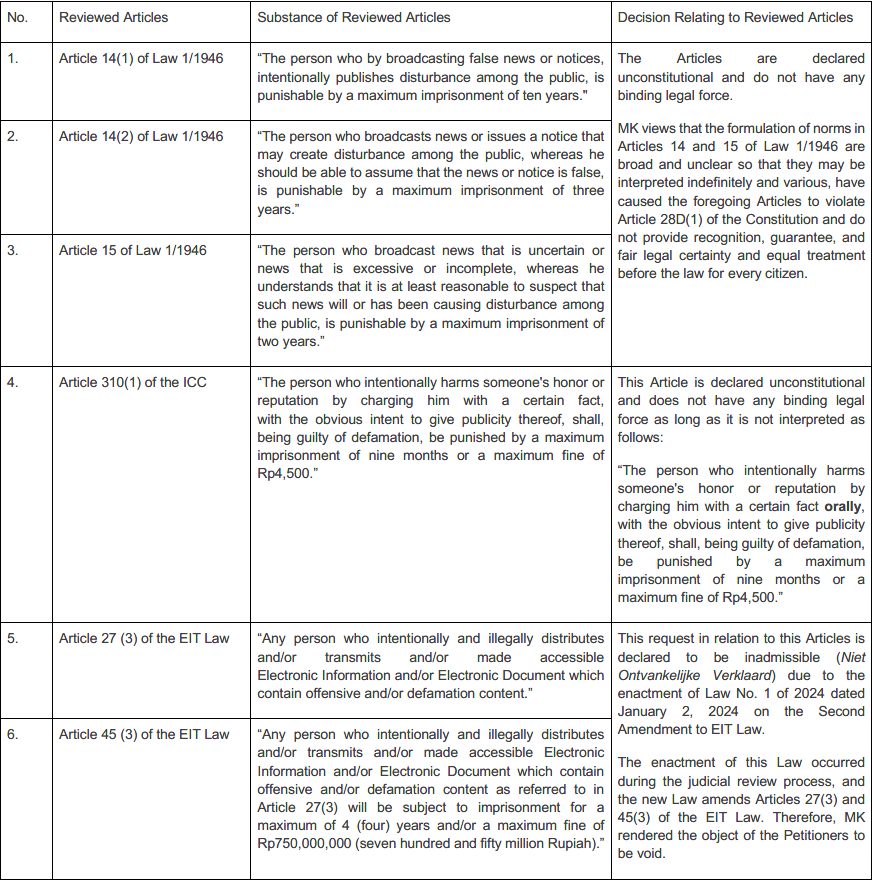
The issuance of the Decision to some extent may be a fresh air or advancement within the Indonesian democracy, where it provides further protection towards an individual’s rights that are ensured in the Constitution. The nullification of Articles 14 and 15 of Law 1/1946 and the interpretation made to Article 310(1) of the ICC may reduce any attempt to silence, restrict, and criminalize an individual’s criticism, opinion, and beliefs.
AKSET
Please contact Johannes C. Sahetapy-Engel (jsahetapyengel@aksetlaw.com), M. Fatih Satria Kasmaliputra (mkasmaliputra@aksetlaw.com), or Justin Amadeus (jamadeus@aksetlaw.com) for further information.
Disclaimer:
The foregoing material is the property of AKSET and may not be used by any other party without prior written consent. The information herein is of general nature and should not be treated as legal advice, nor shall it be relied upon by any party for any circumstance. Specific legal advice should be sought by interested parties to address their particular circumstances.
Any links contained in this document are for informational purposes and are available and relevant at time this publication is made. We provide no liability whatsoever in respect of any information or content in such links.
New Importing Provisions for Entry of Hand-Carry Goods
To strengthen the effectiveness of import controls, the Ministry of Trade saw the need to readjust the policies and procedures on import activities. As such, on December 11, 2023, the Minister of Trade (the “MOT”) issued Regulation No. 36 of 2023 on Import Policies and Regulations (“Regulation 36/2023”). However, to further optimize the implementation of imports of certain goods, the MOT issued Regulation No. 3 of 2024 on the Amendment to Regulation 36/2023 (the “Amendment”). Regulation 36/2023 (as amended by the Amendment) became effective since March 10, 2024.
The Amendment replaces the lists of goods that are subject to certain import requirements previously set out in the Attachments of Regulation 36/2023.
In this Newsflash, we will specifically discuss the import limitations for hand-carry goods of passengers returning to Indonesia.
♦ Limitations on Imports via Hand-Carry Goods
According to Regulation 36/2023, returning passengers entering Indonesia (the “Passengers”) may bring certain goods without any import license subject to certain limitations.
As of March 10, 2024, the limitation on imports of non-commercial goods that comprise hand-carry goods belonging to Passengers is regulated under Attachment IV to the Amendment. The following table highlights several of the hand-carry goods imported to Indonesia by the Passengers that are subject to limitations:

AKSET
Please contact Johannes C. Sahetapy-Engel (jsahetapyengel@aksetlaw.com), Adhitya Ramadhan (aramadhan@aksetlaw.com) or Ayu Nandini Prameswari (aprameswari@aksetlaw.com) for further information.
Disclaimer:
The foregoing material is the property of AKSET and may not be used by any other party without prior written consent. The information herein is of general nature and should not be treated as legal advice, nor shall it be relied upon by any party for any circumstance. Specific legal advice should be sought by interested parties to address their particular circumstances.
Any links contained in this document are for informational purposes and are available and relevant at time this publication is made. We provide no liability whatsoever in respect of any information or content in such links.