
Withholding and Payment of Income Taxes on Other Contractor's Income and/or Participating Interests
On October 14, 2024, the Minister of Finance (the “MOF”) enacted the MOF Regulation Number 81 of 2024 on Taxation Provisions for the Implementation of the Core Tax Administration System (the “Regulation”). The Regulation came into force as of January 1, 2025. The Regulation is an omnibus regulation that consolidates and updates various tax rules to enhance the new Core Tax Administration System. Its objective is to modernize tax administration by ensuring transparency, efficiency, and accountability through advanced IT systems, improved business processes, and comprehensive databases.
Due to the extensive range of provisions covered in the Regulation, this Newsflash only discusses the procedures for the withholding income taxes in respect of a contractor’s income in the upstream oil and gas business. These provisions were previously regulated under MOF Regulation Number 257/PMK.011/2011 dated December 28, 2011 on Procedures for Withholding and Payment of Income Taxes on Contractors’ Other Income in the Form of Uplifts or Other Similar Rewards and/or Contractors’ Income from Transfer of Participating Interests (the “Previous Regulation”).
♦ Withholding Tariff of Income Tax
Under the Regulation, there are no significant changes regarding the withholding of income taxes for an Oil and Gas Cooperation Contractor (the “Contractor”) on any income other than cooperation income. Specifically, for income in the form of any Uplift and/or a transfer of Participating Interests, the following tariffs apply:
- Uplift (or other similar compensation): 20% (twenty percent) of the gross amount
- Transfer of participating interests:
- 5% (five percent) of the gross amount for transfers during the Exploration Period (from the effective date of the Cooperation Contract until the approval of the first field development plan in a Contractor’s work area). The transfer is exempt from income tax if it meets the following criteria:
- not transfer all of the Participating Interests owned;
- Participating Interests are owned for more than 3 (three) years;
- in the work area, the exploration has been carried out and the Contractor has made investments to carry out the exploration; and
- the transfer of the Participating Interests by the Contractor is not intended to make a profit, and
- 7% (seven percent) of the gross amount for transfers during the Production Period (from the end of the exploration period until the end of the Cooperation Contract). This transfer is exempt from any income tax if conducted to fulfill the transfer obligations of Participating Interests to national companies as stipulated in the relevant Cooperation Contract.
- 5% (five percent) of the gross amount for transfers during the Exploration Period (from the effective date of the Cooperation Contract until the approval of the first field development plan in a Contractor’s work area). The transfer is exempt from income tax if it meets the following criteria:
♦ Taxation of Participating Interests Transfers
Under the Regulation, the basis for imposing the income tax on a transfer of the Participating Interests is:
- the amount actually received or obtained by the Contractor; or
- the amount that should have been received or obtained if there is a special relationship between the parties involved in the transfer.
Article 211 of the Regulation mandates that Contractors transferring Participating Interests must report the transfer value to the Tax Services Office where they are registered. The report must include the Participating Interest Transfer Agreement and the Financial Quarterly Report for the last quarter prior to the transfer. This report must be submitted within 14 (fourteen) business days from the signing date of the agreement. If the recipient Contractor is not registered as a Taxpayer, the reporting obligation falls on the transferring Contractor. Non-compliance with these requirements allows the Director-General of Tax to determine the transfer value ex officio.
Article 213 of the Regulation provides that the income tax becomes payable at the earlier of the following events: at the time of payment, at the time of the transfer of Participating Interests, or upon approval of the transfer by the minister overseeing energy and mineral resources. The receiving Contractor must withhold the tax and issue proof of withholding.
Under Article 213(3) of the Regulation, if the recipient Contractor is not yet registered as a taxpayer, the withholding, deposit, and reporting must occur after the recipient’s registration.
Meanwhile, if the transfer of Participating Interest is carried out indirectly and does not change the Taxpayer Identification Number (in Indonesia, Nomor Pokok Wajib Pajak), the Contractor transferring the Participating Interests is required to pay the income tax payable directly no later than the 15th (fifteenth) day of the following month after the relevant tax period.
♦ Uplift or Other Similar Compensation
Article 212 of the Regulation regulates that the income text in the form of Uplift or other similar compensation is payable at the time income in the form of Uplift or other similar compensation is paid or recognized as an expense, depending on which one occurs first. The Contractor making the Uplift payment must withhold the tax and issue proof of withholding/collection in accordance with applicable laws and regulations.
AKSET
Please contact Johannes C. Sahetapy-Engel (jsahetapyengel@aksetlaw.com) or Arthur Basa Okuli Nainggolan (anainggolan@aksetlaw.com) for further information.
Disclaimer:
The foregoing material is the property of AKSET and may not be used by any other party without prior written consent. The information herein is of general nature and should not be treated as legal advice, nor shall it be relied upon by any party for any circumstance. Specific legal advice should be sought by interested parties to address their particular circumstances.
Any links contained in this document are for informational purposes and are available and relevant at time this publication is made. We provide no liability whatsoever in respect of any information or content in such links.

Withholding Taxes on Insurance and Reinsurance Premia Paid to Overseas Insurance Companies
On October 18, 2024, the Minister of Finance (the “MOF”) issued Regulation No. 81 of 2024 on Tax Provisions for the Implementation of the Core Tax Administration System (the “Regulation”). The Regulation is an omnibus regulation that consolidates and updates various tax rules to enhance the new Core Tax Administration System. Its objective is to modernize the tax administration by ensuring transparency, efficiency, and accountability through advanced IT systems, improved business processes, and comprehensive databases.
This Newsflash outlines the provisions regarding the withholding taxes applicable to insurance and reinsurance premia paid to foreign insurance companies as stipulated in the Regulation. These provisions were previously regulated under MOF Decree No. 624/KMK.04/1994 dated December 27, 1994 on Withholding of Article 26 Income Tax on Income in the Form of Insurance Premia and Reinsurance Premia Paid to Overseas Insurance Companies (the “Decree”). The Decree is revoked and replaced entirely by the Regulation.
We set out below the key elements of the Regulation regarding the withholding taxes on insurance and reinsurance premia paid to overseas insurers.
♦ Consistent Tax Rate and Income Estimation
One of the primary features retained in the Regulation is the 20% withholding tax rate applied to the estimated net income from insurance and reinsurance premia paid to overseas insurance companies. This consistency ensures that businesses familiar with the Decree may continue their compliance efforts without needing to adjust to a new tax rate.
The method for calculating the estimated net income remains unchanged. Specifically, the Regulation stipulates that the “estimated net income”, which serves as the basis for withholding taxes shall be calculated as follows: (i) 50% of the premium paid by the insured to an overseas insurance company, (ii) 10% of the premium paid by an Indonesian insurance company to an overseas insurer, and (iii) 5% of the premium paid by an Indonesian reinsurance company to an overseas insurer.
♦ Extended Tax Payment Deadline
A significant modification introduced by the Regulation is the extension of the tax payment deadline. Under the Decree, taxpayers were required to remit the withheld tax within 10 days after the end of the month in which the premium was paid. The Regulation extends this period to 15 days after the end of the month in which the premium is paid.
♦ Simplified Documentation Requirements
Another notable change in the Regulation is the documentation requirements for withholding taxes. Previously, the Decree required the issuance of three copies of the withholding tax receipt: one for the payee, one to be attached to the Monthly Income Tax Return, and one for the withholding agent’s records. Now, the Regulation simplifies this process by eliminating the specific requirement. This change reduces the administrative burden on businesses and streamlines compliance process, making it easier for companies to fulfill their tax obligations with less paperwork.
♦ Enhanced Reporting Mechanism
Another key update in the Regulation is the introduction of a more streamlined reporting process. The regulation adopts the Unified Income Tax Monthly Return Form, which replaces the previously used Income Tax Monthly Return Form (SPT Masa PPh 26) under the Decree.
This unified form integrates various reporting requirements into a single, cohesive document, enhancing efficiency and reducing the likelihood of errors in tax filings. By consolidating reporting procedures, the Regulation aims at facilitating a more integrated and centralized approach to tax administration, benefiting both taxpayers and regulatory authorities
AKSET
Please contact Johannes C. Sahetapy-Engel (jsahetapyengel@aksetlaw.com), Thomas P. Wijaya (twijaya@aksetlaw.com), or Rayhan Andana Harits (rharits@aksetlaw.com) for further information.
Disclaimer:
The foregoing material is the property of AKSET and may not be used by any other party without prior written consent. The information herein is of general nature and should not be treated as legal advice, nor shall it be relied upon by any party for any circumstance. Specific legal advice should be sought by interested parties to address their particular circumstances.
Any links contained in this document are for informational purposes and are available and relevant at time this publication is made. We provide no liability whatsoever in respect of any information or content in such links.
Civil-Servant Docents May Practice Law with Certain Limitations
♦ Background and Parties to Petition
On December 10, 2024, the Constitutional Court rendered its decision number 150/PUU-XXII/2024 (the “Decision”) on the judicial review of Article 3 (1) letter (c) and Article 20 (2) of Law No. 18 of 2003 on Advocates (the “Advocates Law”). The petitioners were civil-servant-candidate docents at an Indonesia university’s law faculty, a docent who intended to become a civil servant while concurrently practiced law, and a law student desiring to learn from a civil-servant docent who could also serve as an advocate. The Petitioners argued that the absolute prohibition on civil servants becoming advocates infringed their constitutional rights to develop academic expertise, enrich legal education, and enhance access to pro bono legal counsel.
Prior to the Decision, Article 3 (1) of the Advocates Law listed several requirements for an advocate, including under subparagraph (c) that an advocate “shall not hold the status as a civil servant or a state official.” Article 20 (2) of the Advocates Law further stated that “Advocates are prohibited from holding any office or position that demands such a degree of devotion as to harm the advocate profession or reduce the freedom and independence to carry out their professional duties.” These provisions became the central focus of the judicial review.
♦ Court’s Consideration and Conditional Interpretation
In evaluating the arguments, the Court acknowledges that the Advocates Law generally prohibits civil servants from practicing law to safeguard the independence of the legal profession. However, it concludes that Articles 3 (1) (c) and 20 (2) of the Advocates Law should be interpreted in a way that allows universities to carry out their mission under the Three Pillars of Higher Education (i.e., education, research, and community service).
Specifically, the Court rules that civil servant docents may provide advocate’s services, but only on a pro bono, non-commercial basis, and only through the official university legal aid channels. The Court also emphasizes that these docents must not neglect their core teaching and research duties, and that they must follow internal approval procedures and ethical standards.
By partially granting the petition, the Court recognizes that while for-profit legal work remains prohibited for civil servant docents, it permits the docents to engage in community-focused advocate’s work. This exception, the Court notes, may enhance the teaching process and broaden access to legal aid for those in need.
♦ Dissenting Opinions and Concern for Advocate’s Independence
Two of the nine Justices, i.e., Justice Arsul Sani and Justice Daniel Yusmic P. Foekh, have dissenting opinions in the Decision. These Justices contend that any exception risks undermining the advocate’s independence and creating conflicts of interest. They reason that civil servant docents could, in practice, struggle to reconcile their duty of loyalty to the state with an advocate’s mandate to defend client’s interests, including in potential disputes against governmental bodies.
In their view, the absolute prohibition established under the Advocates Law is the best way to safeguard the advocate’s autonomy while maintaining clear lines of accountability and ethical regulation. Although the dissent highlighted concerns the challenges of dual professional commitments, the majority of the Court’s Justices determines that a strictly regulated pro bono framework would mitigate these risks. The majority reason that such a framework would not only protect against conflicts of interest but also advance constitutional goals by fostering academic excellence and expanding access to justice for society.
♦ Implications and Final Ruling
In conclusion, under the Decision, the Court declares that Article 3(1)(c) of the Advocates Law, which prohibits civil servants from becoming advocates, conflicts with the Constitution insofar as it prohibits a civil servant docent from engaging in pro bono advocacy as part of community service. In other words, the prohibition against civil servants acting as advocates does not apply to civil servant docents, provided such advocacy is carried out noncommercially and for the benefit of the public in a university framework.
The Court likewise rules that Article 20(2) of the Advocates Law which forbids advocates from holding any position that might undermine the freedom and independence of the profession, must also be read in harmony with this limited exception for civil servant docents. Under the Decision, civil servant docents who conduct pro bono advocacy in a strictly defined academic context do not violate the prohibition. Beyond that narrow scope, the original prohibition remains in full effect, preserving the core principle of advocate’s independence.
AKSET
Please contact Johannes C. Sahetapy-Engel (jsahetapyengel@aksetlaw.com), Thomas P. Wijaya (twijaya@aksetlaw.com), or Rayhan Andana Harits (rharits@aksetlaw.com) for further information.
Disclaimer:
The foregoing material is the property of AKSET and may not be used by any other party without prior written consent. The information herein is of general nature and should not be treated as legal advice, nor shall it be relied upon by any party for any circumstance. Specific legal advice should be sought by interested parties to address their particular circumstances.
Any links contained in this document are for informational purposes and are available and relevant at time this publication is made. We provide no liability whatsoever in respect of any information or content in such links.

Civil-Servant Docents May Practice Law with Certain Limitations
Constitutional Court Decision on the Definition of International Arbitral Award
On December 17, 2024, the Constitutional Court of the Republic of Indonesia (the "Court") rendered its decision towards Case No. 100/PUU-XXI/2024 (the "Decision"). The case was submitted and examined for the judicial review of Article 1 Point 9 of Law No. 30 of 1999 on Arbitration and Alternative Dispute Resolution (the "Arbitration Law").
The petitioners raised the arguments on the applicability of Article 1 Point 9 of the Arbitration Law which was inconsistent with Article 28D Paragraph (1) of the 1945 Constitution of the Republic of Indonesia (the "Constitution") that guarantees the right to legal certainty. Please see below the disputed article, i.e. Article 1 Point 9 of the Arbitration Law:
“International Arbitration Award refers to an award which is rendered by an arbitral institution or individual arbitrator outside the jurisdiction of the Republic of Indonesia, or an award which is rendered by an arbitral institution or individual arbitrator, of which, according to legal provisions of the Republic of Indonesia, it shall be deemed as an International Arbitration Award.”
♦ Petitioners’ Argument
The petitioners contended that the two phrases within the article create conflicting interpretations. The table below highlights the conflicting interpretations:

This conflict, according to the petitioners, creates ambiguity and the risk for misinterpretation. For example, despite the parties agreeing on the seat of arbitration in their agreement, Indonesian courts could reinterpret the classification of the award based on the provisions of the Arbitration Law.
♦ Court’s Decision
Considering the petitioners' arguments, the Constitutional Court agrees to remove the phrase "shall be deemed" from Article 1 Point 9 of the Arbitration Law. This amendment aligns the definition of an International Arbitration Award with the territorial principle outlined in the First Phrase.
Therefore, the revised Article 1 Point 9 of Arbitration Law is as follow:
"International Arbitration Award refers to an award rendered by an arbitral institution or individual arbitrator outside the jurisdiction of the Republic of Indonesia, or an award rendered by an arbitral institution or individual arbitrator, which, according to the legal provisions of the Republic of Indonesia, is an International Arbitration Award."
♦ Impact of the Decision
The Court's decision establishes legal certainty by eliminating the discretionary phrase that could lead to inconsistent interpretations of International Arbitration Awards. Moving forward, the classification of an international arbitral award in Indonesia will adhere strictly to the territorial principle, providing clearer guidelines for parties involved in arbitration.
AKSET
Please contact Johannes C. Sahetapy-Engel (jsahetapyengel@aksetlaw.com), Raymont Travis (rtravis@aksetlaw.com), or Arthur Basa Okuli Nainggolan (anainggolan@aksetlaw.com) for further information.
Disclaimer:
The foregoing material is the property of AKSET and may not be used by any other party without prior written consent. The information herein is of general nature and should not be treated as legal advice, nor shall it be relied upon by any party for any circumstance. Specific legal advice should be sought by interested parties to address their particular circumstances.
Any links contained in this document are for informational purposes and are available and relevant at time this publication is made. We provide no liability whatsoever in respect of any information or content in such links.
Indonesia’s 2025 Provincial Minimum Wages
On December 4, 2024, the Minister of Manpower issued Regulation No. 16 of 2024 on Determination of 2025 Minimum Wages (the “Regulation”). The Regulation introduces a new formula for calculating the 2025 minimum wages.
Under the Regulation, the minimum wage represents the minimum monthly wage determined by the Governor of each province. Adjustment to the Provincial Minimum Wage (in Indonesian, Upah Minimum Provinsi or the “UMP”) emphasizes the significance of fair compensation in fostering economic equity and growth.
♦ Calculation Formula for 2025 UMP
The UMP is calculated by taking into account economic growth, inflation, and certain indexes. The detailed formula for determining the minimum wage, including these indexes, is regulated under Government Regulation No 36 of 2021 on Wages as lastly amended by Government Regulation No. 51 of 2023.
According to the Regulation, the 2025 UMP is set to increase by 6.5%. The formula for calculating the 2025 UMP is as follows:
2024 Provincial Minimum Wage + (6.5% x 2024 Provincial Minimum Wage) = the 2025 UMP
♦ 2025 UMP in Indonesia
The UMP for each province in Indonesia for 2025 came into effect from January 1, 2025. Below is the detailed list of the UMP for each province.


AKSET
Please contact Johannes C. Sahetapy-Engel (jsahetapyengel@aksetlaw.com), Thomas Peter Wijaya (twijaya@aksetlaw.com), or Azzahra Saffanisa S. (asudiardiputri@aksetlaw.com) for further information.
Disclaimer:
The foregoing material is the property of AKSET and may not be used by any other party without prior written consent. The information herein is of general nature and should not be treated as legal advice, nor shall it be relied upon by any party for any circumstance. Specific legal advice should be sought by interested parties to address their particular circumstances.
Any links contained in this document are for informational purposes and are available and relevant at time this publication is made. We provide no liability whatsoever in respect of any information or content in such links.
Indonesia’s 2025 Provincial Minimum Wages
2025 New Value Addex Tax Rate
As you may know, under Article 7(1) of Law No. 8 of 1983 on Value Added Taxes on Goods and Services and Sales Taxes on Luxurious Goods as lastly amended by Government Regulation in Lieu of Law No. 2 of 2022 which was made into Law based on Law No. 6 of 2023 (the “VAT Law”), the rate of the value added tax (the “VAT”) should be 12% commencing from January 1, 2025. Also, under Article 7(3) of the VAT Law, the VAT rate may be reduced to 5% and increased up to 15%.
Despite the above, given the resistance from the society in general of such VAT rate increase to 12%, the Minister of Finance issued Regulation No. 131 of 2024 dated December 31, 2024 on Treatment of Value Added Taxes on Imports of Taxable Goods, Delivery of Taxable Goods, Delivery of Taxable Services, Utilization of Taxable Intangible Goods from Outside Custom Areas in a Custom Area, and Utilization of Taxable Services from Outside Custom Areas in a Custom Area (“PMK 131”). PMK 131 limits the application of the new 12% VAT rate. Please see the summary of PMK 131 below.
Under PMK 131, the new 12% VAT rate applies only to imports or delivery of luxurious vehicles and other luxurious goods which is subject to sales taxes on luxurious goods under applicable laws. The 12% rate shall be multiplied by the taxable amount of such luxurious vehicles and goods.
But, for delivery of any taxable goods to a final customer from January 1, 2025 until January 31, 2025, the calculation of the payable VAT on the goods shall be as follows:
11/12 x Sales Value x 12%
Starting from February 1, 2025 the calculation of the payable VAT on the goods shall be as follows:
Sales Value x 12%
Imports or delivery of goods (other than the foregoing luxurious vehicles and goods) and services will also be subject to the 12% VAT rate. However, the basis of the calculation of the VAT shall be as follows:
11/12 x Sales/Import Value x 12%
It is important to note that PMK 131 does not apply to application of the VAT based on certain sales/import value or certain amounts as determined in the relevant applicable laws and regulations. For instance, PMK 131 does not apply to the VAT applicable to construction work performed by oneself which is subject to the following VAT rate: 2.2% of the taxable amount.
AKSET
Please contact Johannes C. Sahetapy-Engel (jsahetapyengel@aksetlaw.com) for further information.
Disclaimer:
The foregoing material is the property of AKSET and may not be used by any other party without prior written consent. The information herein is of general nature and should not be treated as legal advice, nor shall it be relied upon by any party for any circumstance. Specific legal advice should be sought by interested parties to address their particular circumstances.
Any links contained in this document are for informational purposes and are available and relevant at time this publication is made. We provide no liability whatsoever in respect of any information or content in such links.
2025 New Value Addex Tax Rate
Third Amendment to Immigration Law
On October 17, 2024, the Government enacted Law No. 63 of 2024 (“Law No. 63”) on the Third Amendment to Law No. 6 of 2011 on Immigration (the “Immigration Law”). This amendment was enacted as a follow-up to the Constitutional Court Decision No. 40/PUU-IX/2011 and Constitutional Court Decision No. 62/PUU-IX/2011, both of which called for certain amendments to the Immigration Law.
The key amendments to the Immigration Law under Law No. 63 are outlined below.


AKSET
Please contact Johannes C. Sahetapy-Engel (jsahetapyengel@aksetlaw.com) or Arthur Basa Okuli Nainggolan (anainggolan@aksetlaw.com) for further information.
Disclaimer:
The foregoing material is the property of AKSET and may not be used by any other party without prior written consent. The information herein is of general nature and should not be treated as legal advice, nor shall it be relied upon by any party for any circumstance. Specific legal advice should be sought by interested parties to address their particular circumstances.
Any links contained in this document are for informational purposes and are available and relevant at time this publication is made. We provide no liability whatsoever in respect of any information or content in such links.
Third Amendment to Immigration Law
Constitutional Court Decision on Manpower Cluster of Job Creation Law
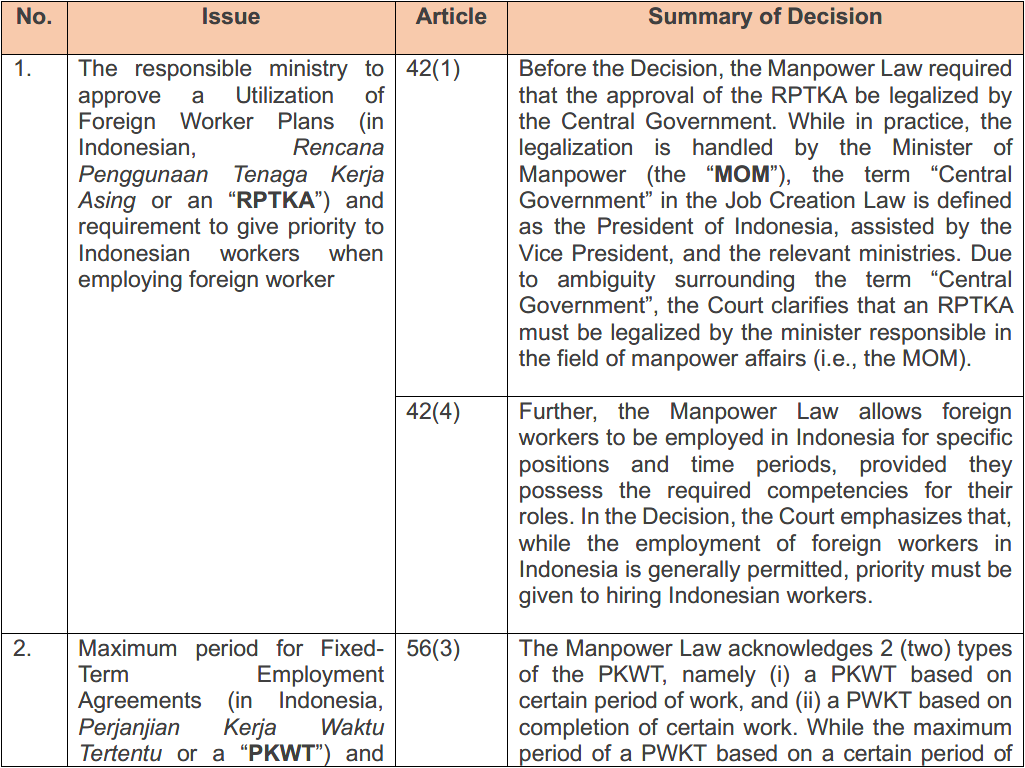
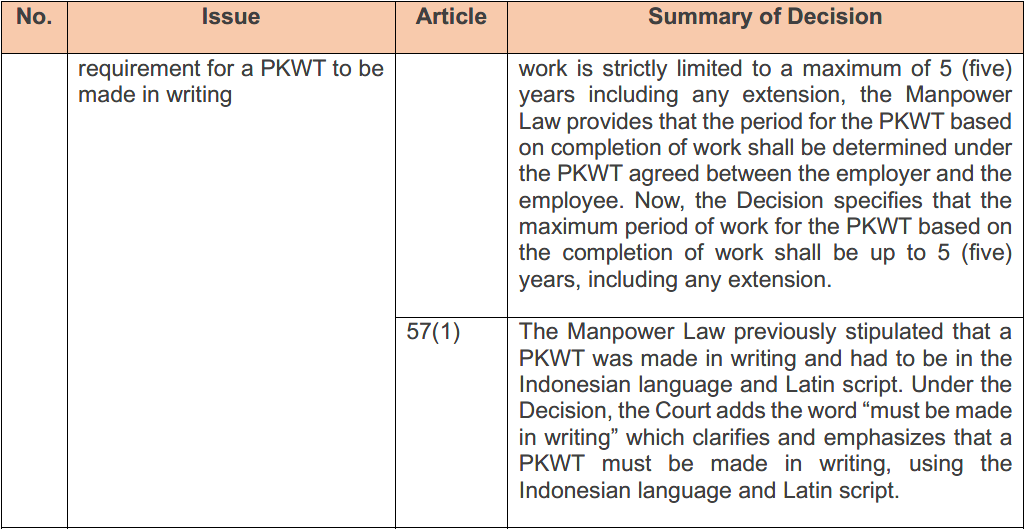
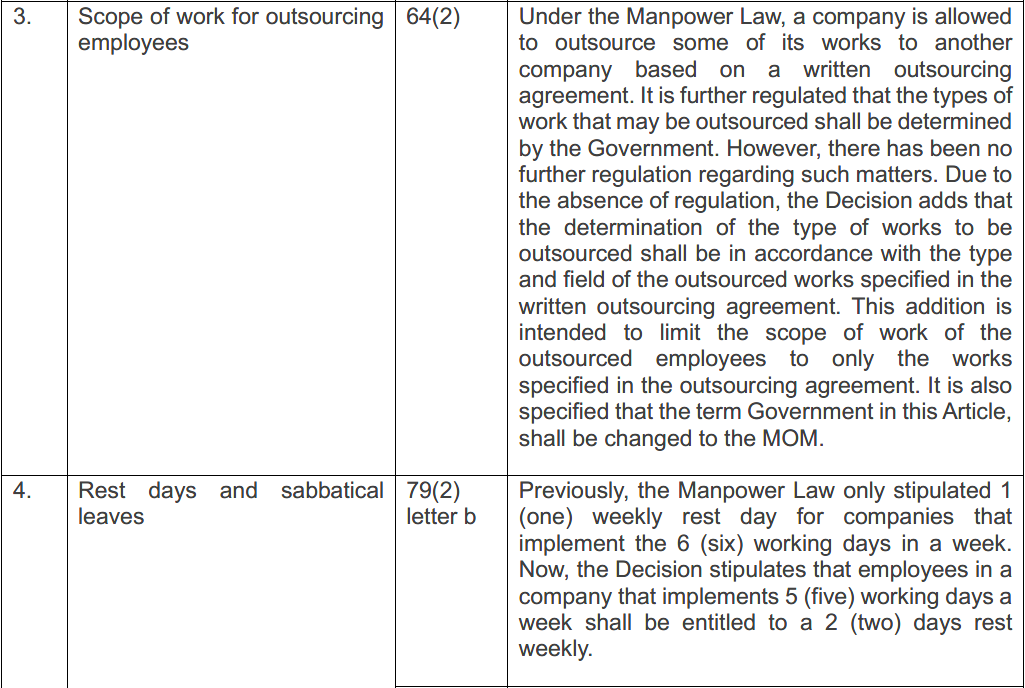
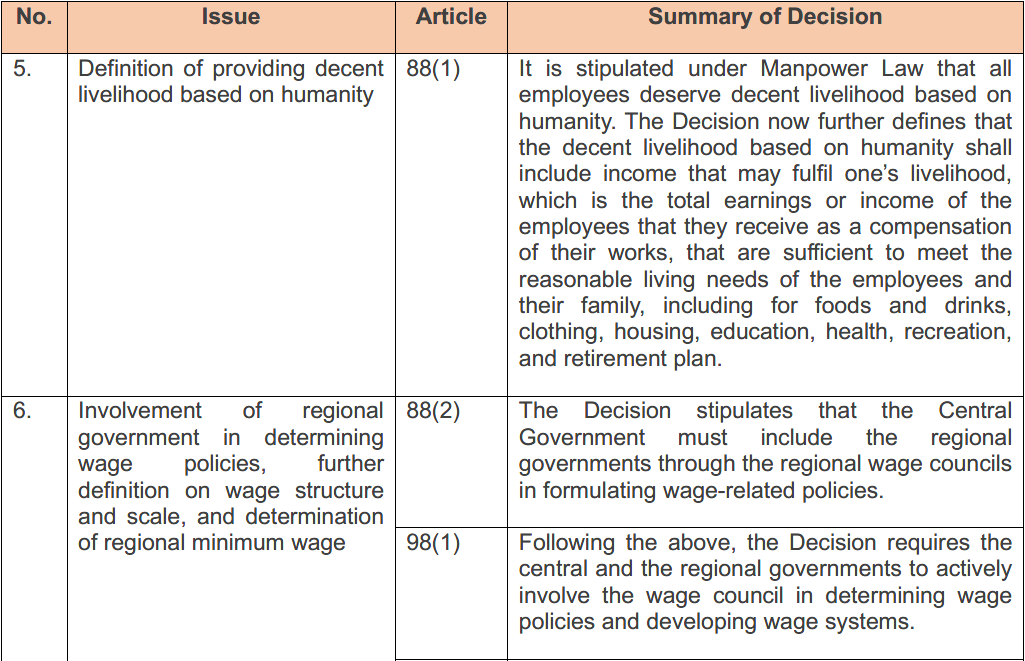
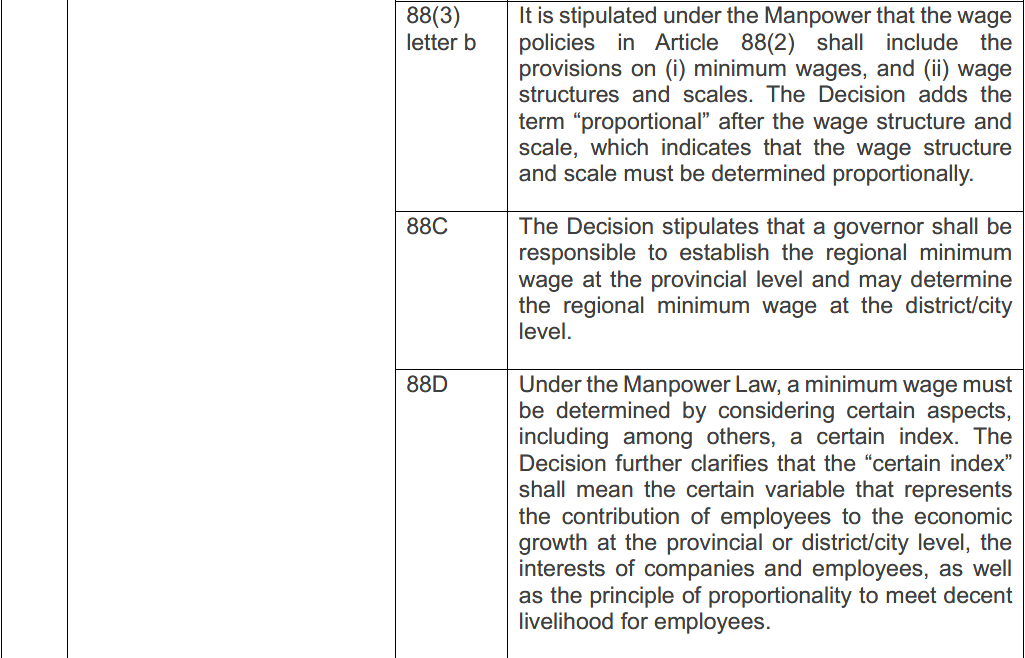
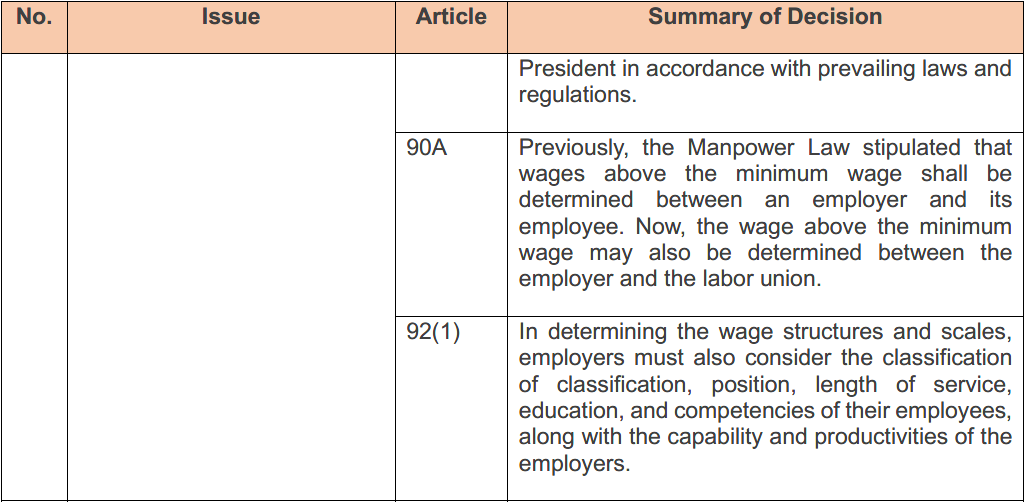
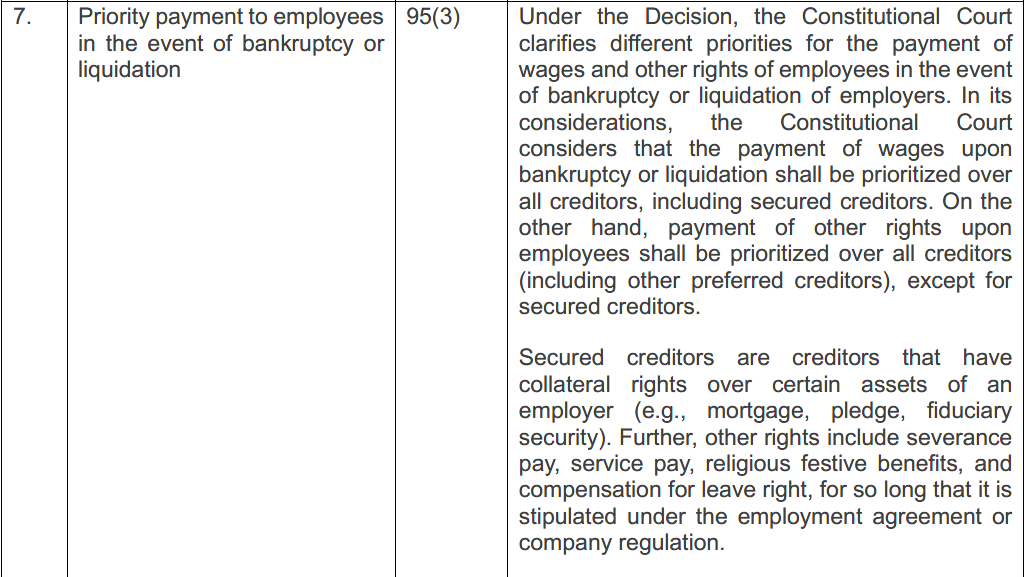
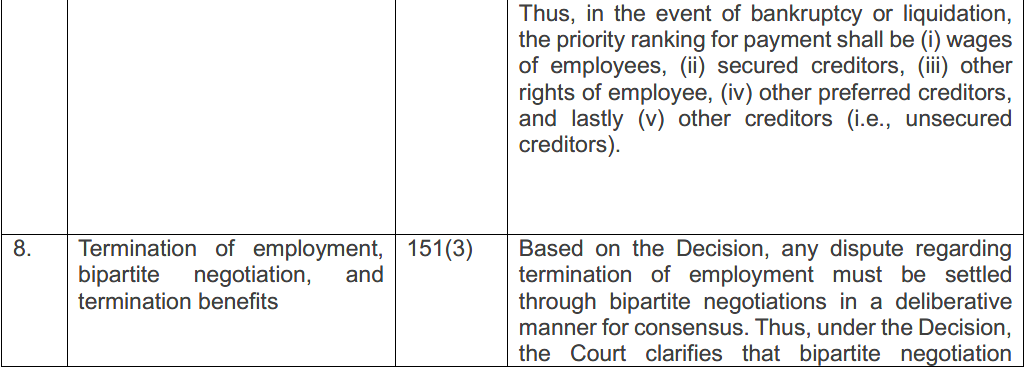
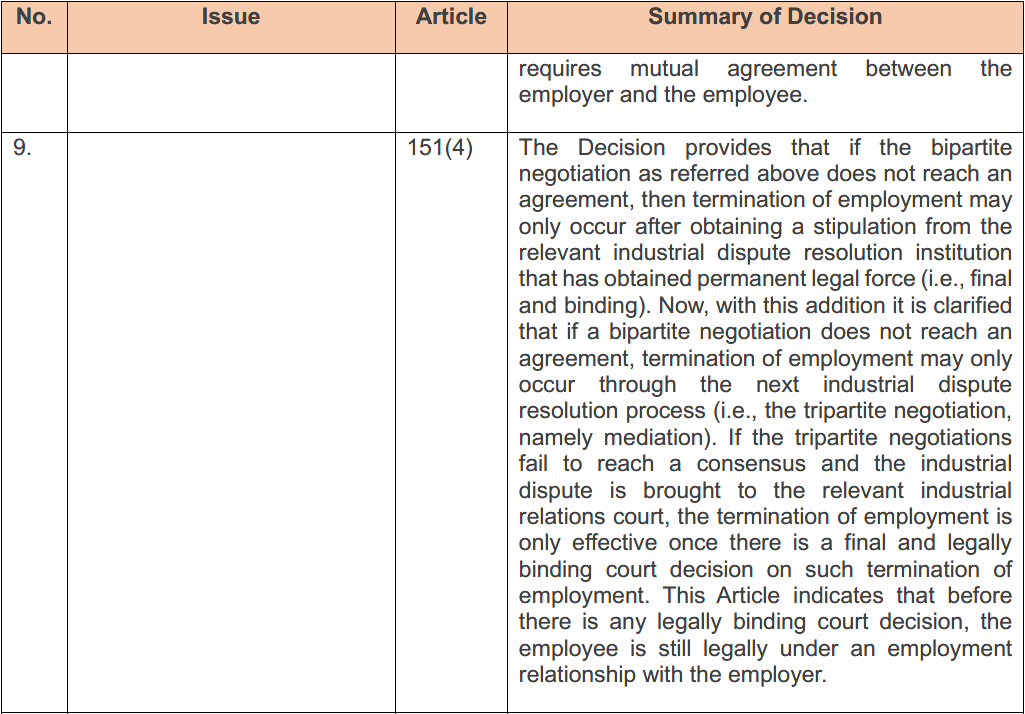
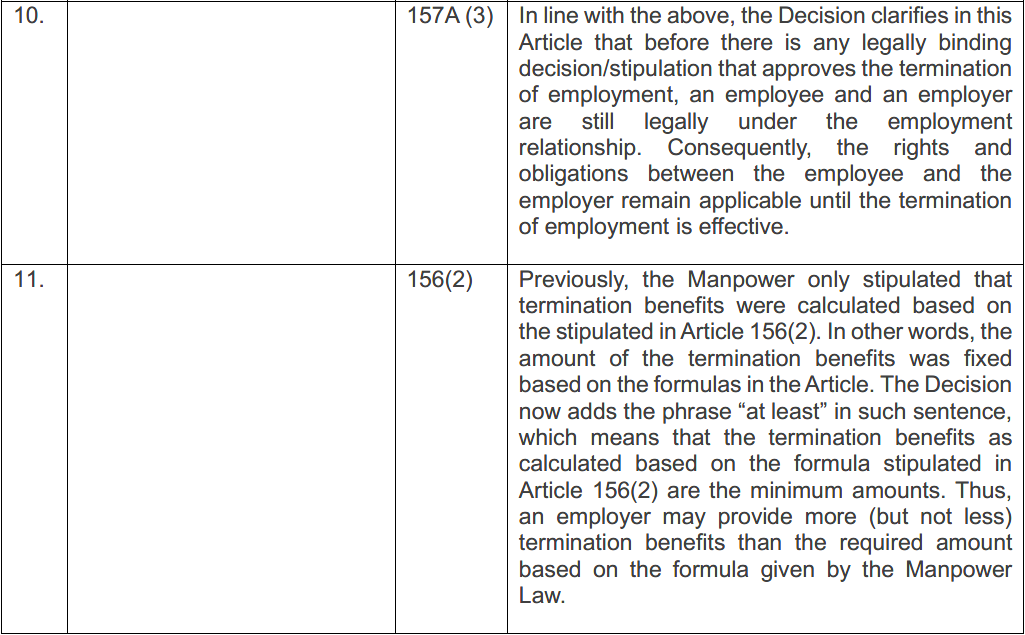
On October 31, 2024, the Constitutional Court (the “Court”) rendered its decision in Case Number 168/PUU-XXI/2023 (the “Decision”) addressing the judicial review of Government Regulation in Lieu of Law No. 2 of 2022 dated December 30, 2022 on Job Creation, which was made into law under Law No. 6 of 2023 dated March 31, 2023 (the “Job Creation Law”).
The petitioners of the Decision sought a judicial review on 49 provisions (or norms) established under Law No. 13 of 2003 dated March 25, 2003 on Manpower as lastly amended by the Job Creation Law (the “Manpower Law”). The petitioners contended that these provisions were in direct conflict with the 1945 Constitution of the Republic of Indonesia (as amended, the “Constitution”). After hearing and considering the issues pleaded by the relevant parties in the proceedings, the Court issued 21 legal rulings that amend and rectify certain provisions of the Manpower Law.
We set out below a summary of the Decision and its impact on the Manpower Law.


♦ Enactment of New Manpower Law
In addition to the changes outlined in the summary above, the Court views that there may be overlapping provisions under the Manpower Law and the Job Creation Law that may create confusions and difficulties for public in understanding the Manpower Law, which in turn may lead to prolonger legal uncertainty and injustice. Thus, the Court mandates the lawmakers (i.e., the Parliament) to create a new manpower law which covers the provisions under the existing Manpower Law and the Job Creation Law as well as any other lower regulations that stipulate the same matters. With the enactment of the new manpower law, the Court believes that any problems of conflict and inconsistency of substance in the Manpower Law can be detected, reorganized, and corrected immediately.
The Constitutional Court requires the lawmakers to create the new manpower law in 2 (two) years.
It is clear that the Decision significantly affects employers in general in a number of ways. For instance, now an employer may not legally initiate termination of employment simply by delivering a notice of termination to an employee. Please reach out to our manpower/labor law specialists to discuss further how the Decision affects employers and how we may assist you in complying with the Decision moving forward.
AKSET
Please contact Johannes C. Sahetapy-Engel (jsahetapyengel@aksetlaw.com), Thomas P. Wijaya (twijaya@aksetlaw.com), Rizky Rakhmadita (rrakhmadita@aksetlaw.com), or Arthur Basa Okuli Nainggolan (anainggolan@aksetlaw.com) for further information.
Disclaimer:
The foregoing material is the property of AKSET and may not be used by any other party without prior written consent. The information herein is of general nature and should not be treated as legal advice, nor shall it be relied upon by any party for any circumstance. Specific legal advice should be sought by interested parties to address their particular circumstances.
Any links contained in this document are for informational purposes and are available and relevant at time this publication is made. We provide no liability whatsoever in respect of any information or content in such links.
Constitutional Court Decision on Manpower Cluster of Job Creation Law
Expiry of Transitional Period of Personal Data Protection Law
On October 17, 2022, the Government enacted Law No. 27 of 2022 on Personal Data Protection (the “PDP Law”). Under the PDP Law, Controllers, Processors, and other parties relevant to the processing of personal data have 2 (two) years from the date of enactment of the PDP Law to comply with the PDP Law. So, on October 17, 2024, the foregoing transitional period officially expired.
Despite the above, there are several remaining questions that need to be addressed to ensure full compliance with the PDP Law, including the following.
♦ Implementing Regulation of PDP Law
As of October 17, 2024, the Government has not issued the implementing regulation(s) of the PDP Law. The absence of the implementing regulation(s) makes it difficult for the relevant parties to comply with the PDP Law. Without the implementing regulation(s), key aspects such as the scope of processing activities, data subjects’ rights, details on data protection officers, transfer of personal data, enforcement mechanisms, and sanctions procedures remain unclear.
The Government issued a draft implementing regulation of the PDP Law as of August 31, 2023. Based on the information obtained from the website of the Ministry of Communication and Informatics (https://pdp.id/rpp-ppdp/1), the draft is currently at the harmonization stage. The Government is yet to confirm when the implementing regulation of the PDP Law will be officially enacted.
♦ Supervisory Institution
The PDP Law mandates the establishment of a specific supervisory institution, determined by the President, which reports directly to the President. The Institution’s responsibilities are to: (i) formulate and determine personal data protection policies and strategies, serving as guidelines for the personal data subjects and relevant key-players within the data processing environment; (ii) supervise the implementation of personal data protection; (iii) enforce administrative sanctions against violations of the PDP Law; and (iv) facilitate alternative dispute resolutions.
The Institution is crucial for monitoring compliance, providing guidance to organizations, and handling complaints from data subjects. Without a functioning supervisory institution, there may be a lack of accountability and a framework for addressing violations, leaving individuals and organizations without the necessary support to navigate their rights and responsibilities under the PDP Law.
Based on several news publications, the Government is actively preparing for the establishment of the supervisory institution mandated by the PDP Law, though it has yet to confirm an official timeline for its launch.
Notwithstanding the missing links in the PDP Law, we strongly recommend that all relevant parties comply with the PDP Law. We will continue to monitor the situation closely and provide timely updates and guidance as new information becomes available.
AKSET
Please contact Johannes C. Sahetapy-Engel (jsahetapyengel@aksetlaw.com) or M. Fatih Satria Kasmaliputra (mkasmaliputra@aksetlaw.com) for further information.
Disclaimer:
The foregoing material is the property of AKSET and may not be used by any other party without prior written consent. The information herein is of general nature and should not be treated as legal advice, nor shall it be relied upon by any party for any circumstance. Specific legal advice should be sought by interested parties to address their particular circumstances.
Any links contained in this document are for informational purposes and are available and relevant at time this publication is made. We provide no liability whatsoever in respect of any information or content in such links.
Expiry of Transitional Period of Personal Data Protection Law
New Regulation on Gross Split Production Sharing Contracts for Upstream Oil and Gas Business Activities
On August 12, 2024, the Minister of Energy and Mineral Resources (the “MEMR”) issued MEMR Regulation No. 13 of 2024 on Gross Split Production Sharing Contracts (“Regulation 13/2024”).
Regulation 13/2024 aims at (i) improving efficiency and effectiveness of the gross split production sharing scheme for oil and gas production, (ii) adapting with the investment climate and dynamics in upstream oil and gas business activities; and (iii) implementing Article 17(4) of Government Regulation No. 53 of 2017 on Tax Treatment for Upstream Oil and Gas Business Activities through Gross Split Production Sharing Contracts.
Regulation 13/2024 revokes and partially revokes the following regulations:

Regulation 13/2024 introduces an extensive range of new provisions in comparison with Regulation 8/2017, including but not limited to (i) calculation of profit-sharing in a gross split Production Sharing Contract (a “PSC”), (ii) additional profit-sharing percentage, (iii) by product profit-sharing, and (iv) local content requirement in a gross Split PSC.
Also, the conversion of a gross split PSC into a cost recovery PSC or vice versa was stipulated in Article 34 of Regulation 23/2021. And, now it is stipulated in Regulation 13/2024.
Further, on September 19, 2024, the MEMR issued MEMR Decree No. 230.K/MG.01/MEM.M/2024 of 2024 on Implementation Guidelines and Components of Gross Split Production Sharing Contracts (“Decree 230”). Decree 230 is enacted to implement Article 9(3) of Regulation 13/2024.
Decree 230 supplements Regulation 13/2024 by determining the amount of the base split in a gross split PSC and the formula to calculate components based on the classification of upstream oil and gas businesses.
We set out the key points of Regulation 13/2024 in comparison to the revoked regulations and the key points of Decree 230.
♦ Calculation of Profit Sharing in Gross Split PSCs
Regulation 13/2024 adjusts the calculation of the profit sharing in a gross split PSC. The calculation is based on the classification of upstream oil and gas businesses, each with different calculation components. The following table highlights the comparison regarding such a calculation between Regulation 13/2024 and Regulation 8/2017.


♦ Additional Profit-Sharing Percentage
In comparison with Regulation 8/2017, Regulation 13/2024 expands the scope for additional profit-sharing percentages, allowing them not only during the approval of the first or subsequent site developments. Specifically, the following are the conditions where an additional profit-sharing percentage may be granted:
- the approval of the first site development plan and/or its changes;
- the approval of a subsequent site development plan and/or its changes; and/or
any extension of the cooperation contract or management of the work area for an expiring
♦ By Product Profit-Sharing
Regulation 13/2024 introduces a calculation of profit sharing from the sale of by product deriving from oil and gas business operations. In this context, the contractor and the state shall share the profit of such sales based on the base split percentage.
♦ PSC Conversion
As a note, Article 34 of Regulation 23/2021 has been revoked, where the mechanism to convert the form and main provisions of PSC is now stipulated under Regulation 13/2024. The following table highlights the comparison regarding such a mechanism:


♦ Determination of Base Split in Gross Split PSCs
Decree 230 sets the amount of base split in gross split PSC, which was not stipulated under Regulation 13/2024. In this case, the amount of base split is as follows:
- 53% (fifty three percent) of state’s share and 47% (forty seven percent) of contractor’s share for petroleum.
- 51% (fifty one percent) of state’s share and 49% (forty nine percent) of contractor’s share for natural gas.
♦ Components Calculation Formula
Decree 230 supplements Regulation 13/2024 by stipulating the calculation formula of the variable and progressive components in non-conventional and conventional oil and gas businesses (i.e., fixed and variable components).
AKSET
Please contact Johannes C. Sahetapy-Engel (jsahetapyengel@aksetlaw.com) or Justin Amadeus (jamadeus@aksetlaw.com) for further information.
Disclaimer:
The foregoing material is the property of AKSET and may not be used by any other party without prior written consent. The information herein is of general nature and should not be treated as legal advice, nor shall it be relied upon by any party for any circumstance. Specific legal advice should be sought by interested parties to address their particular circumstances.
Any links contained in this document are for informational purposes and are available and relevant at time this publication is made. We provide no liability whatsoever in respect of any information or content in such links.